
Christchurch earns its title as ‘Garden City’ in the Spring. In the central city, carpets of daffodils and bluebells etch out the grassy edges of the vast Hagley Park and cherry blossom trees mark the perimeter of the avenues from which the city spreads. The riverside cafes and restaurants buzz with joy as locals and visitors delight in both indoor ambiance and outdoor fresh Spring air.
It is a youthful city, having sprung from the wreckage of the 2011 earthquakes, with renewed energy and imagination. It is acutely aware of preserving its heritage and at the same time rebuilding the city anew. In an inner-city precinct, New Regent Street, with its Spanish Mission architecture, has been restored to its 1930s charm. Pedestrian only access attracts bustling café crowds and retail shoppers, while a stone’s throw away the brand new, recently completed landmark, Te Pae Conference Centre, draws on both environmental features and modern architecture in its stunning design, creating a pleasing, functional asset for the city. It is also the venue for NZPF’s 2022 annual conference.
A thousand school principals, exhibitors and business partners gathered at Te Pae, to be welcomed by the tangata whenua of the city and entertained by the students of Te Kura Kaupapa Māori o Te Kura Whakapūmau i te Reo Tūturu ki Waitaha.
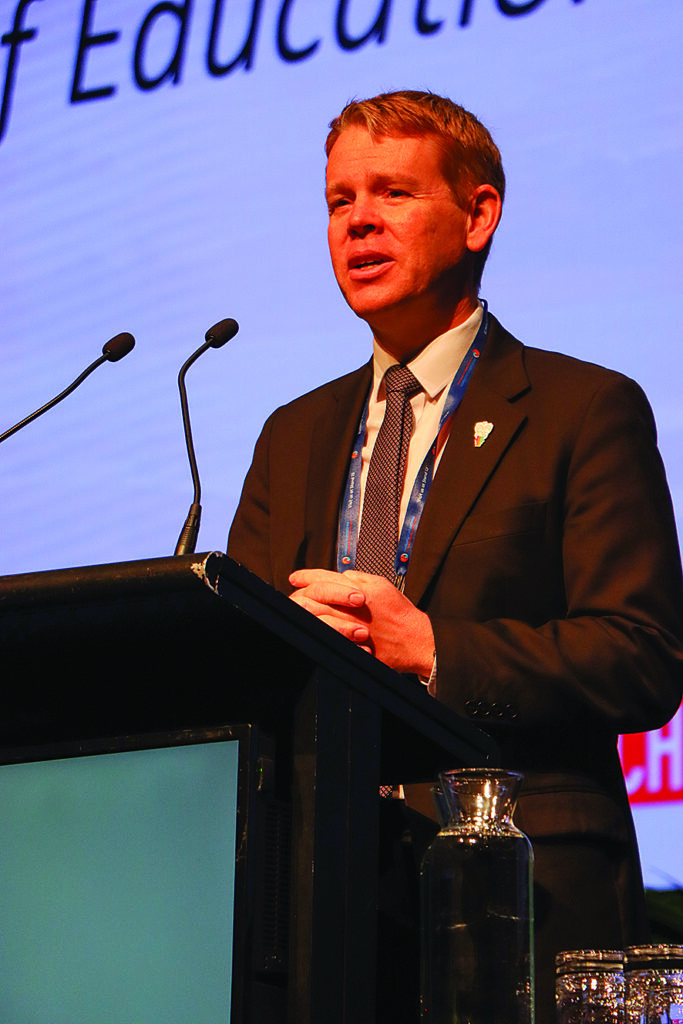
As is tradition, the Minister of Education, Hon Chris Hipkins, opened the conference with three acknowledgements. First, to celebrate Māori Language week, secondly, to mark the recent passing of our Head of State, Queen Elizabeth II and thirdly to acknowledge the Covid disruptions of the last three years.
He congratulated principals on the way they adapted schooling to the Covid lockdowns and partial lockdowns providing home learning and hybrid learning for the nation’s young people. He thanked them for their incredible efforts saying:
‘You rose to the challenges, and we look forward to a much more settled 2023.’
He then looked back to 2017 and explained how his government had addressed challenges they inherited. The population had grown by half a million, twice as fast as ever before, while there had been no new schools since 2008. That meant catch-up. A decade of national standards had narrowed the curriculum. With national standards gone, a new focus on curriculum began. There were also 30 years of growing inequality to address. Decile funding played a part in that, he explained, and that would go too.
With the 2017 Kōrero Mātauranga, the uppermost issue was student wellbeing, which became the priority, as the reform agenda got underway. Alongside wellbeing was teacher supply. ‘We want more young people in teaching,’ he said. ‘While recruiting from overseas is a short-term measure, long term we need to grow our own teaching workforce.’ He noted that post-Covid, ‘School numbers were down but . . . we don’t want to create disruption for something that might be temporary.’ He recognized the acute relief teacher shortage as the Omicron variant took hold and said, ‘The relief funding is usually $145m but we added another $17m to that.’ He noted that a further $20m has been made available to support learners who have missed out during Covid and need extra support to re-engage and get through NCEA levels.
School attendance, he said, continued to be a problem and while he acknowledged there are issues outside the school’s purview, he asked principals, who have connections to whānau, to voice what they need. He was clear that any attendance support was best located closer to the school.
In addressing other inequities, he said his government had introduced ‘Food in schools’ and there are now 220,000 young people getting free meals at school. ‘I would like that expanded,’ he said. There had also been $350,000 allocated for free ‘period products’ to be made available in schools.
As we move forward, he said, the immediate focus for the Ministry will be:
- Curriculum and Assessment and embedding the NZ Histories Curriculum
- Engaging students
- Keeping a balance between achievement and wellbeing
- Introducing the Equity Index to end the use of the decile system
He thanked principals again for their commitment and invited them to continue to engage with him constructively and collaboratively.
NZPF President, Dr. Cherie Taylor-Patel, noted that it was a privilege to be holding a record breaking gathering of 860 principals at the amazing new Te Pae Conference Centre in Ōtautahi, Christchurch. The last NZPF Christchurch conference, she said, was held in 2009 at the Christchurch convention centre, which was demolished after the 2011 earthquake.
As Minister Hipkins had already mentioned, Taylor-Patel also noted the toll Covid had taken on school leaders and teachers. It was not just the daily logistics, she said, it was the plethora of information pouring into principals’ inboxes every day. A new phenomenon emerged, she said, called ‘Bulletin Trauma’. Her comment drew loud assent from the audience. Everybody knew exactly what she was talking about. As the laughter, sighs and groans subsided she launched into an attack on inequities that Covid had highlighted.
‘We want a system for the future that is sustainable, equitable, responsive, and personalized to meet the needs of all our ākonga. That means it is time for competition, performance indicators, targets, standardisation, tests, and top-down accountability to go! No more winners and losers.’
She then turned her attention to our obligations under Te Tiriti o Waitangi saying that too often we have failed to honour our side of the partnership.
‘From the assimilation policies of the past, the near decimation of te reo and the low education expectations of Māori, we have much to think about. It does not take a big leap to realise that so much of the inequity we experience as a country, is linked to this issue.’
She agreed with the Minister that the new Histories curriculum coupled with a strong commitment to teach te reo and tikanga in every classroom in Aotearoa was a powerful recipe to help heal the past and build a strong bicultural future.
No President’s speech would ever be complete without something to say about the impossible state of learning support and the expectation that schools will enrol all children irrespective of the severity of their mental ill-health, learning, behavioural or social problems and whether or not they have adequate support.
‘Schools alone cannot be expected to solve these problems,’ she said. ‘These students need professional help, and professional therapy and counselling. We welcome the Government’s efforts to put more counsellors in schools, but so much more is needed, including viable alternative pathways so that these students receive the education they rightly deserve.’
She encouraged her audience to involve themselves in the Curriculum Refresh, to bring their excellent ideas to the discussion tables, and to help shape future learning for our young people. She also had a message for the Minister saying, ‘What we need are navigators to direct this process. We also need a commitment to reinstating a Curriculum Advisory Support team.’
Next was leadership PLD, its inherent inequities and what NZPF is doing about it.
‘This year, NZPF developed the Raranga Tira Leadership Framework. Designed as an organizer, it is underpinned by principles of whakapapa, whanaungatanga, kotahitanga, auaha, mana and rangatiratanga and addresses the current inequity of access and the lack of systemic ongoing leadership PLD in Aotearoa,’ she said.
‘It is collaboration through new approaches like this that we, as leaders, will grow new leaders, and maintain sustainability,’ she said.
She left the principals with a list of questions to ponder as they engaged with the conference presenters.
The theme of the conference was Hihiri Whakamanawa Auaha / Inspire Stimulate Innovate and the whakatauki was Aotearoa ki te whai ao! / Aotearoa and beyond! It was a future looking conference, designed to help us imagine how our education system might look beyond Covid.
NZPF Awards Ceremony
This year, two NZPF members (one former member) were nominated for awards. These were Julie Hepburn and Jill Corkin.
Julie Hepburn, principal of Red Beach School, was awarded the Associate Membership Award in recognition of her twenty-two years as a member of the NZPF executive committee, which is more than half of its entire 40-year history. She has held the position of Secretary for the past twelve of those years and has led the work of the NZPF help-line for many years. Julie is also renowned for ensuring the driving force behind the annual NZPF Moot is manaakitanga, with all regional presidents warmly welcomed. She has led both rural and urban schools, large and small, and brings her career experiences to executive discussions.
Jill Corkin, former principal of Snells Beach School, was presented with the Service with Distinction Award. During her time as principal, Jill was president of the Auckland Primary Principals’ Association and sat on many task force groups including the payroll advisory group during the novopay debacle. It was through the leadership of principals such as Jill, that change was eventually reached. She was a lecturer at the Wellington School of Education, training newly formed Boards of Trustees, and later established principal training courses through Massey University. She also worked as a Limited Statutory Manager, supporting Boards. Most recently Jill has applied her considerable organisational skills to convening the conference committees of several NZPF conferences.
NZPF congratulates both Julie and Jill for their achievements.
Kaila Colbin is the CEO of Boma, an organisation that supports leaders and changemakers to be more intentional, intelligent and courageous about the future. She entitled her presentation ‘The future we’re living into’.
Leadership, she said, is about our own tino rangatiratanga and is based on collective effort. That takes courage. There are four skills of courage, she said, vulnerability, values, trust and resilience. It comes from within, and only through courageous leaders can we build the world we want to live in.
She invited her audience to think about the purpose of education. ‘How do you define success?’ she asked. What if education was about wellbeing? she prompted. What if it is about creating a safe and just world? She used the research of Kate Raworth, described as ‘doughnut economics’, to illustrate how inequities evolve and how the earth’s resources can be exhausted. When our social foundations lead to shortages in housing, education, health, income, energy, water, food, social equity and the like, we get biodiversity loss, air pollution, climate change, she said. The safe and just place for humanity and a regenerative and distributive economy has been passed over. ‘Is that the world we want for children of the future?’ she asked.
As leaders, we must be intentional and deliberate about our choices, invoke clear ethical values and be courageous, she warned. Collegial and responsible leaders can have positive impact, she said.
Te Kahu Rolleston. If the conference theme was to inspire, innovate and stimulate then Rolleston was the perfect choice. ‘At school,’ he said, ‘I didn’t have an avenue to express myself.’
He became a rapper as a kid, and later decided to put his skills into something productive and empowering. The boy who grew up on Matakana Island, in the western Bay of Plenty, runs spoken word workshops with rangatahi these days, to give them a love of reading and spoken word poetry. He wants learning for them to be joyful and fun.
As a schoolboy, he said, he used mnemonic devices to remember facts and rules and strings of information. ‘My ancestors used metaphor to remember things, he said, and Bob Marley put important information into a song.’ In other words, there are many ways to remember and learn. I later learned Community Law, he said. I listened to the lawyers giving information to the students then I turned their information into rap song.
In his poetry he draws on all the skills he has learned throughout life including kapa haka, whaikōrero and other oral traditions. ‘Poetry gives you access to information you might not otherwise have. That’s the power of it,’ he says. It allows people to communicate on their own terms. There are no boundaries. He used the example of a poem he performed about the Rena disaster, to illustrate. ‘This is not about how to save the tourism of Tauranga, it is the truth as my people saw it.’
Rolleston attended the whole conference and on the final day gave a summary of the presenters’ collective messages in a humorous, informative rap song, of course.
Dr Cheryl Doig, entitled her presentation, ‘Navigating the future: rips, rollercoasters and realities’. She is no stranger to principal audiences in Christchurch. She was once a principal herself and was born and bred in the Port Hills of Christchurch. Speaking of her principal life she said ‘Some will love you, others not so much. Some will like you one day and not the next. It’s all rips and roller coasters,’ she said, ‘and it’s become more and more complex.’
Three big issues affect us all at present, she said. Climate change, conflict and Covid. We see the effects of climate change across the globe, and it is front of mind for young people. Our job is to keep hope alive. It is not hard to find conflicts either, she said. As a result of Russia’s invasion of Ukraine, the UK is experiencing a surge in the number of households struggling to afford heat and electricity. It has been suggested that schools might reduce their opening hours to three days a week to conserve energy. Covid, as we are aware, is not going away. These three things affect the role of education leaders right now, she said.
She showed the eight priorities of the OECD post-Covid with wellbeing, PLD and teacher support and hybrid learning amongst them. While these are all important, Doig’s question was ‘What has Covid enabled?’
While we long for certainty and to return to the way things were, that will not happen. Strategic foresight is not certainty, it is not finding the right answer. It is not prediction but anticipation and neither is there one future, but multiple futures.
She encouraged principals to frame their questions positively. Instead of asking ‘How can we get back to normal in our schools?’ ask ‘How might we take the best of our learning from Covid and amplify it so all benefit?’ Instead of asking ‘How can we stop extremists from being elected to our Boards? Ask ‘How can we create conditions where our community want to positively influence learning?’ Importantly she said, see the past, present and future as one thing. She concluded with a whakatauki: Kia whakatōmuri te haere whakamua – I walk backwards into the future with my eyes fixed on my past.
Dr Farah Rangikoepa Palmer, Ngati Maniapoto, self-confessed (women’s) rugby head and academic, shared her leadership messages with a presentation entitled ‘Leading from the front row – the good the bad and the ugly! ‘I’m Farah Palmer, she said – named after that cup!’ It was a joke of course, but as she explained, the ‘Farah Palmer Cup’ is now better recognised than she is. Quite a tribute to the place of women’s rugby in Aotearoa New Zealand right now. ‘I grew up in the small Waikato town of Piopio, where we had a teacher for Highland dancing, girls played netball and boys rugby and the less coordinated played hockey,’ she joked. The stereotype was that Māori are good at sport, ‘So I decided to excel academically and, in the end, did a PhD,’ she said.
She opened her address with a poignant quote from Warren Bennis about the process of becoming a leader:
‘No leader sets out to be a leader. People set out to live their lives, expressing themselves fully. When that expression is of value, they become leaders. So, the point is not to become a leader. The point is to become yourself, to use yourself completely – all your skills, gifts, and energies – in order to make your vision manifest. You must withhold nothing. You must, in sum, become the person you started out to be, and to enjoy the process of becoming.’
She outlined the Māori Rugby Strategy 2022–2025 to show the components that ensure positive outcomes for Māori. In the shape of a waka, the base is the whakapapa – who you are. The waka head is led by tikanga and te reo (doing things our way using our language). The values include kotahitanga (unity, solidarity), manaakitanga (respect, generosity and care for each other), and wairuatanga (spirituality). The sail to move the waka forward includes rangatiratanga (self-determination), kaitiakitanga (guardianship and protection), whanaungatanga (relationships, kinship, sense of family), taumatatanga (striving for excellence) and poutamatanga (striving to improve). We aim to grow Māori leaders in rugby and we want to see our Māori culture valued. To do this we need resourcing and good decision makers, she said.
In this time of chaos, uncertainty, and challenge, she said, we need to be courageous as education leaders, so we build forward better and address issues of equity, social justice and racism. We need to pass back what we have learned, giving agency to those who follow us, and kick forward, to provide direction, momentum, and motivation. All leaders need their support team, so find your ‘tight five’, she said. ‘Leadership is the work of many, not one.’
‘When I was invited to be on the rugby board, I talked to my teammates and those before me like Louisa Wall. Their message was to take that space and make changes and space for others. You need to be in the starting fifteen, otherwise you can’t have influence.’
Our rugby way is to be welcoming, be passionate, be our best and play fair. These are good messages for all leaders, she said.
Dr Siouxsie Wiles, a microbiologist who became a household name during the Covid pandemic and is well known for her communication skills, was a popular draw card for principals. Her presentation focus was on communicating science. This message resonated with principals who all realise how critical communication is inleadership roles.
She took her audience on a journey through her own career as a microbiologist, keen to share her science knowledge with a wider audience. They learned how she studied bacteria behaviour by placing ‘glow in the dark animal poop’ inside the animals. By observing the light, she could ascertain whether bacteria were growing or not. She won an award for her work in 2005 from the NC3Rs – The National Centre for Replacement, Reduction and Refinement. Media however were not at all interested.
She turned to school students to communicate her work and they were excited about her research. Next came writing a blog in an endeavour to get science into the news. ‘I wanted to learn how to write beyond academic peer review,’ she said. ‘I wrote about infections and outbreaks around the world. This included food poisoning in Germany and how infection could get inside salad leaves. This story broke in New Zealand, and I had my first interview with Mike Hoskings. Radio New Zealand followed with more science stories including how scientists research new cancer drugs to assure the public that they work.’
By 2013 Wiles was making videos about her own research using the ‘glowing poop’. She also talked about how NASA used fireflies to see if there was other life in the universe.
She then collaborated with artist Rebecca Klee to make an artwork out of naturally glowing bacteria, in the field of bioluminescence, using marine bacteria. This won her the Prime Minister’s Science Media Communicator’s Prize. By 2020 she was collaborating with artist Toby Morris producing world leading coverage explaining the Covid-19 pandemic. All her previous media experience came to the fore. ‘I understood media timelines and what was needed,’ she said.
There is no doubt that communities that look after each other come through disasters with the best outcomes. A tweet from Jill Harris drew Wiles’ attention. When you get many cases escalating, you have to flatten the curve to prevent the health system being overwhelmed. This gives power to the people but doesn’t quite show people how they can help. A collaboration with cartoonist Toby Morris, released under creative commons license, was the result and became an iconic image which the public understood. It went viral and was used by our own Prime Minister, the Huffington Post, bus stops in Germany and the USA and finally the World Health Organisation.
‘In a pandemic you must consider the environment. The social, political and the geopolitical,’ she said. ‘Humans, and how they behave, is the most critical element. You can’t just have the economists and the scientists. It takes a whole team,’ she said. ‘That team was the team of five million in New Zealand.’
Trusted voices, she said, are what people will listen to and you need different trusted voices in different communities.
Turning to her audience, she said, you (as principals) are the trusted voices of your community, so schools can model how we navigate this new world. You give the next generation knowledge about climate change and diseases. There is another wave of Covid coming that we have to deal with. While we have anti-virals and vaccinations, and the next wave may not be so serious to health, there are still many affected by long-Covid. Across the globe there are 150 million with long-Covid which calculates as a loss of $100million a week. Covid is not just respiratory. It also affects the circulatory system and we may in the future see an increase in strokes in young people who otherwise have no precondition for strokes. Different countries will have different responses. There are inequities. We have safe water but we also need safe air and ventilation.
She concluded with a tip for schools, ‘Check out the “House of Science” which is free for schools. They will give you a free kit for science teaching, which you then return for the next teacher.’ Wiles is a proud ambassador for the House of Science.
Fi McMillan, Lawyer for Principals’ Advice and Support (PASL), is no stranger to NZPF members who also subscribe to PASL. She is the lead legal counsel for the scheme which addresses employment issues for principals and has been in the role for over 15 years. The most common issues arise from complaints about the principal which come either from Board members, including the chair, from the community or parents of students at the school, or from teachers.
As Fi noted, issues can escalate very quickly when principals are left unsupported and vulnerable. When principals have the support of PASL, however, issues can frequently be addressed and resolved at a much lower level, provided the principal acts quickly and seeks advice quickly.
Over 1200 principals subscribe to PASL and in 2021 about 70 were advised on issues affecting their employment and another 40 on Board matters causing concern. A further 25 reported more serious issues and nearly half of those cases resigned from principalship.
‘You shouldn’t have to remind the Board that they have a duty to be a good employer and treat you in good faith,’ she said, ‘but clearly there are Boards out there who fail in this respect.’
She encouraged principals who wanted to talk with her during the conference, to take advantage of her availability and confidential space where she could meet with them and discuss their issues.
Professor Russell Bishop is well known for his work in secondary schools with the highly successful kotahitanga programme. Te Kotahitanga is a research and professional development programme supporting teachers to improve learning for Māori by creating a culturally responsive context. It enables school leaders to change school structures to support teachers more effectively in achieving this goal. He referred to the programme, saying that while it was being funded, schools made excellent progress in lifting the achievement of Māori students, but as soon as the funding stopped, over 50 per cent stopped engaging.
The focus for his conference address was literacy, and he made the same point very strongly. ‘As leaders you must ensure that your literacy programme is fully funded, at all times,’ he said. ‘You cannot compromise.’
He talked about his latest research into literacy with a case study of 3 schools. Importantly, he said, you implement your chosen strategy with fidelity and sustained practices and outcomes. In Māori, tikanga is the word for fidelity, he said. The job of leaders is to enable this to happen. He talked about teaching to the north-east, in other words on an upward trajectory.
We should not be having a literacy crisis, he said. All children should leave infant classes able to read. Yet at year 8, we have 56 per cent of students who are not reaching the curriculum level in literacy. Māori and Pacific Island students are affected the worst, and I can’t accept that, he said.
He talked about instructional leadership where goals are set, the pedagogy is agreed, the infrastructure is set up and fully supported by the leadership. Then you get spread and finally assess for evidence, so you clearly know the next steps.
Using his case studies to illustrate he said all the schools had goals for excellence and equitable education which included raising Māori achievement. They ensured that Māori learned as Māori and did not leave their culture at the classroom door. To make a difference the schools included coaching of teachers through observations and feedback. They had meetings for collaborative interrogation of the evidence of student performance and they reviewed policies. They also included parents and families which added value and improved student learning.
His strongest message to his audience was to say, ‘If the principal is not leading the literacy programme, forget it. It won’t happen.’
Contributions from students
Student contributions, at different points in the conference, were inspiring, uplifting, compelling and challenging. Ranging in age from Year 6 to Year 13, they shared learning experiences that shaped their views on education, role models who had impacted on their lives and their thoughts about what leaders needed to do to improve education in Aotearoa. Their messages were direct.
-
Let us speak and learn in our language – Te Reo Māori.
-
Get our names right. Say them correctly and work at it until they are right.
-
Sort out toilets so there are gender neutral options.
-
Be prepared to change things at school so learning can work better for students.
-
Don’t stand by and let students bully students. Help us when we are struggling with peer relationships.
-
Listen to students’ ideas and then commit to actioning them.
-
Don’t expect us to be perfect. We’re not – and neither are you.
-
Accept us for who we are, not just the ‘best version of ourselves’ – to be a perfect person 24/7 is exhausting.
-
Know that learning is 24/7 – and not all the best learning happens at school.
-
Meeting inspiring role models inspires us to become better people.
-
Believe in us – and back us, even when we muck up.
Scott Robinson, rugby coach of the very successful Crusaders team for several seasons, was the final speaker of the conference and did not disappoint. He warmed his audience at the start with a simple toss of a coin ‘heads or tails’ game, with winners given a Crusaders cap.
His job, he said, is to be the talent ID and selector. ‘Take a look at my wife,’ he smiled, ‘The best long-term signing I ever had!’
Significant in my career, he said, was Gordon Titchens (the NZ Rugby Sevens Coach). I was in the New Zealand Colts team at the time but knew I had to be educated, having left Mt Maunganui High School a bit early. So, I went to Lincoln University. Titchens was my mentor, he said. All leaders need one.
He then launched into the purpose of his address which was about building culture, which comes from the Latin ‘cultus’ meaning care. When you care, you give, then receive. Culture is about symbols, sounds, smells and stories, he said.
We pick a theme or vision for the year, he said. He used ‘kings’ as an example because they reign and have a succession of rulers. It’s the same in the Crusaders he said, you don’t walk alone ever. You are part of a long line of kings. You are only ever beaten when you give up as a team. When you can’t take one more step, your brothers are there with you. Strength comes in numbers not individuals. ‘We learned this from Muhammad Ali’s shortest ever poem – “Me We”, which expresses a sense of community and an appreciation of togetherness,’ said Robinson. The ‘me’ is being mindful and executing your job. The ‘we’ is working together as a team. He used the Golden Gate bridge as another symbol of the importance of team. The bridge can withstand an earthquake, he said and what keeps the bridge up is the foundation, the structure and the steel the ‘we’ maintains the tension, the design is about keeping the nuts and bolts and the support wires connected. ‘It all falls down if we loosen the connections,’ he said.
Stories matter. They help us remember the past and learn from it, so we don’t repeat mistakes. ‘In 1996 we were last in the competition. We need to tell that story, so we reflect and don’t repeat it,’ he said.
Sounds also matter. ‘We ring a bell every time we go out on the paddock. It reminds us we’re going into battle. It’s like the alarm clock in the morning, or the sound of church bells. There’s a purpose.’
Smells matter too. ‘Think Sunday night roast dinner from your kitchen at home. Those things, he said remind you of family and feeling good at home. So, three times a week, we have family time in our training room where the boys discuss their home life, the renovations they’re doing or how the baby is growing. Then they have a good week before a big match.’
‘In our team, the players vote for the MVP (most valuable player). We sing for them and we give them a spade,’ he said. ‘Every human loves to be praised. It’s affirmation that you are valued and belong. When you feel good, you perform better.’
In leadership you swap roles from time to time. ‘I stand behind the coaches who are guiding the players. I’m observing and noticing,’ he said. ‘That’s a leadership role too.’
Robinson gave a different perspective of leadership in sport, with humour and fun, as the audience expected. He was the perfect speaker to conclude what had been a hugely successful and informative conference.