
When the Ontario Principals’ Council (OPC) invited NZPF to launch a principal exchange programme with them, executive members Stephanie Thompson and Jen Rodgers immediately volunteered to give life to the concept. Principals from Aotearoa New Zealand would travel to Canada, to be hosted for a week by a Canadian school principal and in turn their Canadian host would travel here, to be similarly accommodated by their New Zealand principal host.
The exchange is all about professional learning at a leadership, curriculum, teaching, and systems level. It also encompasses cultural and social interaction to better understand the customs, habits and differences of the host country’s people.
Applications were quickly received from more than a dozen Kiwi principals who were matched with their Canadian counterparts. This year, the first exchanges got underway. Here, we report on a Canadian principal’s visit to New Zealand and the experiences of a Kiwi principal travelling to Canada.
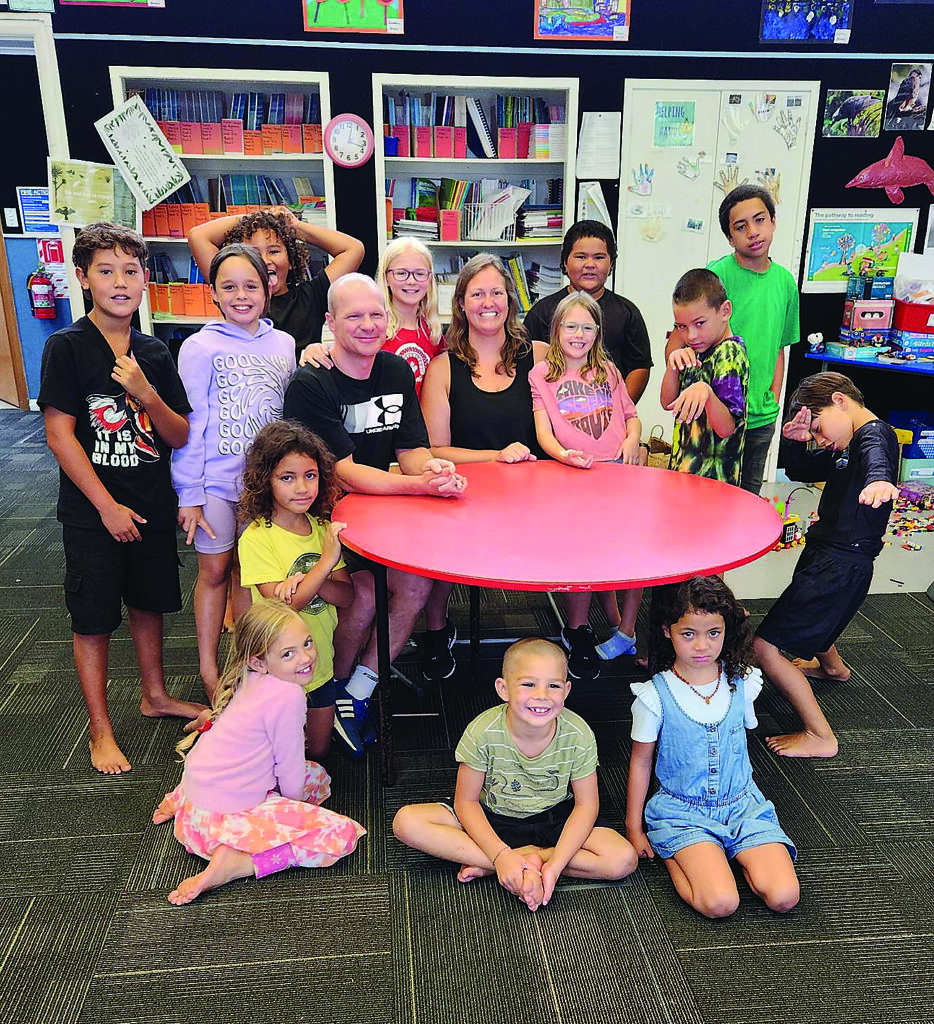
Maree Rossiter, principal of Tinopai School in the Far North, hosted Canadian principal Matt Dodds, in March this year. Maree’s kura is a sole charge, Decile 1 school of around 20 students – unlike Matt’s own much larger school in Canada.
‘We staged a powhiri to welcome Matt and his family – wife Lindsay and daughters Kaitlyn and Jessica – on the Monday after they arrived, with kura, whānau, community and Iwi all present,’ explained Maree.
‘The following day Matt and Lindsay (also a trained teacher) and their girls spent the morning in our kura, working alongside us,’ said Maree.
Maree further reported that tamariki loved hearing about Canada from Matt, as they shared Kiwi treats and colloquialisms with their Canadian guests.
‘There were lots of giggles as we shared the very different lifestyles between Toronto, Canada and Tinopai, New Zealand,’ said Maree.
With the family returning to Australia – their temporary bolt hole during Matt’s six-month sabbatical – Matt immersed himself in Northland’s schooling scene. Visits were arranged to other kura in the area including Te Kopuru School, Otamatea High School, Ruawai College, Matakohe School, Maungaturoto Primary School, and Kaiwaka Primary.
Each school was given advanced intel on Matt’s special interests so they could share knowledge, examples and learning programmes that particularly interested him. They were all welcoming of their colleague from Canada and keen to show their new friend the diverse range of Kiwi students and the different approaches teachers adopt for individualised learning. Individualised teaching is a standout feature of New Zealand’s schooling and one that always fascinates visitors.
All schools were welcoming and made sure that Matt got plenty of time to visit a variety of differently styled Kiwi classrooms, where he could observe learners of different age-groups. He also had the opportunity to meet with groups of principals, to talk with them and enjoy the Northland camaraderie.
‘At the end of the week, we farewelled our new Canadian colleague as warmly as we had welcomed him – this time with a poroporoaki,’ said Maree. ‘Our school presented him with a tokotoko to demonstrate that we held him in esteem and had greatly valued his visit.’
During the week Matt spent in Tinopai, Maree took the opportunity to talk with him about the commonalities and differences between the education systems of each of their countries.
One of Matt’s first observations was how hard it is to be a sole principal in Aotearoa New Zealand, because you are also a full time teacher. The principal’s duties don’t go away because you are teaching all day, and instead they go home with you. ‘I think that is true for all sole principals,’ said Maree.
One stand-out difference was the level of autonomy New Zealand schools have relative to their Canadian counterparts. Canadian schools also have considerably larger rolls than schools in Aotearoa New Zealand, and the principal groups or clusters are also much larger than in New Zealand regions.
‘In Canada, schools teach the curriculum, as in New Zealand, but content does not vary much across schools. Teaching practices are nowhere near as diverse as we find in New Zealand schools,’ said Maree. This is a further reflection of the level of autonomy public schools have in Aotearoa New Zealand.
Schools are funded differently in Canada too, leaving little decision making to the principal. For example, in Canada, principals ask permission to purchase a text for their school and it must be approved, before procuring it.
In Canada, students are assessed by a test, at the end of certain grades. ‘I understand from our Canadian visitors that it is not unusual for teachers to ‘teach to the test’ so that children get through,’ said Maree.
Reflecting on the direction shift for education in New Zealand and thinking about the ‘Canadian story’ gives Maree a sense of unease.
‘As a country we are heading down the path of relinquishing our autonomy,’ she said. ‘Mandatory literacy and mathematics, common assessments, being told how we are to teach, are just some of the things that are threatening our autonomy,’ she said.
After hosting her Canadian exchange partner, Matt, Maree said she would like to see the organisers consider extending the programme beyond a week. ‘A week just isn’t long enough to explore everything we would like to examine about each other’s education systems and different cultures,’ she said.
She applauded the initiative, however, and was much looking forward to visiting Matt at his home in Canada, in the third term. ‘My own daughter, who is also my Teacher Aide, will be travelling with me. Having two sets of eyes in Canada, will add richness to the experience,’ she said.
Last term, one of the first OPC–NZPF New Zealand exchange principals headed off to Canada. Ontario in Toronto was the destination for Cherie Taylor-Patel, former president of NZPF, who has now returned to West Auckland to continue leading Flanshaw Road School.
Cherie confirmed Matt Dodds’ observation that schools in Canada are much larger than in New Zealand.
‘The Toronto Board oversees around 600 schools, in a city of 10 million people,’ she said.
In New Zealand, a country of a little over five million people, there are 2,500 schools. That is about four times more schools than in Toronto for half the population size.
‘Generally, the Canadian schools are built of brick and blocks which helps with the weather. Temperatures range from 30 degrees celsius to –30 degrees celsius,’ said Cherie. ‘In the winter the children are continuously indoors, so schools are built spaciously to accommodate them,’ she said.
‘There was just one support staff worker at Elizabeth Simcoe Elementary,’ said Cherie, ‘but a similar sized school in New Zealand would have eight.’
It was the same for administration support, with just one person taking on the roles of receptionist, PA to the principal, administrator and bursar, whereas an equivalent sized school in New Zealand would have three staff members to cover these roles. The same applied to the senior management team. Elizabeth Simcoe Elementary had two senior leadership positions and both were full time teachers. In New Zealand the school would have a DP and five middle leaders.
The school timetable and class sizes are like a typical New Zealand school.
School budgets are overseen by the District Board and there are no local school boards, so parent involvement in Ontario is limited.
Cherie was matched to Ruth Coulter, the principal of Elizabeth Simcoe Elementary School in Scarborough, Ontario. She discussed Professional learning and development (PLD) with Ruth, to compare with New Zealand offerings.
In Ontario, the District Board runs all PLD and there is a wide range of programmes school leaders can work through to complete modules and qualify for promotions. To be considered for a principal’s position, applicants must be approved by both their own school principal and the school’s superintendent. Conferences for principals are held twice a year and resources for PLD are supplied through the District Office. Access to the Toronto District Board is difficult, compared to accessing Ministry regional support in New Zealand, but principals can readily seek support from their own school superintendent. Clearly, opportunities for principals to access PLD are far greater than for New Zealand principals.
Classroom teachers are given four hours release time each week and, as in New Zealand, finding relief staff to cover classroom release is very difficult. In Ontario, relief teachers must be registered teachers and be registered with the District Board. Retired teachers can relieve for just 50 days per year, before impacting on their retirement pension. Consequently, there is a chronic shortage of relievers and principals frequently cover classes throughout the year. This is contributing to ‘burn-out’ for Canadian principals. Cherie could see immediate parallels with the reliever shortages in our own country.
Culturally, Canada has not come to terms with First Nations issues as readily as in Aotearoa New Zealand. Despite many First Nations tribes signing Treaties with England, they are still, after 400 years, trying to establish the necessary evidence for historical grievances – and are doing so with the support of Māori constitutional lawyers!
Many of their issues are the same as for Māori – loss of land, language and culture through assimilation processes. First Nations history is systematically taught through the curriculum, however there is no local history taught in Ontario and the school culture very much follows westernised traditions. Cherie was pleased to be able to visit the Woodlands Cultural Centre, an indigenous First Nations education centre, where she observed many parallels with Māori history.
What is taught in all Canadian schools is French. A specialist French-speaking teacher takes all classes for the school. Certain professions in Canada require fluency in French, even though it is not commonly heard amongst the general population.
All schools in Canada are public schools. However, if parents choose specialist learning for their children, they pay fees. There are specialist schools and specialist classes within schools. For example, the School of Fine Arts, which has both public and private funding. There are ‘gifted’ classes in specific schools and outdoor education programmes which students might attend for half of the week. These are all fee-paying programmes.
On reflection, Cherie said there were many likenesses to our schooling system but also some stark differences, as noted in this story. Having the autonomy to make local decisions, in collaboration with school communities, is one thing Cherie said she will cherish after seeing Canadian schooling which does not enjoy that privilege. Being able to personalise learning for children rather than relying on standardised lesson plans and text books, was another plus for New Zealand schools, and infusing Te Ao Māori mātauranga | knowledge was a further special strength of our own education system. On the other hand, the superior principal PLD system was a strength for Canadian principals, from which we could learn.
On balance the OPC–NZPF principal exchange programme is proving an excellent way for both Canadian and New Zealand principals to learn from each other and experience each other’s similarities and differences. Judging by the level of interest from both countries, this programme is likely to endure for many years to come.