
Our kura is very fortunate to have a close and respectful relationship with our local iwi Patuharakeke, Takahiwai Marae is nine kilometres from our kura and earlier this term all of our 350 tamariki visited to learn about Matariki and Puanga.
In 2014, one of our kaiako sought the support of then Principal Marilyn Dunn, to begin a bilingual classroom – 10 years later we have grown five classes of Māori medium learning. In 2022 the whānau and kaiako of our bilingual unit, named Te Whānau Harakeke, made the decision that from 2023 all classes would become rumaki reo – full immersion Te Reo Māori learning environments. We currently have 100 tamariki in Te Whānau Harakeke – 99 per cent of whom whakapapa Māori.
We are midway through a roll growth project – much of that growth due to our Māori medium classes. As five new classroom spaces began to take shape, the Senior Leadership Team met to review what the overall plan for the school layout will look like when the building project is finally complete. The five new classes were originally intended for English Medium classrooms, as we talked, it became clear that these would make the perfect new home for Te Whānau Harakeke as a space dedicated to Te Reo and Tikanga Māori | Māori language and practices. It has been a privilege to enact Te Tiriti o Waitangi in our space through giving the best to our tamariki Māori.
Having worked in many schools in Aotearoa New Zealand, both primary and high school, it has been my experience that classrooms dedicated as Māori spaces are sometimes the most rundown and often the furthest away from the hub of the school – the fact that Māori language programmes bring in additional funding to a kura means that we, as school leaders, have a responsibility (and the budget) to put this right.
As we planned for our Kawanga Whare | building opening, we worked closely with our iwi. Firstly, we used the Maramataka Māori | traditional Māori lunar calendar to plan the date for the opening – we were able to choose a day during Matariki which is an obvious time for a new beginning. Working with iwi takes time, these hui needed to be kanohi ki te kanohi | face to face. I take the time to be there, because through these hui, stories and tikanga are shared which enrich our knowledge as a kura and deepen our relationship with iwi. We first met with our kaumātua – who pointed us in the direction of who to communicate with to arrange the details for the dawn blessing.
We are fortunate to have several BoT representatives from Patuharakeke. One of them, Ari Carrington, proposed a mauri stone for the building opening. His kōrero was that the stone is a symbol of the hononga | connection between Patuharakeke and our kura. He (half jokingly!) said that if that connection is broken Patuharakeke will come back and reclaim the kōhatu | stone. Choosing the biggest stone we could find will hopefully make that less likely!
He gave his time to accompany us to a quarry in Otaika to choose a stone. The stone was delivered and lowered into place by a hi-ab. Several of our local iwi were passing by as the truck arrived and were able to come in and supervise the positioning. When it was in place we gathered around and put our hands on the stone to pass on our mauri | spirit to the stone. In so doing the stone gathers the mauri of all who touch it.
The building was blessed before dawn with over 100 people in attendance. An ahi | fire was lit and kaumātua passed through each building saying karakia called waerea, we carried rau | branches to cleanse the space. We unveiled the stone and went through a naming ceremony. Our kaumātua called out, ‘He aha te ingoa o tēnei kōhatu?’ ‘What is the name of this stone?’ We called, ‘Kukunui.’ This was repeated twice more. Each time more people joined in calling the name. Kukunui is the name of the pae maunga | the range of hills behind the school. This was where Patuharakeke had an inland pā site in addition to their coastal sites. This process was also followed for the naming of the building. The building was named Te Pā Harakeke, a pā harakeke is the place where harakeke flourishes.
We also chose a smaller mauri stone which will accompany Te Whānau Harakeke to special occasions. A basket was woven for this stone and it was named ‘Pirihi.’ Pirihi is the name of the whānau of our kaumatua Paraire and Heidi Pirihi and their daughter Ramari who was the kaiako who started the first bilingual classroom 10 years ago in 2014. The selection of this name will help our tamariki to remember the whakapapa | history of those who have built our kura.
As the stone was named it was passed around the gathering. Following the classroom opening we held a whole school assembly, to celebrate the 10 year birthday of Te Whānau Harakeke and honoured all those who had played a part in the ara | journey of the kura.
Whatever tikanga you follow to mark special occasions, resourcing is required. Our local quarry donated the mauri stone to us and we paid for the transportation. We employed Visual P – a Māori photographer who understood the kaupapa – to record the occasion. We paid the weaver who created the kete for our kohatu Pirihi. We also gave koha to those from our local iwi who advised and attended. Our iwi cannot function on a cup of tea and a lamington – we need to pay for their time and skills. I find koha challenging – if in doubt, I think about how many hours have been spent and what I would pay for the equivalent to a PLD provider or in tradie hours!
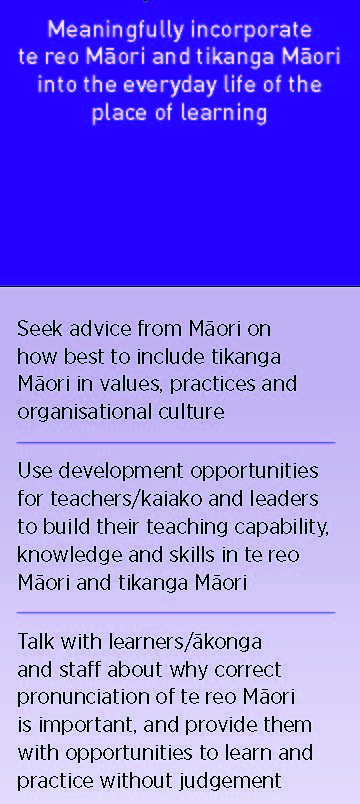
The way in which we use the significant resources of our kura is political – we have a clear mandate to enact Te Tiriti in the management of those resources. Under Objective 3 of our National Educational Learning Priorities, Quality Teaching and Leadership, we should ‘meaningfully incorporate te reo Māori and tikanga Māori into the everyday life of the place of learning.’
Looking back, I feel we honoured the journey and the achievements of the last 10 years and as we begin te tau hou Māori I am excited about our next steps.