
‘As a young teacher, I never thought I would have to be a weather expert!’ Meteorology was not a curriculum option at Teachers’ College in the ’60s and besides, there were far more important things to focus on, such as life-altering, revolutionary music, debating the ethics of the Vietnam War, buying a first car, and resisting the smoking culture – both legal and illegal. But in 1972 the weather was to become a major feature of my working life, because the school I would be leading was also a weather station.
1971 was a tumultuous time for the teaching profession, and a number of changes were made to staffing and salary scales. For reasons unknown, the authorities dropped the ‘2-Year Rule’ that prevented teachers from applying for a new job within two years of their appointment. My fiancée and I spotted an advertisement for a ‘Dual Appointment’ in the Gazette – for a school whose name we could barely pronounce – in the backblocks of Otago. We had moved to the Waikato to start our ‘Country Service’ and were still in our first year. But with the ‘2-Year Rule’ officially gone, we were free to apply. Dual Appointments were created for hard-to-staff schools, and although we had just four years teaching experience, we optimistically applied.
Back then, under the old Education Board structure, there were no interviews for those applying for a principal’s position, if the school had fewer than 11 teachers. There was just a standard one-page application form, on which you stated your experience and ‘grading mark’ – allocated after a one-day assessment by a school inspector. The only other relevant question was ‘If appointed, are you prepared to occupy the Education Board-provided schoolhouse?’
A couple of months later, we returned from our August holiday break, to telegrams advising us that we had been appointed to ‘Hakataramea Valley School’. We had to search the map, and discovered it was near the Waitaki River in North Otago (geographically in South Canterbury but administered by the Otago Education Board).
I flew down and met the School Committee. Mike,the outgoing principal, who would be taking up a new position in Dunedin, had already written me a lovely letter congratulating me on winning the ‘choicest two-teacher set-up in the Country’! He also told me that he would return in April, to teach me how to prepare for the severe winter conditions. I was impressed by the goodness of the people, and the pride they held in their small school. Along with a small church, the school was the only public building in the valley, so it served as the centre for all social events. The locals also told me of their consternation when informed by the Education Board that ‘Mr — and Miss — had been appointed, and would be taking up their positions at the beginning of the 1972 school year . . . and would be occupying the school residence’. Oh, What Scandal in the Valley!
A quick phone call cleared the matter up, and the locals were reassured that before taking up the position, ‘Mr and Miss’ would become ‘Mr and Mrs’. The morals of the valley children would not be compromised!
We celebrated our honeymoon on the trip south. Our meagre possessions (a single divan bed, a new lounge suite, a gate-leg table and two chairs) were loaded onto a tiny trailer and travelled with us. We spent two nights in Kurow while we organised our school house, buying all our basic furniture in Oamaru. The trip gave us the opportunity to practice the correct pronunciation of our new school’s name, Hakataramea Valley. (Haka – dancing; Taramea – Speargrass). The name referred to the dancing spear grass (tussock) that grew prolifically on the nearby ranges. It therefore came as a shock to arrive and find people referring to the place name as the Haka Valley (pronounced ‘Hacker’)! Fortunately, that would not be the case today.
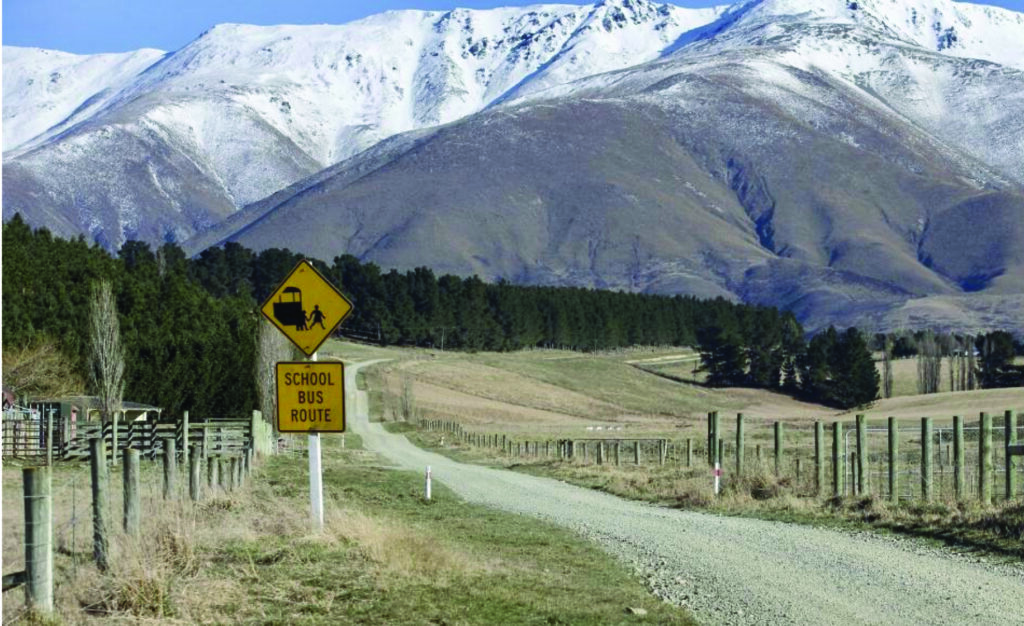
The Hakataramea Valley is a huge tract nestled between the Hunter Hills and the Kirkliston Range, east of Waimate, west of the MacKenzie Country and north of the Waitaki Hydro Lakes. A page from a geography book, left on the staff room table, told us that this corner of the valley was believed to have the greatest extremes of temperature in New Zealand. Not quite the hottest in summer, not quite the coldest in winter, but certainly the greatest difference between the two.
The school’s weather station came complete with instruments provided by the Meteorological Office. Each morning, we recorded the readings and sent these to the Met Service. We quickly learned that this place was very special, with extremely low annual rainfall – about 13 inches of rain (35mm) each year. February temperatures were in the high 30s–low 40s, and June–July–August lows were around –10°C.
Weather became a fascination for me, and a daily talking point. We recorded 42°C more than once, and the ‘best’ frost we ever recorded was –19°C. We quickly learned to adapt. The vagaries of the weather required our full attention.
Pipes would freeze, pipes would burst, and I was grateful when former principal, Mike, did arrive in April to teach me how to manage the winter, including that:
The cylindrical heaters behind each toilet pan in the school had to be turned on in April, and left on until August (otherwise the water in the pans would freeze and the toilet pans would break).
The swimming pool had to be left half full, and a dozen old tyres placed in the pool to help prevent the water from freezing. He also showed me the four pick-axe handles that the Form 2 (Year 8) boys would use to break the ice each morning.
The kerosene–diesel fired heaters in the two classrooms were turned on from April through to August. We turned them down each evening, and boosted them to high at 7.00am each morning, prior to the bus run. That way, hopefully, the room temperature would reach 0°C (yes, zero!) before the children arrived at 8.40am.
Most critical was the care needed to manage water to the school house, which was situated in the corner of the large school property. It was a 1905 villa, and during the long winter months, I had to drain the cold-water pipes every night. On really cold evenings, I would check the weather station, and if the temperature had dropped to zero before 11.00pm I would also drain the hot water pipes.
For five years, I managed most of these tasks without drama, except on two occasions. The first involved pipes freezing. The plumber discovered the supply pipes between school and house were buried only 40cm into the ground (they should have been much deeper). This was our first plumbing challenge.
The second involved a house flood. A quick visit to the house one lunchtime found my wife standing in 7–8 cm of water. Pipes in the ceiling had burst and water had flowed for several hours before being discovered. This was challenge number two for the local plumber!
Apart from the frozen and flood water niggles, life for us personally, in those early Hakataramea days was relatively peaceful. However, that was not the case for our farming families who had several climatic disasters to deal with through the early part of the decade.
The ‘Big Wind’ of 1971, before our arrival, had taken out a huge number of farm buildings and woolsheds that were still being repaired and replaced.
Less than a month into our arrival I was called on to help control the ‘Big Fire’ of 1972 which whipped viciously across the Kirkliston range, scorching thousands of acres of snow tussock.
Then came the most memorable of all, the ‘Big Snow’ of 1973 blanketing South Canterbury and North Otago resulting in the loss of over 120,000 sheep and 4,000 cattle. The snow was up to a metre deep in many places, with drifts of 3–4 metres. The school was closed for a week.
Once the phone lines and power were restored, we called the parents to deliver their children back to school – if they could. The school bus was still out of action, buried in a large snow drift, so bus children would be absent for a while longer. The children who could make it to school boisterously rolled gigantic snowballs across the sports field. One boy told us his father had built a huge 9-foot (2.75m) snowman in an earlier storm, so of course, we had to build a 10-foot (3m) one. It took weeks to melt.
The elements could be extreme, and summers were no different. The unrestrained dry climate meant that our little school concerts could be held outside, and sports events were never cancelled or postponed on account of rain.
Local inter-school sports events were held at Otematata (the village built for the construction of Benmore and Aviemore dams in the ’60s), Kurow, Campbell Park Special School (A Social Welfare residential school, for boys with intellectual disabilities), or our own Hakataramea Valley school, and drew wonderful community support. Sports Days were more than just competition for the children. They drew the wider communities together, allowing the locals to create connections and share common interests.
Our school facilities meant we were the hub of the community. The national library service partnered with us so that we could serve not just the children’s reading needs but those of the entire valley. The service replenished and exchanged our reading stock every year. Our school’s tennis court and swimming pool were also available to the local community who made good use of them during the long summer evenings and weekends.
For a few years in the early ’70s, the International Heatway Car Rally came through the valley, shortly after midnight. Irrespective of the inhospitable hour, the school’s parents would be there serving soup and hot food to the rally drivers and support teams. Caring for visitors was an important value in the valley. No one came through Hakataramea without being offered the very best of hospitality.
In every rural community, you will find a local character and in the Hakataramea Valley it was our neighbour who was also the school bus driver.
He talked about how ‘the chooks’ eggs freeze solid in the nesting boxes in winter.’ and advised us to ‘Just leave the carrots in the ground over the winter. When you need some, pour a jug of hot water over them, and dig them out!’ I can attest to the egg story – it happened to our own eggs – frozen solid, they were in the nesting boxes, just as he said. I never did verify a further story, however, about the chooks’ feet being frozen to the perches. Perhaps that one belongs in the ‘rural myths’ section?
One thing our bus driver friend failed to do was warn us of the danger of storing a dozen glass bottles of lemonade on the outdoor laundry’s shelf in the winter. We came home one afternoon to a scattering of shattered glass – turning our laundry floor into a milky way with meteorites – whilst naked statues of frozen lemonade stood proudly in their ‘bottle shapes’ upon the laundry shelf.
The weather could make us shiver, but the community’s kindness and generosity warmed us to the core, whatever the season. We frequently arrived home from school to find brown paper wrapped parcels of hogget or lamb, or bags of produce and baking left on the school house doorstep. We felt absolutely spoiled by a community who took us into their hearts and their homes.
It was always exciting as well as sad to farewell our Form 2 (year 8) students, with some graduating on to the local Area School in Kurow while others moved away to boarding schools in Oamaru, Timaru and Christchurch for their secondary education. Many years later, in 2003, it was distressing to hear that Education Minister Trevor Mallard closed the school forever, just one year short of its 120th jubilee. The decision was controversial, given the school was a viable entity and very much the central hub for the whole valley community. However the winning argument was that the local Area School roll had dropped and the closure of the Hakataramea Valley School enabled the neighbouring Kurow School to continue to operate (now ‘Waitaki Valley School’). There are many small, rural schools with similar stories to tell.
Looking back across a 50-year career in teaching and principalship, my days of country service in rural schools like the Hakataramea Valley School, still linger in the memory as some of the happiest and most fulfilling of my career. Geographically isolated we might have been, but never alone and certainly never lonely. Rural communities in New Zealand are special and still are, and principals who have the privilege of serving them do so much more than just deliver the curriculum and fill out forms for the Ministry. They advance the values of the community’s rural culture. They become ‘rural’ themselves, for a time, join in and enjoy life experiences they may never have again.
If you take a rural principal’s position, take it with both hands. Become part of the rural community and make memories that will last a lifetime.