
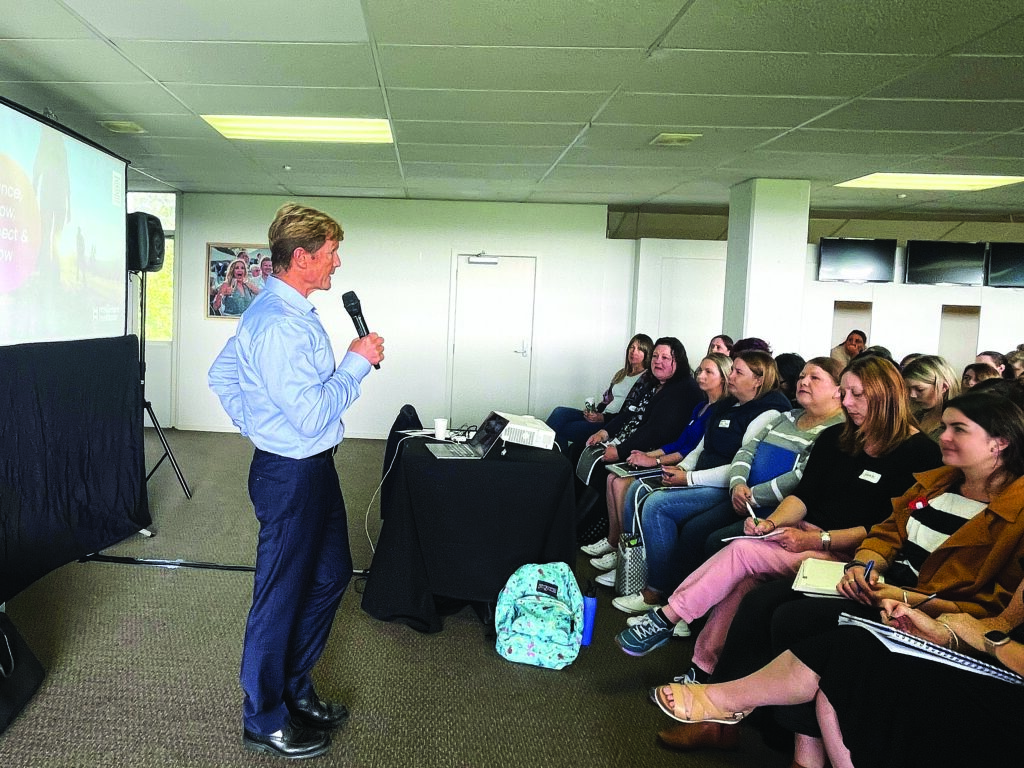
Most schools run their own Teacher Only Days (TODs) or meet as a Kāhui Ako (KA) cluster of schools. In a first for the district, Franklin hosted 46 schools with over 600 teachers for this year’s TOD. The day included multiple KAs and multiple individual schools.
The agenda for the day was as ‘mega’ as the event itself. Teachers and principals traversed the Aotearoa New Zealand Histories Curriculum (ANZHC), the Curriculum Refresh, including exploration of the progressions model, the selection of resources to support teaching, and principal and teacher wellbeing and resilience.
Jonathan Salisbury, Lead Principal of the Tuakau KA summed up the day saying,
It was a valuable opportunity for all Franklin educators to come together and receive a unified message. As educators, we understand that our work is never truly finished, and we are always looking for ways to better support the growth and development of our students. The event emphasised the importance of working together as a community, sharing our knowledge and resources, and learning from one another.
The ANZHC was a feature of the day, given that in its construction, the learning model of ‘Understand, Know, Do’ (UKD) was adopted. It had already been announced that this model would equally apply to learning for the entire Curriculum Refresh or Te Mātaiaho.
Explaining the model was the job of Shaun Hawthorne of the Ministry of Education. He gave his audience a comprehensive overview of the progression model, and the UKD learning model.
The curriculum, he said, starts from the premise that all ākonga are taonga who can achieve their potential and excel. Progress through learning phases is cumulative and strengths based, and meaningful progress will require teachers to use responsive pedagogy.
So, what do we mean by Understand, Know and Do as a model for the curriculum?
Hawthorne offered an explanation:
-
Understand means at the heart of learning there is a set of big ideas that all ākonga can relate to.
-
Know refers to the contexts that enable illumination of these big ideas, bringing them to life.
-
Do means that ākonga develop practices that enable them to think and act as ‘experts’ in each learning area and across learning areas.
He then described the seven key features of the progression framework as:
-
Five phases across Years 1–13 that replace the eight curriculum levels.
-
Each phase has eight learning areas.
-
Each learning area has one progress outcome in each phase (five in total).
-
Progress outcomes replace achievement objectives.
-
Each progress outcome describes what ākonga should understand, know and do at each phase of learning.
-
More granular progress steps describe the literacy, communication and numeracy that support the learning described in the progress outcomes.
-
Together they provide explicit signposts along the schooling pathway, while leaving space for local decision making and classroom teaching that is responsive to individual ākonga.
Next were the six phases of learning from early childhood through Years 11–13. Descriptors ranged from early childhood – ‘being confident curious learners’ – to Years 11–13 – ‘navigating pathways and developing agency to help shape the future’.
Leitia Preston, from Vision Education, a PLD provider, also discussed the ANZHC workstream and the links to Understand, Know and Do, as well as the Literacy workstream. She acknowledged mana whenua, Ngāti Tamaoho, and gave clear explanations on the authority within iwi and manawhenua to speak on local curriculum and history.
Through this discussion, Leitia identified how to be culturally responsive, when asking tamariki to prepare and present a pepeha, ensuring the appropriate use of the pepeha for Māori and Pasifika, as opposed to a mihi for all other tamariki. She explained that the Ministry’s generic template doesn’t necessarily allow for differences in whānau backgrounds and situations as some tamariki are not living with their biological parents.
Tikanga is often used in schools and Leitia explained that schools are covering the ‘Do’ aspect of the ANZHC, however, they do not always focus on the ‘Understand’ and ‘Know’ aspects. There can, at times, be little understanding behind the history of tikanga, why they do it, and the meaning behind it, however, they ‘Do’ aspects of tikanga. What is important is to identify what ‘Understand’ and ‘Know’ really means. She explained that this is the focus for each of the workstream representatives to learn about then share within their own schools.
In support of the ANZHC mahi, Matua Henare shared his story about growing up in Pukekohe and Waiuku. This was followed by Matua Selwyn explaining how Waiuku came to be and the whakapapa of Ngati Te Ata. The kaipūrakau team taught the room a newly written, uplifting waiata about the Waiuku rohe and whakapapa of the tupuna entitled ‘Puketapu’. ‘Learning waiata about the rohe is brilliant for history recall and engages our ākonga,’ said Lysandra Stuart, host for the day and lead of the Waiuku Kāhui Ako.
Whaea Ngātipikiao (Piki) Jakeman and Lysandra Stuart outlined the opportunities kapa haka and waiata bring to the classroom and how they link to Te Mātaiaho, the local curriculum, the ANZHC and the Waiuku Kāhui Ako Education plan for Māori. Lysandra also led a session highlighting the importance of working alongside mana whenua. She noted the work her Kāhui Ako is doing with their local Ngati Te Ata iwi with wāhi tapu (sacred places) and celebrating other taonga or treasures in the community.
There was also a presentation from, Te Kāhui Ako o te Puuaha o Waikato who outlined their shared focus, and the resources available to educators for learning, learning support, transitions, and assessment. The information presented by the Across School Leaders was both informative and practical, providing teachers with valuable insights and tools that can be applied to their daily work as educators.
Principal and teacher wellbeing and resilience has been a focus for many years, so it was appropriate that the TOD would include a session on resilience and how to live a fulfilled life. This session was led by Dr Sven Hansen of the Resilience Institute.
Hansen engaged his audience in practical ways to ‘bounce, flow, connect and grow’. He listed a number of threats to leading a fulfilled life: worry, fatigue, anxiety, apathy, rumination and insomnia.
Lack of sleep caught the attention of many in the room, as Hansen explained that ‘our daytime effectiveness depends on regular, disciplined and structured sleep.’ He outlined ways to improve sleep quality by:
-
Having a small early dinner, abstaining from caffeine after 2pm, limiting alcohol and protein.
-
Having a cooling down phase before sleep.
-
Ensuring you have a cool, dark and quiet bedroom with no technology.
-
Exercising early in the day, including both strength and aerobic exercise.
-
Having at least 7–8 hours of quality sleep every night.
Another strategy to overcome anxiety, said Hansen, is to stay in the present. ‘Thinking is over-rated,’ he said to the surprise of his audience. He continued, explaining that depression is thinking too much about how you ruined the past. ‘When you stop thinking, you become present, focused and effective,’ he said.
He offered a few tips on how to keep your mind in the present. These include:
-
Take one thing at a time.
-
Stay focused for short bursts.
-
Rest plenty.
-
Seek out your optimal rhythm for your workflow.
-
Practice noticing and block out mental chatter.
-
Strengthen your ability to focus attention.
-
Be aware of your context.
-
Influence situations to the positive.
-
Principals and teachers appreciated the simple, practical advice Hansen offered and found his presentation relatable.
Overall principals and teachers found the mega TOD event a worthwhile investment and were grateful for the Ministry support which allowed so many to participate.