
This year’s NZPF Conference was an early sell-out, such that in her President’s address, Leanne Otene extended an apology to all those who weren’t able to attend. Queenstown has always been a favorite with principals, but the venue capacity limits delegate numbers. That is a problem for future conference organisers to resolve, but those present were very clear in their feedback – the conference was a roaring success and the location superb.
With a nod to the physical landscape, the conference was entitled ‘Reimagine Remarkable’. Traditional practices, like the sit-down conference dinner, gave way to a less formal night in the ‘Kingpin’ Queenstown. The dinner was indeed reimagined as a night of fun and games – from bowling alleys to battling virtual enemies, escape rooms, karaoke, table tennis and more. There was an endless supply of very tasty food on hand and the bar didn’t close till late. If the organisers worried about how delegates would respond, they shouldn’t have. The principals loved it all.
Highest NZPF Award For Worthy Former President
It was a fitting event at which to honour former NZPF President, Whetu Cormick with the highest award of Life Membership of the Federation. Reading the nominating member’s endorsement, President Leanne Otene said Whetu’s service to the NZPF membership was outstanding. He held the unusual record of being elected President in three consecutive years and was instrumental in the establishment of the Māori Achievement Collaborations (MACs), a prominent PLD Kaupapa which has proved most successful in changing school culture to lift the achievement of tamariki Māori. Whetu continues his involvement with MAC as a Facilitator in his home region of Otago. He was praised for his relationship building skills, including with media, and lifting the media profile of NZPF to greater and greater heights. The MAC team was on hand to perform a rousing haka in his honour.
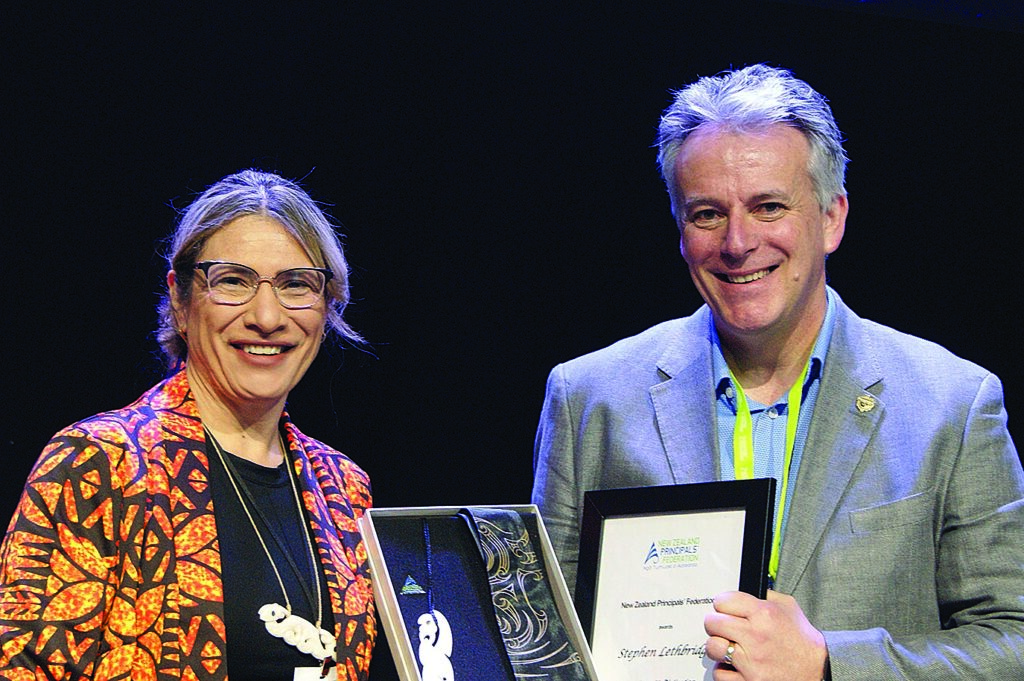
Steven Lethbridge, former President of the Auckland Principals’ Association was also honoured with a ‘Service with Distinction Award’ for his outstanding support of Auckland principals during the Covid-19 pandemic.
NZPF President, Leanne Otene
Early in her opening speech, NZPF President, Leanne Otene commended the ‘remarkable’ way that principals have led their schools this year through the pandemic, floods, and cyclones. She especially noted those affected by cyclones in Gisborne and the Hawkes Bay region, saying, ‘Despite your own personal tragedies and challenges, not one of you walked away [from your schools].You are all absolutely remarkable,’ she said to the applause of the packed audience.
She then invited the principals to reimagine a ‘world leading education system’ that is uniquely Aotearoa New Zealand, and what that system would look like. She summarized the elements of such a system under six headings.
-
It would be free from party politics and instead education policy would be developed by a ‘Cross-Party Coalition’ comprising representation from all political parties, educational practitioners, researchers, and academics. It would make considered long-term educational plans that would extend beyond the three-year electoral cycle.
-
It would enact – not just honour – Te Tiriti o Waitangi. That would mean normalising Te Reo Māori in schools and bringing a deeper understanding of Māori relationships with whenua and takiwa or place. The Aotearoa New Zealand Histories Curriculum would be a great starting place to connect with local hapū, iwi and marae, hear stories directly from local Tangata Whenua and become immersed in a Māori world view. In this way racism will fade and partnerships, friendships, and unity will blossom.
-
It would have equitable, ongoing, fully funded professional development for teachers and principals, because opportunities for professional learning and networking have a hugely positive effect on the quality of education our young people receive. Currently smaller and rural schools suffer disproportionately because the funding model is based on roll numbers not the professional needs of a teacher or school leader.
-
It would have a broad and rich curriculum mix of national and local curriculum. Assessments would focus on progress, not meeting measurable accountability standards. ‘What’ to teach would be prescribed in the national curriculum whilst the local curriculum would be constructed locally. ‘How’ to teach would be decided by the school in consultation with the leadership and teachers. Professional learning would support teaching in an ongoing way.
-
It would have equitable support and resources for our diverse tamariki and their diverse learning needs. Currently one in five tamariki require some form of learning support and that means reducing class sizes, and drastically increasing learning support funding and personnel including trained specialist support services, to be available to all schools irrespective of size or location.
-
It would have professional principal and school Board relationships and Board members would be skilled and trained. When leadership is strong, the school will be successful. School Boards of Trustees are variable. Too many schools have untrained and unskilled Boards who do not make good employers of principals. They can be: ignorant and benign, leaving all the decision making and Board preparation work to the principal: ignorant and hostile where the principal is repeatedly undermined; skilled and benign where Boards function highly effectively; or efficient and hostile where the principal is constantly being questioned. Although the majority function effectively, for principals saddled with less capable or hostile Boards, careers can be destroyed.
She concluded by inviting all principals to read the NZPF manifesto before heading to the general election voting booths in October.
Minister of Education Hon. Jan Tinetti
The Minister opened her address, agreeing with the NZPF call to take politics out of education. She agreed that education systems such as Finland and Scotland, with cross party political consensus on education, did well. ‘I am happy to keep working on this with you,’ she said.
She listed some of her Government’s achievements, emphasizing that all initiatives have been developed in partnership with the sector. These included:
-
100 million school lunches have been delivered to 995 schools which also provides employment for people in the community making the lunches.
-
Free period products for intermediate and secondary schools reducing shame for young people and allowing many to come to school full time again.
-
Equity Index providing better targeted resourcing for schools.
-
Collective bargaining delivering pay increases to teachers.
-
Eligibility criteria for principalship.
-
Promoting recruitment into teacher training.
-
Curriculum refresh with special emphasis on literacy and numeracy without narrowing the curriculum. Development of new online curriculum resources.
-
Attendance and new attendance officers.
-
Ministerial Advisory Group (MAG) to be chaired by Karen Sewell, with a staffing focus including teachers and non-teachers and learning support staff with a view to setting schools up with staff needed for the future.
In answer to questions from the floor the Minister said she had not lost sight of principal wellbeing and would be following up on the business case for the High Needs Review, and in-class support.
On reducing class sizes, she said that dropping the ratio to 1:28 had cost $105m. The MAG would be working on future staffing but currently the budget was tight because of the collective bargaining settlements.
Patrick Camangian
Camangian entitled his presentation ‘The transformative lives we lead: Making education our own’. His area of expertise is social equity and cultural relevancy for marginalised students. To explain resisting the status quo, he offered a critique of social oppression. Transformational resistance, he said, refers to demonstrating a critique of social oppression and an interest in social justice. It indicates a belief in the possibility of change at both the individual and societal levels, incorporating both internal and external resistance.
If you engage in self-defeating resistance, he said, you are not motivated by social justice. If you practice transformative resistance, you are.
Too many marginalized students, he said, are blamed for their own circumstances and this results in angry kids behaving badly. It is self-defeating resistance which results in interventions, but there is no racism critique.
For these kids, the dominant narrative devalues their narrative. Education is engaging them in a system that despises their humanity.
He told his own story to illustrate his point saying that his Filipino parents were highly motivated to move to America to give him a better chance at education and life. This was the American dream. They achieved their goal, at great sacrifice, and it was the American nightmare. Camangian said he was disengaged, marginalized at school, and got poor grades. He experienced racism every day, so he joined a neighbourhood gang. He engaged in ‘horizontal violence’ because school was not aligned with the everyday reality in his community. It was during a stint in prison, talking to another marginalized prisoner, that made them both realise that they were doing what an inequitable societywanted them to do – start on small crime and move on to big weapons.
Beyond prison, he focused on his own success and finally completed university in 1999. Initially conforming to expectations, he then became transformational and moved on to culturally relevant teaching which includes more than knowing students’ ethnic backgrounds. Culture is not just a proxy for race, he said, it’s also about who has the power and who doesn’t. To humanize learning, as educators, you have to look beyond policy that has ignored history and ignored young people navigating social oppressors. This includes changing the way we assess young people’s learning. Rather than designing assessment based on repetitive learning we may need to look at growth over time, he said.
Pasi Sahlberg
Sahlberg entitled his address: ‘The Big Picture of School Education: What every principal needs to know’.
Much of Sahlberg’s message had also been delivered to the Australia Primary Principals Conference in Hobart, which is reported on page 8 of this issue.
He told his audience that the achievement gap in New Zealand, like Australia, has not changed in 22 years. The question is how to narrow the gap. The education system, he said, is giving more to kids who have more and less to those in need.
He explained that in 1983 the US President, Ronald Reagan announced that there was a crisis in education and unless something radical happened they would have a national security issue on their hands. This was nonsense but it paved the way for the introduction of the Global Education Reform Movement. He warned his audience to keep away from toxic narratives about crisis and to focus on hope.
He offered some ways primary schools can be transformed and these too appear in the Australian story on page 8.
Abbas Nazari
Nazari told his own extraordinary story of his family’s 2001 escape from their mountainous northern village in Taliban occupied Afghanistan to eventually end up in New Zealand, via Pakistan, Indonesia and the Norwegian container ship, the Tampa. It is a story of corruption, desperation, courage, high risk and high seas, terror and inspiration. As the Tampa approached Australian shores and what the occupants believed to be freedom, Australia closed its doors to the asylum seekers. The Nazari family were some of the fortunate few, he said, to be resettled in New Zealand. His family has thrived in their new country of New Zealand and in 2019 he was awarded a Fulbright scholarship w to study at Georgetown University in Washington DC where he attained a Master’s degree in Security Studies. He continues to work for refugees to help them build meaningful lives. In 2021 he published his story in a book entitled ‘After the Tampa – from Afghanistan to New Zealand’.
Dame Valerie Adams
If ever there was a reason to stay for the final day of a conference, it is Dame Valerie Adams. Her imposing figure is even more imposing in person and her personality and confidence make her a treat to meet. Dame Valerie was interviewed by MC for the conference, Wikitoria Day.
Now retired from top level athletics, Dame Valerie said retirement isn’t always easy to navigate for top athletes unless they have a clear plan. They often don’t easily fit back into society. She added that she was fortunate to have two young children and a brand but that is not the story for every athlete.
Her plan is to inspire the next generation because, she said, it’s all about the future of youth. She has immersed herself in charitable work including ‘Jamas for kids’ to make sure all children have warm pyjamas for the winter. These are things, she said, she couldn’t be involved in when in training, but now she must take care she doesn’t spread herself too thinly.
Wikitoria asked her which of her Olympic medals was the most important to her. Her answer was clear: every medal has a special story.
Inevitably the mental side of preparing for big events would enter the conversation and Dame Valerie said her early attitude was ‘take a concrete pill and toughen up’. Seeking help, she said, was seen as a weakness for a Tongan. That’s how it was. She was very particular about who she opened up to, although she saw a sports psychologist, she felt the need to keep this a secret.
Her message now is different: Even the strongest fall over!
She told the story of growing up in Mangere, Auckland and personal tragedies that affected her.
‘My Mother died at 39 years old when I was 15,’ she said. ‘It hit hard.’
She was already seen as an adult because she was six feet four inches tall at the age of twelve with size fourteen shoes. ‘I grew up quickly,’ she said, ‘and realized I had two choices. One was to dream of going to the Olympic games.’
Her schooling years were not all fun and at Intermediate school she was bullied because of her height. Sports became a saviour because she was always good at sport, and everyone wanted to be in her team.
A standout PE teacher paid for her first Nike athletic shoes because she had none. ‘I’ve now been sponsored by Nike for 15 years, but will never forget that first pair. I adored this teacher,’ said Dame Valerie. ‘She took the time to help me, was positive, pulled me up for bad behaviour and gave me positive affirmation when I did well. She built my self-esteem. She was such a special teacher. When you have no money you can’t see a future, but this teacher changed that for me.’
Dame Valerie was scathing of the ‘tall poppy’ syndrome that continues to thrive in New Zealand. ‘You just have to grow a thicker skin,’ she said, ‘and remember that for every one negative comment, there are 99 positive ones.’
She spoke of the importance of her team. Her sport may be individual but there is still the team behind her. She used the analogy of a bus. I am the bus driver and everyone on the bus is here for a reason – the physiotherapist, the chiropractor and so on. Everyone is helping the bus go forward. If someone is not pulling their weight, they have to get off the bus, because if everyone is not working together, I can’t perform.
Her stellar career has not been without its hurdles and the greatest of these is injury. She told her audience she has now had eight surgeries. ‘Each time there is that doubt and you question whether you can come back. That’s when you need the team behind you to plan ahead.’
The media is another pressure, but Dame Valerie has worked out her own strategy. ‘I know I am public property as an athlete, and I take it in my stride. What you see is what you get. That works for me, if media disrespects my story for their own ego, I won’t talk to them.’
A balanced life and hauora rank high on Dame Valerie’s list now, although she says as an athlete, she had no balance of life at all. Her number one focus is her two children and she has a balance between time for herself (when the children are in bed), movement and training, including 30 minutes in the gym, and the daytime activities. Her body is now very damaged with knee issues, vertebrae, discs and back issues and her life goals are different.
‘If I can inspire one child to see a better life for themselves, I will feel I have achieved,’ she says.
A documentary movie has now been made of her life called ‘It’s more than Gold.’ ‘I took up the challenge,’ she said, ‘because I’ve been through a lot in my short life, and I just wanted to tell my own story.’ A Tongan speaker herself, Dame Valerie took the film to Tonga to show her people. ‘A thousand children saw the screening every day,’ she said, ‘and I could talk to them about it in Tongan. It was a beautiful experience.’
Our thanks to Dame Valerie for sharing her story. You were our beautiful experience.
And so the curtain falls on another successful NZPF conference. From the networking to the social events, from the inspiring speakers to the camaraderie, the celebrations and the fun, Queenstown 2023 will be remembered for being truly remarkable.