
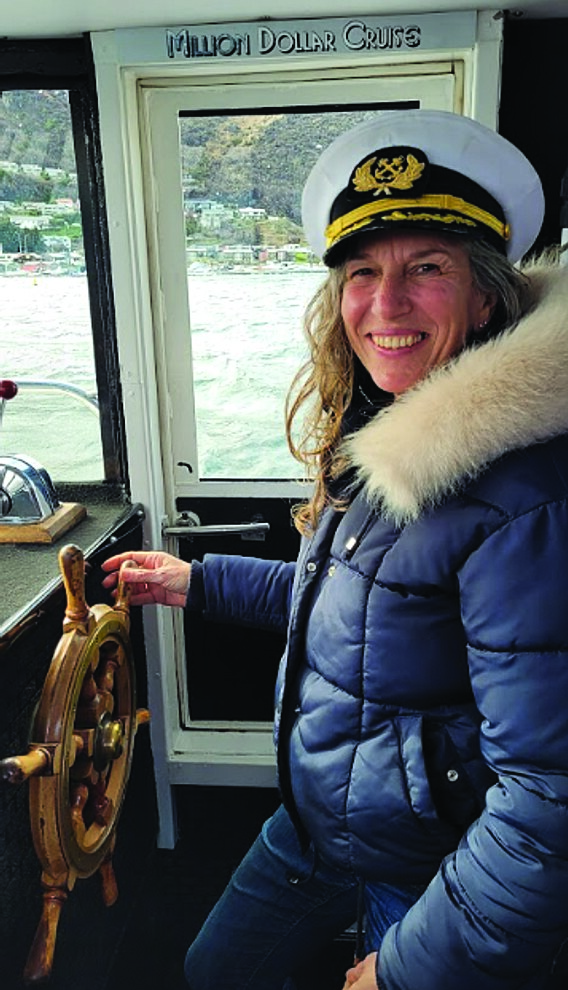
Hats off to whoever had the genius idea of taking 500 school principals to an amusement arcade for the night! Yes, I loved the Virtual Reality pirate shooting game but I laughed the most playing Hungry Hippos. I also had a great time playing at being Captain of the Million Dollar Cruise on beautiful Lake Wakatipu. Thus, the importance of play was an overarching conference theme for me. It is good to remember – for children and adults – that play is important for relationship building and learning happens within relationships.
I first heard Pasi Sahlberg speak at the NZPF/APPA Conference in Melbourne in 2012. At the time he was Director General of the Finnish Ministry of Education & Culture. He gave a keynote entitled ‘Finnish Lessons: What can the world learn from educational change in Finland?’ At the time I was Principal of a small rural school in the Manawatu and had successfully applied for the NZPF Don Le Prou PLD award which allowed me to attend. (Applications for the award close on 1 March next year, details on the NZPF website) I came back and listened eagerly to the audiobook of Finnish Lessons – the updated version is still available on Audible. My takeaways during the Global Educational Reform Movement were about the Finnish focus on learning support interventions in the early years of children’s learning rather than waiting until we were labelling their achievement ‘Well Below’.
Educational research is a fiendishly difficult pursuit – measuring the outcomes of educational systems is complex but isolating the effect of individual variables of a system in the learning lives of children is almost impossible. Hearing Pasi speak 10 years later has left me reflecting on the impact of researchers fully immersing themselves within a culture. Having his own children schooled within the Australian Education system has clearly given him a new and valuable perspective which cannot be gained by researching a system from the outside.
Pasi has always talked about equity in education – looking back on presentation slides from 2012, the key areas he talked about were the same ie food in schools and play based learning. However, until we live and work in other places, we can fail to recognise the most basic aspects of our education systems. His realisation that looping – teachers remaining with the same students for more than one year – is not commonly practised in the UK, Australia and New Zealand, may be an example. As he said, if we focus on the value of relationship building (and we also take into account Russell Bishop’s emphasis on the significant value of relationships for Māori learners) it seems incomprehensible that we would have a system where teachers spend a year getting to know students and then begin the next year with an entirely new group of learners.
This term I will be taking this idea to my staff as a trial in 2024, along with a different way to organise our school day. Pasi’s presentation can be found on his website www.pasisahlberg.com.
One of the benefits of stepping away from the busyness of school life is the opportunity for reflection. As I cruised around a breezy Lake Wakatipu I thought about the changes I am noticing having returned to Year 0–6 Principalship after ten years in High school leadership. If I was creating a PMI chart these would be the three significant changes that strike me.
My Plus would be the impact of Structured Literacy – I have to be honest when I first came to New Zealand, having trained in the UK and taught in International schools, I had no idea that children were not being taught to decode words phonically. I taught Y7/8 and saw immediate success in shifting poor readers through using PROBE assessment and teaching tools to teach inference and evaluation skills. Looking back I also taught them to sound out words because that is how I taught reading – it did not occur to me that many children had never been taught phonic strategies. I have only come to discover the legacy of Marie Clay’s mistaken beliefs in recent years – I found Emily Hanford’s podcast, ‘Sold a Story: How Teaching Kids to Read Went So Wrong’ really useful. Regardless of what you believe about the efficacy of Reading Recovery this is essential listening for all NZ educators.
My Interesting would be the massive change in approach to the teaching of mathematics. When I moved out of the primary classroom Accelerated Learning in Mathematics (ALiM) had been introduced as a short term intervention for students deemed to be below the national standard and teachers and researchers were beginning to question outcomes of the Numeracy Project. The subsequent rise of Numicon, DMIC and the common use of textbook teaching through PRIME mathematics is a surprise to me and I am watching with interest.
My Minus, the significant area of struggle I see, is the rise in numbers of young children lacking the social and emotional skills to play and thrive in a school environment. Hence Patrick Camingian’s presentation about overcoming trauma was sadly of great relevance.
The value of a conference is always the casual chat with other professionals. One of the significant themes of the coffee queue chat was how to make best use of the Wellbeing fund. Finnish Education Tours sound amazing (https://visitedufinn.com) as do the Eduteach Conference in Canada and the World EduLead Conference in Singapore. For me developing a better understanding of the impacts of trauma on children is a real priority, so the Trauma Aware Education Conference in Brisbane in October 2024 is currently top of my list. Since an Aussie conference delivers pretty good bang for buck, I am also planning to invest in some mentoring. My social worker friends have the benefit of regular professional supervision – a confidential place to unload, think out loud and assess their own wellbeing. I will be looking for someone to take on this role for me in 2024.