
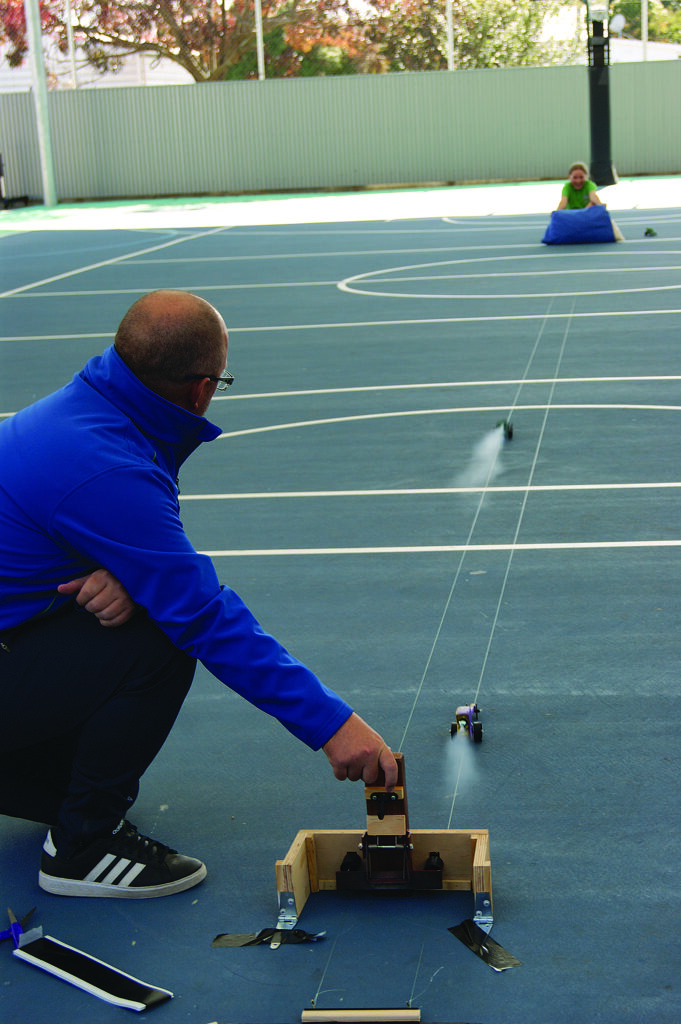
Principal, Heath Chittenden, is setting up a Tech demonstration on the Ashhurst School courts when I visit. He is surrounded by an enthusiastic bunch of Year 7–8 students, each clutching a light-weight wooden racing car. From his kneeling position, he glances up from his gadgetry, flashes a welcoming smile and explains that he’s taking the Tech class today because he’s a teacher down.
ball
In a very short while, with a little helpful advice from his participating students, the racetrack is set – two long fuse-wire thin metal tracks run from the starting blocks, about ten meters down the court to a kneeling student holding a big soft pillow. She holds the ‘buffer’ the rocketing cars will blast into.
Cars race two at a time. They each have a small gas cylinder plugged into them (potential energy) and the underside of the cars are threaded onto the thin metal tracks. At the flick of a switch (to release the energy), the cars explode down the track reaching the pillow in barely a second. The winner of each race is recorded by the highly excited watching class of children.
The children’s excitement is palpable but so is their learning about kinetic energy, the conversion of potential energy into motion. They have already learned the theory for homework, through their teacher’s three minute video recording. At school, they put the knowledge into action by doing the experiment. They see for themselves how kinetic energy is created and what the effects are. The learning is even more exciting because it’s also fun.
In between his unexpected class duties, Heath escorts me to his office where we talk about learning, and he tells me what inspired him to choose Ashhurst School’s pedagogical approach.
‘It all began a decade ago when I attended an International Conference on Teaching, Learning and Education (ICTLE) in Singapore,’ he said. ‘At the time Singapore led the [OECD] World in PISA (Programme for International Student Assessment) and other international measures of student achievement,’ he said. It was there that he met Aaron Sams, who together with Jonathan Bergmann, wrote the book Flip your classroom: Reach every student in every class every day. The flipped classroom is synonymous with mastery learning.
Sams’s thinking was based on Benjamin Bloom’s Taxonomy (Cognitive Domain), a triangular shaped construct, with remembering and understanding, the lower order learning skills, at the base of the triangle, followed by application, analysis and the higher order learning skills of evaluation and creativity at the apex of the triangle. The size of the area for each learning skill was commensurate with the attention afforded it.
Flipped learning would turn the triangle into a diamond shape. In this way, the lower order skills would be in the bottom apex of the diamond, application and analytical skills would be expanded as the middle section and evaluation and creativity, the highest level skills, would be at the top.
This thinking changes the proportion of time teachers would devote to each skill, with the largest proportion devoted to application and analysis. Learning then becomes an active experience.
‘This idea rang alarm bells with me,’ said Heath.
He explained that the way we teach hadn’t really changed in a century. All we have really done is make the learning groups smaller, he said. We always spend the most time on theory, knowledge, recall of facts and basic concepts after which we give children tasks to explain, discuss, describe, and identify, to demonstrate their understanding of the facts and concepts. Much less time is spent on applying and analysing, which are far harder to achieve and require more intense teacher time.
The idea behind flipped learning is that direct instruction is not the best use of class time. Students therefore encounter information before class, freeing class time for activities that involve higher order thinking.
Heath spent the next year talking to staff and thinking about how they might use new technologies to cover off the lower learning skills of knowledge and comprehension more effectively and efficiently so that maximum classroom time could be spent on application and analysing. He wanted all his students to become mastery learners.
Next, he went to the International Society for Technology in Education (ISTE) conference in Denver, along with 12,000 other teachers and leaders. There, he encountered some of the smartest, cutting-edge experts in the world. At a ‘flip learning’ workshop, he met John Bergmann and Aaron Sams, the inventors of mastery learning. At this stage, flipped learning was being used in secondary schools and at tertiary level, but not in primary schools.
It was considered too hard for primary schools to direct the concept learning, knowledge gathering and comprehension to homework. It was too much to expect the children to direct their own learning at home so that they were ready for the higher order applied and analytical learning at school.
Heath found the answer was ‘in flip’ which happens inside the classroom. Instead of the students doing all the research and reading to acquire the knowledge and understanding at home, teachers create a three minute video each day which the children watch from home after school. This covers off what they need to know and understand to do the applied work and analysis at school the next day.
‘We call this front-loading,’ said Heath, ‘because we want the majority of the teaching time spent on applying and analysing not on memory and understanding, which can be achieved through the video,’ he said. ‘This way, teachers are able to teach one on one because the video has enabled it,’ he added.
Flipped learning also means that teachers work more closely with their students and get to know them better. This allows teachers to provide better support and promotes increased collaboration between students.
Heath is no fan of self-directed learning which has become popular in many schools and expected to lead to student agency or control of their own learning, by allowing students to opt in rather than having their learning directed by the teacher. ‘The pendulum has swung too far encouraging children to follow their passions,’ he said. ‘For some children their passion doesn’t extend beyond watching the Xbox.’
‘We open doors for our kids, but we say which doors,’ he explained.
‘Right now, we are developing structured literacy. The teachers are preparing the videos. You can teach any concept in this way,’ said Heath. ‘That is the beauty of it.’
Heath says there are added bonuses to children watching the teaching video at home. ‘We find that sending a video home every night strengthens the home–school relationships and engagement with families,’ he said, ‘because the families are connecting to the learning as well.’
As a result of Heath’s adoption of flipped learning, the school is now a partner with the Derek Bok Centre for Teaching and Learning at Harvard University.
‘We feature in their research work,’ Heath explained, ‘because we are pioneers in applying flipped learning at the primary school level.’
The Manawat town of Ashhurst has a population of 3,500 people. To discover such a close connection between Ashhurst School and one of the most internationally acclaimed universities in the world, was not what I expected to uncover on a visit to the little town’s school.
‘Yes, we are proud to be internationally recognised by Harvard University,’ said Heath, ‘and we are indebted to the international community of researchers who introduced us to flipped learning in the first place,’ he said.
If flipped learning can enable increased higher-level learning, more teacher one on one time with students and be as much fun as I observed, it’s certainly worth a second look.
u