
The NZCER National Survey of Schools has shown that only 18% of teachers in primary settings have any level of interest in becoming a principal in the future. The survey also shows that the longer someone is in a teaching role, the less likely they are to aspire to become a principal.
Growing new leaders fundamental for a healthy future in the education sector, as outlined in the Ministry of Education’s Strategic Intentions 2025-2029, so there is clearly a need to make school leadership pathways more visible, accessible, and appealing to kaiako across all stages of their career.
NZCER has explored this in their recent research brief from the 2025 National Survey of Schools, highlighting how the twin pillars of school leadership and teaching beliefs can support pathways to leadership.
Kaiako, on why they are not interested in principalship:
It is a massive job coordinating all aspects of running a school (Students, teachers, parents, whānau, the community, BOT). The financial aspects of running a school, keeping up with educational changes and implementing effective learning programmes, ensuring student achievement, managing students with a huge array of learning needs – the list just goes on and on!
Why (or why not) become a principal: what the teachers said
NZCER’s National Survey findings suggest that teachers’ aspirations for principalship are closely intertwined with their professional confidence, beliefs about teaching, and perceptions of leadership roles. Further analysis helped us to understand the school-level conditions that might help sustain leadership aspirations throughout a teacher’s career.
We received 78 responses to the open question, “What aspects of the principal job are most appealing to you?” The most common these were (1) aspiration to lead a school toward becoming its best and (2) having the autonomy to set its direction.
Kaiako, on why they are interested in principalship:
Making a bigger difference for students and school culture: Principals create the atmosphere for the whole school. They make a school-wide impact and may find this role appealing. They can create rules, make the school safer, and build a positive place for students and staff.
For teachers expressing no or little interest in becoming a principal, we asked, “What aspects of the principal job are least appealing, or are putting you off?” Among the 352 comments, the most prevalent concerns were the workload and stress associated with principalship, with many teachers expressing worries about the pressure, responsibilities, paperwork, and lack of support involved in the role. Managing the demands of parents and community was mentioned as another factor that makes the principal role less appealing. Additionally, several teachers noted their preference for working directly with children and not wanting to leave the classroom.
Kaiako, on why they are not interested in principalship:
Principals need to be an expert in everything from accounting to children’s welfare, strong knowledge of legislation required, critical role in staff wellbeing, deep curriculum knowledge, what works best for children in so many different situations, care and concern for every child, health and safety minefield – too hard!
I like and enjoy the interaction and the light bulb moments with the children.
What predicts interest in leadership?
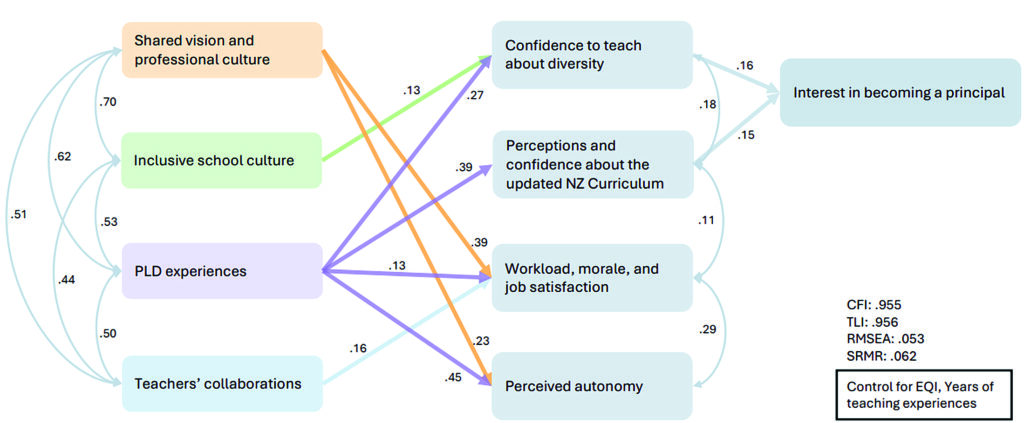
By exploring both school-level and teacher-level factors together, we found that interest in becoming a principal is likely to increase when teachers have stronger teaching confidence and more positive teaching beliefs.
Teachers’ confidence in teaching about diversity, alongside their positive beliefs in the updated New Zealand Curriculum, are two positive predictors of teachers’ principal aspirations. Meanwhile, school leadership practices are found to be important in shaping teachers’ professional beliefs and experiences.
Specifically, shared vision and professional culture are positively associated with teachers’ perceived autonomy, higher morale, greater job satisfaction, and more manageable workloads – which is also predicted by strong teacher collaboration within schools. On top of this, an inclusive school culture positively predicts teachers’ confidence in teaching about diversity and positive PLD experiences contribute to all teacher-level factors explored in this study.
This doesn’t mean every single one of the above factors directly influences leadership aspirations; rather, they work collectively and contribute to the development and sustainability of those aspirations. In other words, factors such as teachers’ sense of autonomy or positive workplace experiences may not directly link to wanting to be a principal – but because they do contribute to teachers’ confidence and beliefs, they’re an important part of the wider system influencing leadership aspirations.
What does this mean for future (and current) school leaders?
There is a complex professional ecosystem, involving school-level leadership practices, individual beliefs, and professional experiences that shape teachers’ aspirations to become future leaders.
Building leadership aspirations in teachers doesn’t just mean adjusting workload or increasing their autonomy. It requires fostering professional confidence and building teachers’ positive beliefs in the curriculum. School leaders can create environments to support teachers’ professional confidence and belief in curriculum by:
-
promoting inclusive cultures
-
establishing a shared professional vision
-
allowing meaningful professional learning and collaboration.
By prioritising these conditions, schools can create an environment that inspires leadership aspirations and actively supports the development of the next generation of school leaders.
Author: About the authors
This article was adapted by the NZCER from their 2025 publication Aspirations for principalship – The role of school culture and teaching beliefs by Mengnan Li, Jessie Dong, and Jo MacDonald. The full research paper can be found here: www.nzcer.org.nz/research/publications/aspirations-principalship-role-school-culture-and-teaching-beliefs