
Recently the NZPF national office appointed a young, new staff member. In preparing for the interviews, we drew up a list of personal characteristics to look for in selecting the best candidate. This included having the confidence to push boundaries, a sense of humour, good communication and time management skills, being a problem solver, having self-discipline, the mental toughness to finish a task, responsibility, respectfulness, being a team player, having a sense of service, compassion for others, open-mindedness, being a motivated learner, and possessing leadership. In other words, we were looking for a Duke of Edinburgh’s Hillary Award candidate!
The Duke of Edinburgh, HRH Prince Philip, established the Award which has been offered for over sixty years in New Zealand, and is intended to ‘challenge young people to dream big and discover their potential.’ It is open to young people aged between 14 and 24 years and is run through school programmes, community groups such as the Girl Guides, Cadets, and Scouts New Zealand.
There are five discrete sections to complete to achieve the Gold Award. The first of these is volunteering. Candidates are challenged to give back, through service to their communities. Young people learn all about helping people, the community, the environment, or animals. The 2023 recipients covered many different volunteering activities from working in animal shelters, helping Department of Conservation staff with pest eradication, repairing walking tracks, volunteering in soup kitchens for the homeless, or working in a charity shop, visiting residential care facilities, keeping company with the elderly or entertaining them. For many, these were settings in which they had no previous experience.
Physicality is the next requirement and sustained weekly activities are in order. Candidates might pursue a sport, gym or dance class, or they might plan out a walking or running routine. Of the 2023 graduates, all these activities were covered with some including swimming, rowing, and cycling.
The third section is about skill development. Recipients wrote about their development or continuation of speech, drama, photography, singing and dance skills. Some took up blogging, others gardening including plant and vegetable growing. Dressmaking and drawing attracted a few and First Aid courses and learning about emergency services became a passion for others.
All Duke of Edinburgh Award candidates complete an expedition, the fourth section of the Award requirements. This may be a tramping adventure, canoeing, kayaking, cycling, horse riding or sailing. It may involve more than one of these activities. The Duke of Edinburgh Award organization provides leaders who are also responsible for training candidates. There are specialist trainers for different activities and candidates undergo training with their instructors before commencing the expedition of their choice. The 2023 candidates described the expedition section as the most challenging but also the most rewarding. They listed countless skills and personal attributes they either acquired or honed, while completing their expedition. Many spoke of persistence, growing self-confidence, of problem solving, resilience and the value of disciplined effort. They challenged themselves to adventurous journeys, tramping through the Abel Tasman National Park, tenting, rock-climbing, white-water rafting, horse riding and climbing on Mt Ruapehu. For many, these were new activities. As Gregory Whitiskie wrote, ‘It has given me the self-confidence to try new things and take opportunities when they are given to me.’
Finally, to qualify for the Gold Award, candidates must complete a week-long residential experience. The point of the residential experience is for the candidates to leave their comfort zone and go to a new place to meet, live and work with new people as a group. They work with these same new people throughout the week and socialize with them in the evenings. Developing social skills by interacting with people they don’t know, in a setting that is new to them, is an important point of this exercise. Candidates may be doing charitable work, indoor or outdoor work. This year’s Gold Award winners reported that the residential experience was an excellent way to establish new friendships and working relationships. Several said the friendships they made have continued and many said that interacting with people from different cultures, different areas of society and with different interests, broadened their own minds and made them more reflective.
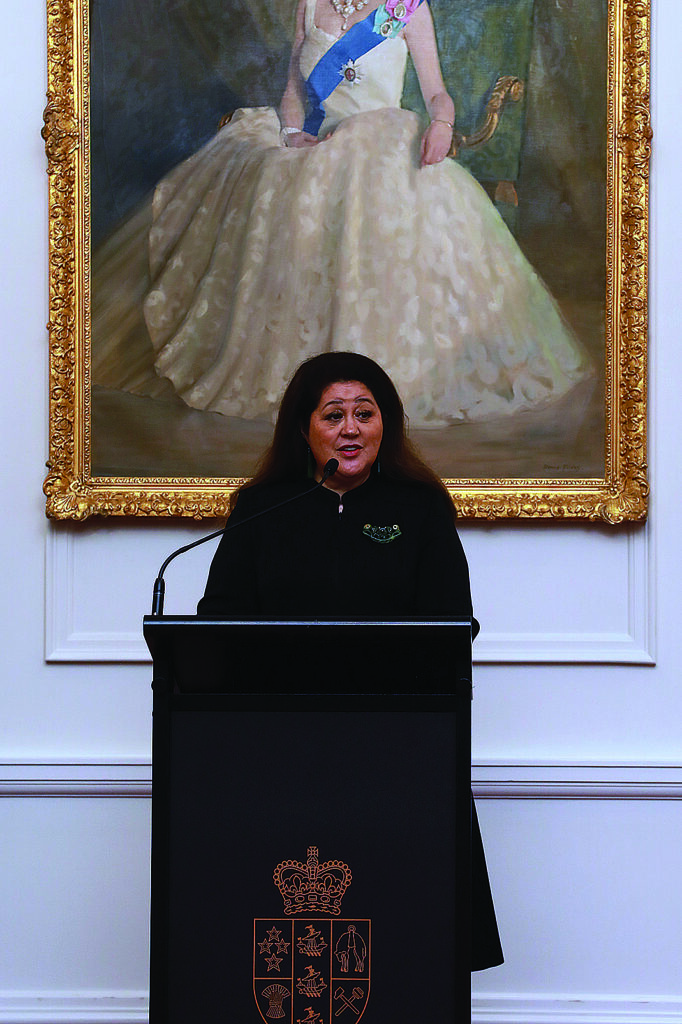
It was a privilege to join NZPF President, Leanne Otene, and celebrate the outstanding achievements of 43 young New Zealanders, as they received their Duke of Edinburgh Gold Awards from the Governor General, Dame Cindy Kiro, at Government House this year.
Hope Anderson-Gardner spoke on behalf of all the recipients, and showing her respect and value for the culture of Aotearoa New Zealand, introduced herself to the appreciative audience, by delivering her pepeha in te reo Māori.
She thanked the Governor General, Dame Cindy Kiro, and her husband, His Excellency Dr Richard Davies, for hosting the Awards ceremony and welcoming the recipients and their families into their home – Government House.
She noted that the path to the Gold Award was challenging especially through the Covid years and lockdowns. At the same time, she acknowledged that recipients all felt proud that they had committed to completing the Gold Award which had been a rewarding experience teaching them all a new level of resilience.
She said they had all learned to set goals for the year in completing the Bronze, Silver and Gold levels of the Award. For most, the goals were set with their dedicated Award leaders at school. For herself, she said, completing the physical tramping challenge for the Silver Award was the most testing and there were moments when she wondered if she would make it home! ‘My toenails were badly affected,’ she said, ‘which was not so good when I returned to ballet classes.’
She then paid tribute to the host of volunteers and trainers who supported the recipients on their journey to reach the prized Gold Award. ‘For us to complete this Award has taken a village,’ she said. ‘On behalf of us all, I thank all those who mentored and supported us and led us through this incredible journey.’
She concluded her heartfelt address with a whakataukī.
He waka eke noa We do not achieve alone, but as a collective.
Dame Cindy Kiro had the final word, acknowledging the attainments of all the recipients of the Gold Award. She reported that with the passing of the Duke of Edinburgh, HRH Prince Philip, his son HRH Prince Edward would now take the title of the Duke of Edinburgh and become patron of the Award scheme. ‘Prince Edward completed his own Gold Award in 1986,’ she said, ‘and is proud to see the high participation levels in New Zealand. A further connection with the Prince is that he completed his own gap year in 1982, as a Junior Master at Whanganui Collegiate School here in New Zealand,’ she explained.
Dame Cindy reported that the Duke of Edinburgh Award scheme was established in New Zealand in 1963 and the first Gold Award was presented [to Michael Menzies of the New Plymouth Scouts] in 1964. [The first young New Zealand woman to receive hers was Margaret McHugh of the North Dunedin Land Rangers, in 1965]. Since then a quarter of a million young New Zealanders have participated in the scheme.
‘All of these young people test themselves and become future leaders for good in our communities,’ she said.
‘Like Prince Edward, the Award experience spans generations and the basic principles of the Award still resonate. Like kaitiakitanga, these principles are preserved for future generations. Like manaakitanga, participants engage in the service of people, volunteering to give mana to others, to support and care for them.’
‘The Duke and later Sir Edmond Hillary, provided legacies that live on in this Award – to achieve what they never thought possible, through motivation, resilience and confidence. These qualities leave you well placed to make your mark on the world,’ she said.
She noted that participants in the Award are not alone, thanks to the Award leaders, volunteers, parents and friends who support them. She extended her thanks to them all for making it possible for so many young people to meet the challenges of the Award.
Dame Cindy’s final words were addressed directly to the recipients, ‘Keep hold of the knowledge you have achieved, live your lives in the loving service of others and care for the natural world you live in.’
As the Award programme states, by creating opportunities for rangatahi to discover or develop a skill, get physically active, give back to their communities, and take part in an adventure, young people are challenged to leave their comfort zones. Participants build self-confidence and greater resilience, helping to set them up for success in today’s uncertain world, where they face more challenges than ever.
The next time I am in a position to help choose a new staff member, I will be adding Duke of Edinburgh’s Hillary Award recipient to the list of candidate characteristics.