
With its fervent drive to address inequities for principals, the NZPF national executive is acutely aware that principals in some areas of the country feel their voice is not heard. They say specialist resources don’t reach them, no one is advocating for them, and their unique circumstances are not recognised. One of those areas is the West Coast of the South Island.
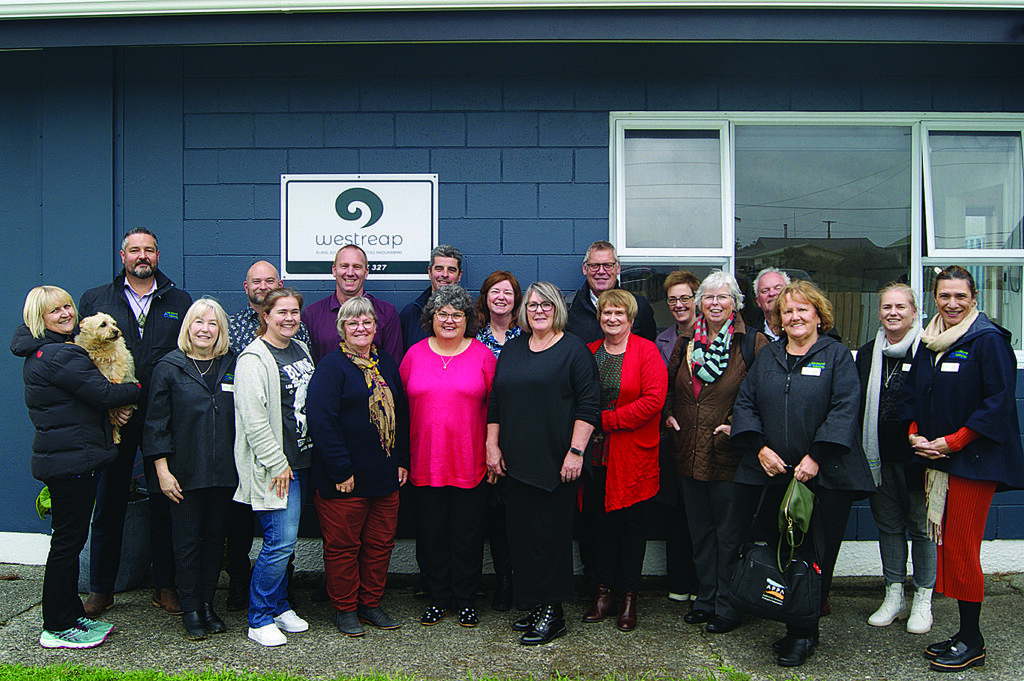
In response, a group of NZPF executive members, led by president Leanne Otene, travelled to Hokitika to meet up with principals from the Buller Principals’ Association and the West Coast Principals’ Association. They came to listen to their stories, to understand their context and to act on their suggestions.
The remoteness of the West Coast became quickly apparent as the group travelled from Hokitika, through the breathtaking West Coast landscape, to Westport, the venue for the first meeting. For those who had never visited the West Coast, the trip was a revelation.
They drove the winding, spectacular Coast Road through the Paparoa National Park and from the windows of their nine-seater van, were mesmerised by the steep landscape, lush vegetation, and wild exposed coastline. They passed the famous Punakaiki Pancake rocks and blowholes [vowing to visit them on the way home], and were awestruck by the dense forest, bursting with miro, rimu, kahikatea, matai, totara, tree ferns, vines, and ground ferns all spiked with glades of impossibly exquisite nikau palms. The nikau is New Zealand’s only native palm and the world’s southernmost naturally growing palm.
Leah Marris, principal of St. Canice’s School in Westport hosted the visitors. She opened the meeting, noting it had been a tough gig since 2020 when Covid-19 arrived on our shores. ‘Our local principals’ association has been amazingly supportive,’ she said, ‘keeping us together and helping us cope, because it’s been really hard.’
With the introductions over, the group got down to sharing their experiences as principals of schools in the small, remote Buller community. Six local principals had gathered, mostly from Westport, Granity, and Reefton. Hearing the stories of these principals first hand was both affecting and informative and certainly useful.
Craig, from Westport South School concurred, times had been tough, especially since he was a beginning principal. ‘I went to South School as a child and taught here for several years and this year my eldest child started school here,’ he said proudly. He went on to say that there is much poverty in Westport now, of which even he wasn’t aware. ‘The community hasn’t fully recovered from the 2021 flood,’ he said. ‘Add Covid to that and you can see why we have a disengagement problem and some negative behaviour creeping in.’ For all that, Craig said he still felt privileged to be leading the South School and like Leah, acknowledged the great support from the Buller Association and his great team at school. ‘We all trust and support each other,’ he said.
Wayne, principal of Sacred Heart School in Reefton said that despite the risk of moving, he was lured to Reefton from his Paraparaumu Beach school, by his wife’s family who were from Reefton. ‘Four years later we are still here,’ he laughed. He reported being amazed at the drop in curriculum funding for his 30 students, after what he was used to in a school of close to 600 students. He agreed with his local colleagues that Covid had taken a toll and the last two terms had been especially trying, but in his optimistic way said, ‘The good days still outdo the bad days.’
Executive members expressed empathy, particularly those who had experienced the Christchurch earthquakes, and understood the devastating effects of natural disasters. They also shared the importance of collegial support and congratulated the West Coast principals on their strong bonds and support of each other.
But if they thought that was the end of natural disaster stories, they were wrong. Gemma, principal of Granity school, had another version. ‘Coastal erosion is really bad for us,’ she said. ‘We’ve had rocks in the playground from sea surges, so nature is a serious issue.’ Gemma is confident that the new sea wall will contain further sea surges, but ‘managed retreat’ is still not off the table. ‘The problem is, there is no alternative site. We have the sea, then the hills. We have nowhere to go.’ She reported that quite a few houses in Granity had also been affected by the surges. Despite this, her school roll was climbing. ‘We were expecting 18 but by day four of this year, we had 24 and now the roll is 37.’
‘We are fortunate,’ she said, ‘to have excellent staff, including a second year beginning teacher, who make the best team, and we have a very experienced junior release teacher who is fabulous. I also have good principal release, so I am lucky,’ she said.
Cath O’Loughlin, experienced principal of Westport North school said poverty had grown very quickly in the town, as had transience and the number of methamphetamine addicts. ‘Getting learning support, psychologists, specialists, and therapists for children is frustrating because of our isolation. They travel from Christchurch,’ she said. She also raised the staffing problems that the West Coast faced. ‘Principals and teachers often use Westport as a stepping stone in their career and don’t stay long,’ she said. The reasons were many including isolation, and cost of living. ‘Housing may be cheaper, but power and petrol are expensive on the Coast,’ she said. There were also interminable problems in getting specialists in literacy, mathematics and science.
Further problems included that they are all feeling tired, time-poor and unsupported by the agencies that should be serving them. They feel neglected for being small, mostly U1 and U2 schools. Most were paid less than Deputy Principals in larger schools, or lead teachers in a Kāhui Ako – which none of the principals supported. PLD was virtually non-existent and teacher resilience was low. They dreamed of guidance counsellors, business managers, child mental health experts, extra release time and more staffing. The lack of a post-principalship career pathway on the Coast meant principals retiring were being lost to the profession when they still had more to offer.
They would love to be more focused on the Curriculum Refresh which has their full support, but little support from anywhere else and no time to think, reflect and work together on it. There were positive ideas about how to keep teachers longer by bonding them and giving them an isolation allowance, as secondary teachers get and they all had good relationships with their school Boards of Trustees, even if, as principals, they did all the Board work themselves. Some favoured ‘hubs’ which were a centrepiece of the Tomorrow’s Schools Review, so they could reduce their workload and pass property and other issues over to what might have been the ‘business unit’.
Sixteen principals had gathered in Greymouth and squeezed into the very compact Rural Education and Activities Programme (REAP) rooms where the West Coast Principals’ Association members reported similar issues as found in the Buller.
The RTLB also attended this meeting explaining that there were 14 RTLBs for the entire West Coast, serving 34 schools over a stretch of 500 kilometres. Teams were based in communities, she said, and they worked mostly with Kāhui Ako. Yet again, the implications of living in this very beautiful but isolated stretch of the country, became apparent.
Principals opened discussion by raising the issue of technology contributions. The question of the additional cost of hardware used by the students was raised. One principal reported that when asking parents to contribute to these costs, about 20 per cent responded positively. The West Coast is not an affluent area and any request to meet additional costs for education are likely to be met with inaction. The answer was for the schools to pull together and cover the costs as a collective.
Like the Buller principals, the West Coast principals were well connected, because they had little or no other support. With more schools and bigger schools, West Coast principals could achieve more, like the South Westland Schools Day for teacher and teacher aide training and the work of the Kāhui Ako.
One of the most affecting stories came from Donna, the principal of Fox Glacier school, who had driven 3 hours to join the meeting. ‘I am a sole charge principal with 18 students. I am my own caretaker. I do all the cleaning as well as all the principal duties and teach full time. If I get Covid, I close the school for a week. There is no one else. I can’t even call on a kind parent or a LAT (someone with a limited authority to teach) because everyone in Fox Glacier is already employed. I would love to have a break sometimes and leave staff to lead for a time, but I have no staff. To come to this meeting, I shut the school. I don’t even have ‘Teacher Only Days’ because that’s a conversation with myself. I am Secretary to the Board of Trustees as well as principal on the Board, but with all the other work, I really haven’t time for Board business. In no other industry in the country would this happen. Sole Charge Principals are so vulnerable. I live in the most picturesque part of the country, but I never see it. I go to school early and come home late.’
The conversation turned to safety and whether sole charge principals with not a single other staff member were safe. It was agreed that they were not and that all sole charge schools should be allocated at least one fulltime equivalent teacher. ‘No one comes to Fox Glacier for a 0.3 position,’ said Donna.
The executive members pledged to take the issues raised in both the Buller and the West Coast, to the decision makers in Wellington, and lobby officials until they got action. In the case of sole charge principals, across the country there are not many of them and the cost to the Ministry to provide each with at least one full time staff member would not break the bank. It’s not asking much, given the sacrifice and hard work going into educating the youngsters of one of the most isolated areas in the country.
The van trip back to Hokitika was quiet, punctuated only by a stop to take in the extraordinary pancake rocks and blowholes of Punakaiki. Back at the executive table in Wellington, rural issues debates now have a newfound substance, and real examples to guide the executive’s next stage of advocacy.