
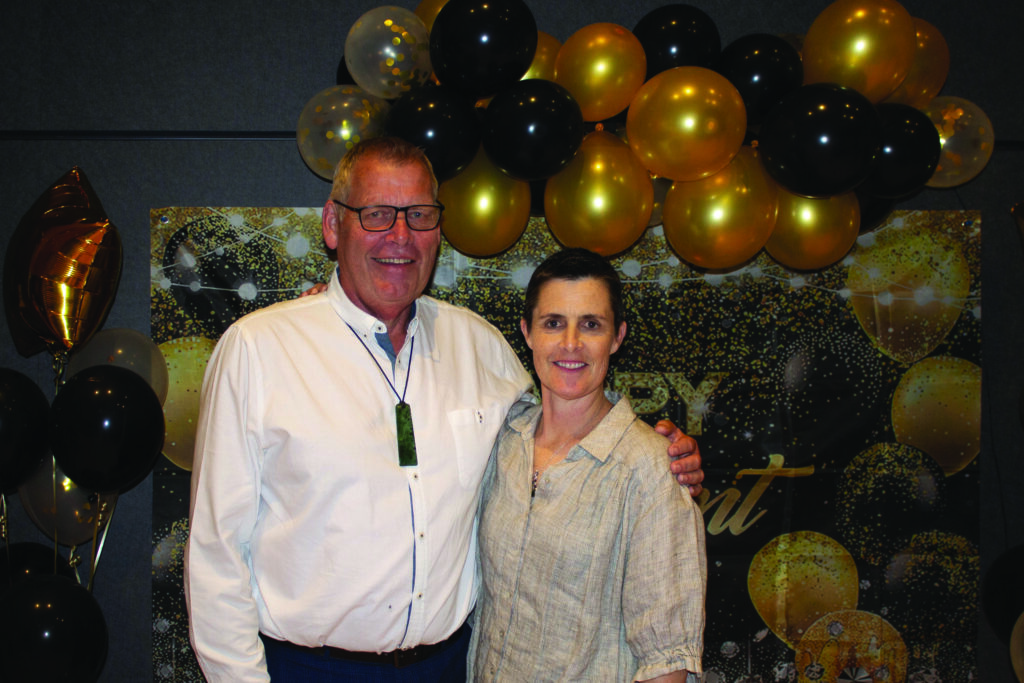
Principal retirement parties are jolly affairs that never disappoint. If you are invited to one, GO! You will come home well-nourished and mightily refreshed; you will learn about habits and practices of the retiree you would never have imagined and will be heartily entertained by the upbeat speeches – especially those delivered by children or grandchildren.
It is said that you know everything about the principal, if they’ve had a long career in a school, but you never do. It’s retirement parties that tell the whole truth. The guards drop, alcohol levels peak, and stories flow. I’d suggest, if you harbour dark secrets, don’t have a retirement party!
John Bangma, Principal, Mairehau Primary School
John Bangma harbours no dark secrets, but he and his well-wishers revealed a few ‘less-well-known’ characteristics of the big man. We learned, for example, he is a scrooge and thus a popular choice for treasurer of any and many committees, including his own Canterbury Primary Principals’ Association (CPPA), on which he served for many years. We were told his frugality is attributed to his Dutch heritage. Related to his presumably ‘indigenous’ talent with money, we also learned that teaching was not his first career choice. In his own words, ‘I worked in a bank for seven years, had a mortgage and a family, and then thought it was a good idea to go [teacher] training – Really?’ Indeed, what was he thinking?
We also learned that the publicly facing demure, sensible, level-headed, ever reasonable John Bangma, has an alternative personality akin to a mischief-making brat – the sort of kid you strategically place at the front of the room so you can intervene the moment he aims a paper dart at an unsuspecting classmate; or launches lolly missiles in the direction of his equally disruptive accomplices. We are told the mischief-making John emerges with greater energy, the more his boredom threshold is breached, however, ‘He can stir up chaos, just to keep everyone on their toes,’ said experienced Resource Teacher of Learning & Behaviour (RTLB), Michelle Maule. Given the abundant examples of ‘disruptive John’ on offer at the party, I would deduce that the ‘mischief-maker’ is more endemic to the John personality than being simply prompted by random moments of boredom.
John’s farewell party was skilfully managed by MC for the evening, Peter Simpson, a former principal and Canterbury stalwart, who also served his colleagues nationally as NZPF president in 2011. He launched the party with a message from Catherine Bates, a member of the recruitment panel who appointed John to lead Mairehau School. She later became the school’s Board Chair and said she greatly valued John’s insights and support. One of her abiding memories was observing John interacting with the children, ‘so he could learn every child’s name.’ John later said, ‘When I asked one boy his name, he said “Hamish – don’t forget that one!” I never have’, he told his appreciative audience.
NZPF President, Leanne Otene, was deeply upset that she was unable to attend the party in person. Her speech was delivered by her Executive Officer. She acknowledged John’s impressive career of thirty years in the principal’s chair saying, ‘He left an indelible mark on the educational landscape of Aotearoa.’ She then revealed the John Bangma, familiar to many on the NZPF national executive – the staunch learning support advocate, with zero tolerance for prevarication. Driven by his experience leading several schools, and his keen desire for every child to have the very best opportunity to succeed in education, John recognised that if we could just fix equity of learning and behaviour support provision, everything else would fall into place. During his seven years of service on the NZPF executive, he enthusiastically promoted the Positive Behaviour for Learning (PB4L) programme, an initiative of school principals and the Ministry, and hosted an RTLB cluster at his Christchurch school. He sat on many of the Ministry’s learning support working parties and task forces, and participated in several reviews, including the two-year-long Highest Needs Review.
He would report to the NZPF executive with a terrifying directness which might include words like stonewalling, evasion, fudging or even fibbing. Leanne described this as his ‘no-nonsense’ approach – such was his scorn for the torpidity of the process that, in his view, was not advancing the quality or quantity of learning support one jot. As the 2024 year tottered its way towards the Christmas break, the Minister of Education announced a further review of learning support. John’s response is not printable, but thankfully he will be spared the pain of another trip around the ever-increasing circles of learning support inertia.
Leanne acknowledged John’s dedication to tamariki, his staff, colleagues and community saying, ‘If an initiative was not tamariki centred, it was unlikely to get traction in John’s school.’ She also noted his deep human values and his special love for his family saying to them, ‘Thank you for sharing John with us. Your sacrifices have enabled him to make a positive difference to thousands of teachers and young people across the Canterbury region.’
These sentiments were reinforced by his current Deputy Principal, who added that John has a special talent for growing excellent school leadership and creating a culture of care. ‘He has made our school a welcoming and caring place, and there are many former Deputy Principals here tonight, who are now principals, thanks to John’s mentorship’ she said. She also referred to John’s outstanding crisis management throughout the earthquakes, mosque attacks and Covid pandemic. ‘Throughout these events he demonstrated calmness and applied findings of trauma research, including from Japan, which had a powerful impact’, she said. She reported that he was always true to his values and his vision for the school which ‘ . . . will help us face future challenges with confidence.’
Before he presented two certificates, recognising John’s retirement and service to education, Jason Miles, NZPF’s Vice President, had a few observations of his own. He told the audience he first met John at a CPPA meeting. ‘I was a new principal and turned up in my polo shirt, dress shorts and boat shoes’, he confessed. ‘The only other person in shorts and a cotton open-neck shirt was John, and he immediately gravitated my way to welcome me.’ As Jason later learned, ensuring everyone felt welcome at an event was a special talent of John’s which subsequent speakers also noted. The President of CPPA, Lisa Dillon-Roberts, emphasised John’s devotion to service. ‘John was always the first to volunteer to host a group of aspiring principals at his school, and was an excellent mentor and coach to many’, she said. ‘He has been a highly respected member of CPPA and was always ready to serve his Canterbury colleagues as much as his own staff’, she said.
Coral-Ann Childs, the Regional Director for the Ministry in Canterbury, described John as a ‘Shining Beacon for Tamariki.’ She admitted calling John on several occasions, outside of school hours, seeking his advice about children, with severe family complexities, who were in crisis. He was incredibly generous with his time. ‘His message was always loud and clear. He would say children are seen, heard and valued. That message was central to the way he interacted with all children’, she said. She added that John was never quiet about his own expectations of the Ministry, saying, ‘You always reminded us who we are here to serve – the children and their communities.’
John’s wife Paula was keen to acknowledge the many gathered to celebrate John’s career, and introduced us to the immediate family members, from John’s 94-year-old mother to their 11 grandchildren. She thanked John’s staff, especially those who had been so supportive during John’s health episode some years earlier, and said, ‘He will miss the camaraderie, but now he can enjoy the grandchildren!’
Next up were John’s eldest daughter, Monique, and representatives of the grandchildren. Monique told us her Dad’s holidays were spent marking and planning, ‘which scared us all off teaching – except the third sibling, Danielle, – but of course you can’t tell third kids anything!’ she said wryly.
Monique told us, she was taught by her Dad at Woodend School, ‘Which did have its down side.’
‘You could never get away with not doing your homework, or make up excuses like other kids could,’ she said. Monique also told us that no matter how he tried, her father could not teach her how to read an analogue clock. ‘Don’t worry about it Dad,’ she eventually said, ‘I got Mum to teach me.’ She said her father, a grammarian extraordinaire – and the only person known to edit the Editor of this very magazine – was very useful when they got to writing university essays. ‘We had our own personal grammar and spelling checker, which no doubt helped us get through’, she said.
‘He may be stepping down from this part of his life, but he’ll be spending more time with us and we will keep him very busy for many years to come – thanks Dad for that’, she quipped – as mischievously as if it was her own father speaking.
The grandchildren said everyone knows Papa and he knows everyone. They said ‘he’d tell stories about the horrendous kids at his school’, but I don’t think the audience or the grandchildren believed for one second that these stories were true! The grandchildren acknowledged that ‘that was the fun part of having Papa as a principal.’ And now they look forward to being forever spoiled by Papa.
John said he was humbled by the memories shared by many speakers and thanked those who had travelled long distances to join him on his special day. He said he was the third son of a family that emigrated from the Netherlands because ‘they [parents] wanted a better life for us than they had.’ Growing up in New Zealand, he said, ‘we were loved unconditionally, although we had little material possessions.’
He gave us a brief synopsis of his 40-year career, including the traumatic Christchurch earthquakes, the Mosque Attack, the Covid pandemic and his own health crisis. He extended heartfelt thanks to all who served as his teachers, Deputies (who made me look good!) and Board members. He said ‘you all ensured we had fun work environments, where we could laugh and sometimes be sad. You are all remarkable staff,’ he said. ‘It has been a great privilege to serve at this level.’ Special moments, he said, included receiving emails from past students. ‘I had an email from a student from 40 years ago to thank me for being his teacher’, he said proudly. ‘If we always seek to make a difference, the reward, when we achieve this, is immeasurable’, he said. ‘That makes us very privileged people.’
His final words were for his family. ‘Thanks to my amazing wife, Paula, my children and grandchildren, and my mother and late dad’, he said. “You have shown me love and support throughout my career, and I can never thank you enough.”
‘I’m not actually retiring’, he announced – to gasps of alarm. ‘I’m rewiring for a new adventure.’ Puzzled, the gathering clapped, shuffled to the bar for refills then off to witness the ‘retirement cake’ cutting ceremony.
Denise Torrey, Principal, Somerfield School
As is typical of principal retirement celebrations, there were loads of laughs at Denise Torrey’s party, and it didn’t take long for the merriment to erupt. Her MC, Craig McCarthny, who once worked for ‘Evaluation Associates’, formally opened the celebrations saying, ‘Denise and I met as young teachers and we instantly connected.’
‘Inappropriate!’ yelled a heckler from the floor – easily recognisable as retired Principal and former NZPF President, Philip Harding. The audience lost it, and formality was officially abandoned.
McCarthny did his best to recover and acknowledged Denise’s family in the room – husband, Ron, brother Chris and sister Jan, her School Board members and staff, CEOs and Presidents of various educational organisations, including the Ministry, Teaching Council, ERO, NZCER and Mana Ake, Denise’s own Community of Practice group, ‘Kahukura’, six former Presidents of CPPA and five former (and the current) Presidents of NZPF. It was an impressive line-up of education’s movers and shakers.
Denise, he said, spent 22 years as Principal at Somerfield school, ‘Whilst simultaneously holding many other leadership roles in sector organisations.’
He added that, ‘The school assembly this morning was a very special event and included a stunning new haka which had been created and performed in honour of Denise – as a surprise for her – such is the respect in which she is held.’
School Board Presiding Member, Stephanie Muller, said it was an honour and a privilege to celebrate Denise’s legacy.
‘Denise has always had a huge amount to give and her mantra has always been “to serve”’, she said.
‘It takes a village to raise a child’ is a sentiment close to Denise’s heart. Muller went on to explain how Denise made that sentiment real. At the school level, it was evident in the way she made every school decision ‘tamariki centred’ and beyond the school, she saw the importance of principals and teachers having abundant opportunities to collaborate, share best practice and learn from each other for the betterment of children’s learning collectively. This prompted her involvement in NZPF, CPPA and Kahukura, her local Community of Learning. She also envisaged the broader education system as the means to fund and resource initiatives that supported best learning practices. And so, the importance of building relationships with ERO, the Teaching Council, the Ministry, NZCER and all the other organisations that make up the system of education. Denise’s notion of ‘a village’ is a very broad church.
‘You have been inspirational, and served your school, your community and your wider community of colleagues with positive enthusiasm’, said Muller, ‘using your expertise and professionalism to raise the bar for everyone.’
It doesn’t matter what background you come from, you can thrive at Somerfield School and so many youngsters have fulfilled their dreams at the school. Muller said, Denise created a culture of caring, of kindness and helping, with one small child saying this morning, ‘Who is going to hug me now?’ Denise acknowledged at her school assembly that there were 500 reasons to come to work every day – the 500 students who were bouncing through the school gate.
‘Denise is highly respected within the school and in the community. She is trusted, devoted to standards of excellence and encourages collaboration in all she does’, said Muller. ‘Today our whole community came together with that sense of connection that you have fostered over many years’, she said. ‘And as you step into a new chapter of your life you leave our school in a much stronger place than you found it,’ she said.
‘We farewell you today, but your roots will be planted here at this kura forever’, she said.
Peter Simpson, a Canterbury colleague and former NZPF President gave further examples of Denise’s community spirit. He referred to the Pike River Mine tragedy on the West Coast and explained that one of the less obvious impacts of the tragedy was on teachers, children and schools. Denise set up a support network of Canterbury teachers and principals to go to the West Coast and relieve the teachers and leaders of affected schools, allowing them to grieve.
In the wake of the Christchurch earthquakes, Chris Harrison of the European School Heads Association (ESHA) invited Denise, Philip Harding and John Bangma to present at the ESHA 2012 Conference in Edinburgh, on what they learned from the Christchurch earthquakes and the role of schools in maintaining ‘normality’ for communities affected by a disaster.
He said Denise also led many other initiatives including the Professional Development of Middle Leaders, a much neglected group yet critical to sustaining strong school leadership. She also began a support group for Beginning Principals, affectionately known as the ‘Minties’, which was deeply appreciated.
Coral-Ann Childs, Regional Director for the Ministry in Canterbury, told a story to illustrate Denise’s style and commitment to equity.
There was a young boy enrolled at the school who presented with a number of challenging behaviours. The young boy said that she (Denise) walked me around a lot and one day, I drew a snake and she pinned it up on her wall. Coral-Ann said the boy spoke at the assembly for Denise that morning in front of the huge crowd which included his very proud Mum and whānau. He now can read and has made enormous progress in all other learning areas too.
In other words, there is no prescription for teaching children with complex needs, and Denise knew that. What she also knew was that building a relationship with a child comes first. If that meant walking him around the school, then that’s what she would do. The point is, Denise was determined that every child would have a fair go and she was determined to find out what worked best for each one of them.
Denise’s senior school team created a special report card for their retiring principal which comprised only descriptors beginning with the letter ‘E’. Her Deputy Principal, Nicky Horne, presented the report.
It began with Energy. Denise is well known for her insatiable energy which links well with her staunch positivity. She never tires of hard work, or dreaming up more good ideas. Her team said they have tried to take her batteries out, but without success!
Evidence is critical to Denise. If you want to make change and you want the budget to do it then you’d better have the evidence to show it’s a good idea. And if you need evidence to show Denise’s own commitment to the job, just turn up at school at 7am any week day – she’ll be there.
Excellence applies to both her own professional standards and that of the tamariki in her school. Winning a Woolf Fisher Scholarship to study leadership at Harvard University was a professional highlight and she later told us how overwhelmed she was, soaking up the history of Harvard University. Only the best is good enough for her children, and that includes the quality of teaching and resources they receive.
Expertise includes expanding her own knowledge and enhancing that of others. Gathering expertise has taken Denise to many countries of the world. There are other levels of expertise expected too, including Emergency Management. The staff are to be prepared for anything. ‘Fortunately for Denise, when disaster strikes, she is usually away. Like the time two new entrants experimented with the fire alarm which after two and a half hours, no one was able to turn off. Then it was the floods and all the children were sent out onto the field’, said the Deputy Principal. ‘Why is it always me dealing with these things?’ she mused aloud. ‘Next time Denise goes to Wellington she’ll probably organise the locusts! We do sometimes think she has extraordinary powers.’
Empathetic Denise makes sure no child ever misses out. Whether it’s food, a school uniform, money for camp or some other resource that she deems essential.
Entertaining Denise is hugely funny. She once dressed up as a Queen so I could be her attendant and we sailed off into assembly in full regalia. Following this special event some children believed that ‘Queen’s Birthday’ was Ms Torrey’s birthday. As the story spread, many principals across Canterbury started calling her ‘Queenie’, and the nickname stuck.
Equity has always been top of the pile for Denise. For example, when the Covid lockdown was announced, she immediately arranged for school laptops to be sent home with children who may not have access to technology at home.
Encouraging is a quality Denise lives constantly. You could come out of a school meeting with three new jobs and think, how did that happen?
Efficient and very hard working, Denise sometimes says, ‘I can sleep when I’m dead!’
Enthusiastic Denise borders on fanatical we are told. Once an idea for a project kicks in, the enthusiasm levels soar. Like the bike track, upgrading the interior of all classrooms so everyone gets a super environment to work in, and now she’s negotiating for the school roof to be replaced.
Ethical Denise is strongly bi-cultural and has an excellent understanding of what it means to be a Tiriti partner. Everyone knows this which is why 520 Somerfield students learned a new haka for her. They practised every time she was out of the school, to keep it secret from her.
Esteemed by her school staff and tamariki, her parent community and her regional and national colleagues. She is highly regarded by all who have worked with her. Naturally, Denise scored an Excellence grade for her life as Principal of Somerfield.
Denise’s husband, Ron acknowledged some special family members who were unable to attend the party, then introduced us to Erik Erikson’s Psychosocial stages of development. The fifth stage, he said, is identity versus confusion.
‘Denise has no problem with knowing who she is, and what she wants, and sometimes can also tell you what you want!’ he quipped.
He quickly moved on to the eighth stage which is integrity versus despair. This is where Denise is at right now,’ he said. ‘It is the stage of assessing and making sense of life, hopefully feeling fulfilled and content with the contributions made, and there are many contributions to contemplate as you have heard tonight. It is the stage of wisdom. Denise has that integrity,’ he said, ‘and if she ever did despair or be overwhelmed by fears, she knows there are people there for her.’ In other words, her future is assured.
‘We have together learned much from education and Denise has filled her kete over and over again’, he said, ‘and will no doubt keep doing that. That is balanced by the fact that we have received the sustenance of friendship from many of you here tonight and that too will continue into the future’, he said.
Ruminating on the teaching profession for a moment, he shared a well-known whakatauki, ‘Mā mua ka kite a muri, mā muri ka ora a mua’ which translates as:
‘Those who lead give sight to those who follow, those who follow give life to those who lead.’
It is a wonderfully insightful whakatauki demonstrating the essential, reciprocal relationship between teacher and learner. It is exactly the relationship required for successful learning to take place, and as a ‘Servant Leader’, Denise lived by this whakatauki.
He then quoted Jon Ronson, a journalist and film writer, who was once reported by the New York Times as saying, ‘Don’t go into something with ideology. Go into something with curiosity.’ In Ron’s view, this was also excellent advice for any teacher, and very much the way his wife operated.
The last words were from Denise herself. She took us on a whirlwind tour of her career, much of which was already covered by other speakers, but there were a few interesting additions, such as the battle with the Ministry to take Year 1 and 2 children on a camp. And then another Ministerial battle after the earthquake when the Minister thought it was OK to open schools that had no running water. At the same time, the Minister was making up her list of schools that would be closing. Inevitably, that announcement did not go down too well. Denise was unafraid to defend decisions she knew to be the right thing to do whether that was confronting a parent, teacher or indeed, the Minister.
She talked of the Communities of Learning which emerged in 2013 as Communities of Schools. These have since morphed into Kāhui Ako and in Denise’s view are one of the greatest inequities in the system. Leaders of Kāhui Ako and lead teachers are well paid and the Kāhui Ako well resourced, whilst no other learning collectives get close to the same resource. Denise would know. She helped establish her own local community of learning, Kahukura without the Kāhui Ako resource.
She was scathing of the politicisation of education, the divisive politics of charter schools and the Treaty Principles Bill before parliament. In her view these things represented a waste of millions of dollars which could do so much good to strengthen our public education system.
But to balance things out there were also the laughs, like the time the Kahukura learning group took a cultural education tour of Rotorua. They booked into the hotel, whereupon the gates were locked. The only way out to have a quiet ‘bonding’ drink was to heave each other over the locked gates and do the same on their return . . . presumably with a great deal more difficulty.
She gave a big shout out to the organisers of the Mana Ake programme promoting wellbeing and positive mental health to children in Christchurch post-earthquake, and now operating in other areas of the country, such as Te Tai Tokerau. Denise had been instrumental in getting the Mane Ake programme up and running.
She concluded with a roll call of thank you’s to staff, board members, colleagues, supportive friends, and family.
‘I will carry memories of Somerfield School forever and thank you to all the staff over my 22 years for making Somerfield School unforgettable’, she said.
Leanne Otene concludes the retirement stories with the following whakatauki:
Kua eke koe ki te taumata o tō mahi, ā, ināianei ka whai wā koe ki te okioki me te koa i ngā hua o tōu whakapau kaha.
You have reached the pinnacle of your work, and now you can rest and enjoy the fruits of your dedication.