
Lemonwood Grove School arises from a massive housing boom in the Christchurch suburb of Rolleston. Opening in 2017, with a roll of 59 students, the school now welcomes 1,000 students a day and expectations are for further growth on the ten-acre site.
Although Rolleston is located close to the epicentre of the 2010 Christchurch earthquake, it suffered minimal damage due to the stable rock on which it was built. Consequently, post-earthquakes, displaced residents from central and eastern suburbs found tranquility and peace relocating to the outer suburb, south of the city. Housing growth continues and has now spread to nearby Lincoln and Prebbleton. The more recent housing boom is less to do with the earthquakes and more to do with the cost of housing in the city and growth in the Christchurch population. Christchurch has become a popular choice as cities go, and now easily rates as the second largest city in the country.
Lemonwood Grove is a school of diverse needs, according to Blair – the founding Principal – and therefore needs a clear strategic focus underpinned by an equally clear vision. All staff at Lemonwood Grove School are called by their Christian names, including the principal.
‘The best of you, as you’ is a vision to which every student can realistically aspire. This vision is overlaid with a set of guiding principles or values. These are Grit, Responsibility, Integrity and Thinking. And if that all sounds very serious, Blair is insistent that learning must be fun and enjoyable. This is, in part, achieved through education outside of the classroom (EOTC), making good use of the expansive fields, sports facilities and outdoor play areas.
The framework driving the school’s curriculum is based on a simple mental model which explains the purpose of schooling – the why, what the school does and how it does it. Six curriculum principles are woven into the mix alongside some of the rich cultural history of the area.
The name Te Uru Tarata was gifted to the school by the local rūnanga Taumutu. Tarata is the lemonwood tree – a large variety of pittosporum. It can grow to 13 metres in height and is common to the area. It has lemon scented flowers and leaves and is a beautiful plant that attracts birds and bees. For tangata Māori, the tree has multiple uses.
With a school of this size, Blair needs all the leadership support he can muster and that includes leadership which springs from the students themselves. Lemonwood Grove School encourages student leadership aspirations and invites Year 7 and 8 students to apply for a leadership position. They must outline why they should be chosen as a leader, what qualities they would bring, why they would be a good leader and what they would want to change.
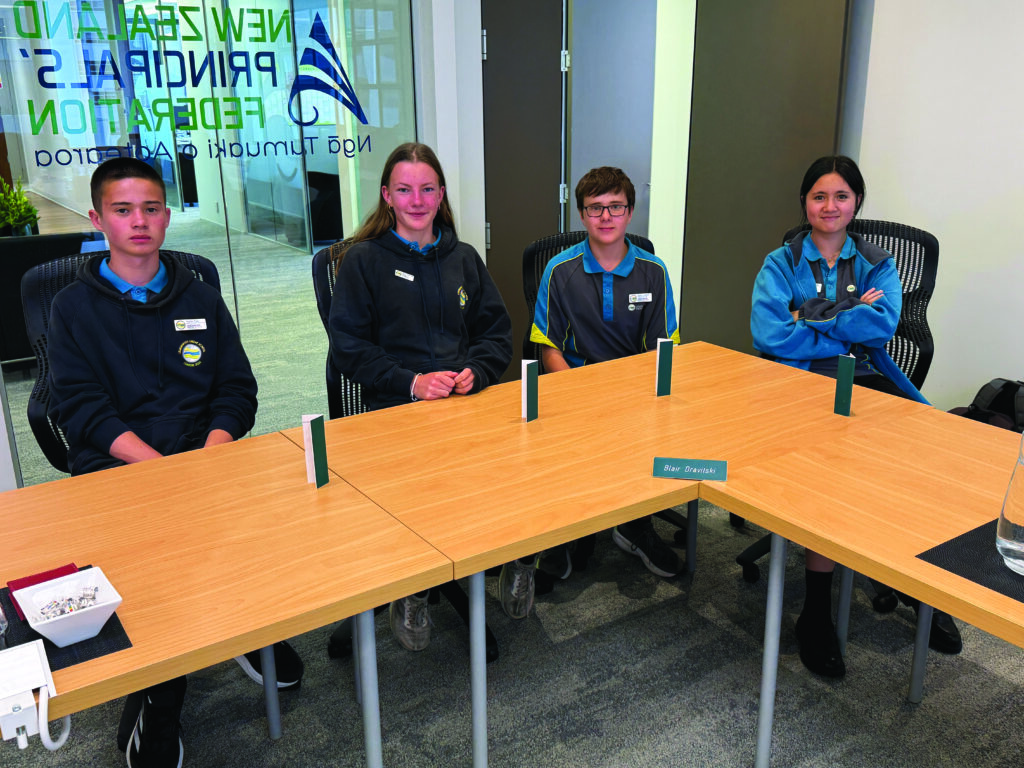
Applications are sent to Deputy Principal Troy. Troy chooses the top 10 to be interviewed. There are four student leaders each year, two head student leaders and two deputy head student leaders. The leaders for 2024, Flynn (Head student), Elodie (Head student), Kaedence (Deputy Head student) and Hunter (Deputy Head student) made the journey, in December, to visit Wellington, the capital city and centre of parliament, centre of the country and centre of NZPF.
Before visiting the corridors of power at the Beehive, they stopped off to have a chat with NZPF President, Leanne Otene. She engaged them in a brief leadership kōrero then asked them why they were chosen for their positions.
Hunter answered, ‘I was chosen because I am responsible, well known and I get on well with the kids.’ He said he was a Year 7 student and part of the role was to be the ‘face’ of the school. He explained that each term the school holds a mihi whakatau to greet the parents and the kapa haka team performs. New students are welcomed. That is an expression of the school’s culture.
Kaedence said she does kapa haka and helps the young ones coming through. She’s confident, hardworking and was chosen because teachers and students backed her. ‘I think there were teachers advocating for me,’ she said.
Flynn, a foundation student of the school, was reluctant to talk about himself, so instead talked about the Olympics. ‘It’s hard to have one full assembly at our school when we’ve got 1,000 kids, so all four of us, as leaders, became hosts for the Olympics.’
‘Each class took a country’s name and chose field events to compete in each day. Points were awarded to the winners and it was very close at the end, so Blair had to announce the overall winning class/country.’
Flynn also explained the leaders’ involvement in ‘House’ activities during which they help organise colouring competitions which run over four weeks.
Elodie, a Year 8 student, said as a leader you are expected to speak in front of everyone at events and she explained that she and Flynn are the MCs for the Year 8 students’ assembly on Mondays. Further duties include helping to run ‘Grandparents’ Day, greeting the grandparents as they arrived and looking after them. ‘It’s all part of our culture of caring for our visitors,’ she said.
Kaedence talked about her involvement in the NZ AIMS (New Zealand Intermediate and Middle Schools) Games which involve three days of sports competition. Between them, Kaedence and Hunter have badges for volleyball, football, rugby and netball. They love the inter-school competition which draws students from all over the South Island. ‘The Christchurch competitions are quite different,’ she said. ‘Usually the private schools win those!’
Kaedence also helped with the lighting for the Junior production which ‘ . . . included every junior student in the school,’ she said. She has a passion for the arts and sings in the school choir.
School leaders are also responsible for allocating awards for students who demonstrate the school values of grit, responsibility, integrity and thinking. ‘Every two weeks there is an assembly or hui for Years 7 and 8’, explained Hunter, ‘and that is when awards are given out.’
Leaders are also involved in voluntary organisations such as the scouts or are learning outdoor or electronic skills, volunteering as marshalls for events, participating in telethons or other fundraising and taking on social responsibilities.
Within the schools they organise road patrols and act as house Leaders. Elodie said, ‘We take responsibility for the little ones too, when we have free time, and just hang out with them or help them organise their games,’ she said.
Leanne asked them how they would react if they came across a negative situation, for example, name calling in a sports game. Hunter said ‘I would say to them, sort it out! This is school football. It’s not that serious.’
Flynn was more circumspect and said it depended on the situation. If someone was already dealing with it then best to keep out or suggest they talk about it.
Elodie said if kids are mucking around when they are supposed to be cleaning up it’s best to tell a teacher rather than get involved because you could make it worse. Kaedence agreed. Calling a teacher was the best option.
Troy said all four leaders have been taking groups on tours of the school. This is an expression of kaitiakitanga and manaakitanga which are also linked to their roles. ‘They are brilliant ambassadors for our school,’ he said.
‘They all have different strengths in different areas,’ he said. ‘Kaedence is strong in the Arts and in sport like netball, the Cross Country and athletics. Flynn stands up for those around him and is diligent. Hunter had an impact the moment he arrived at our school. He was always available, always responded and has the ability to make time for extras, whilst still prioritising his own work.’
The session concluded with the school leaders asking questions of Leanne:
Q: What makes a leader?
A: As a leader, I always follow a mantra of Listen, Learn and Act. It is important to hear what people are saying to you, to think about that and learn from what they are saying and then to take action. I was probably beginning to do that long before I was a leader.
Q: Why did you choose to become a teacher?
A: I was the one in my family who loved kids and always helped the little ones – much like you do. When I became a teacher, I always looked at the kids as if they were my own. Your parents want the best for you and I would give you that.
Q: What is your favourite memory of being a principal?
A: My best memories are always with the kids. School camps and sports events are my favourite times to get to know kids better. I love the informality of EOTC. Relationships are important and the less formal setting makes it easier to build those relationships.
Q: Have you ever had a job outside of education?
A: No! I think I would struggle finding a different job that I liked, because I love being a teacher. Perhaps I was born to be a teacher.
Q: What single thing would you want to change about your job?
A: Principals and teachers are experts in teaching and sometimes we don’t have enough resources, money, books or special help for kids who need it. I’d like to be able to change that!
The last question came from Leanne to the kids.
Q: What is Blair like as a Leader?
A: Blair is lots of fun. He’s great at relationships and is an excellent role model as a leader!