
This year the conference theme – Tākina Te Hau – was all about the winds of change. Just as the Wellington winds can envelop us with calmness, batter us moodily, or just flow over us, in the education sector we can experience the same emotions.
It was the first time an NZPF conference had been hosted at the new Tākina Events Centre in Wellington. The name Tākina, meaning engagement, was gifted to the Events Centre by the local Te Āti Awa iwi. As they explained, when you come to this place you bring your whole history with you to share conversations and ideas and learn together from each other.
The venue did not disappoint. Being located close to the waterfront and Te Papa National Museum meant delegates had plenty of opportunities to go sightseeing or shop in the nearby central city fashion stores.
Those attending were warmly welcomed by the local iwi, with a pōwhiri, staged at Te Papa. It was a moving event, held at the museum’s Rongomaraeroa Marae, and a very special experience for our international visitors.
After a lively introduction from MC, Jehan Casinader who is no stranger to NZPF events, Marcus Winter aka ‘The Sandman’ took the stage.
Marcus Winter
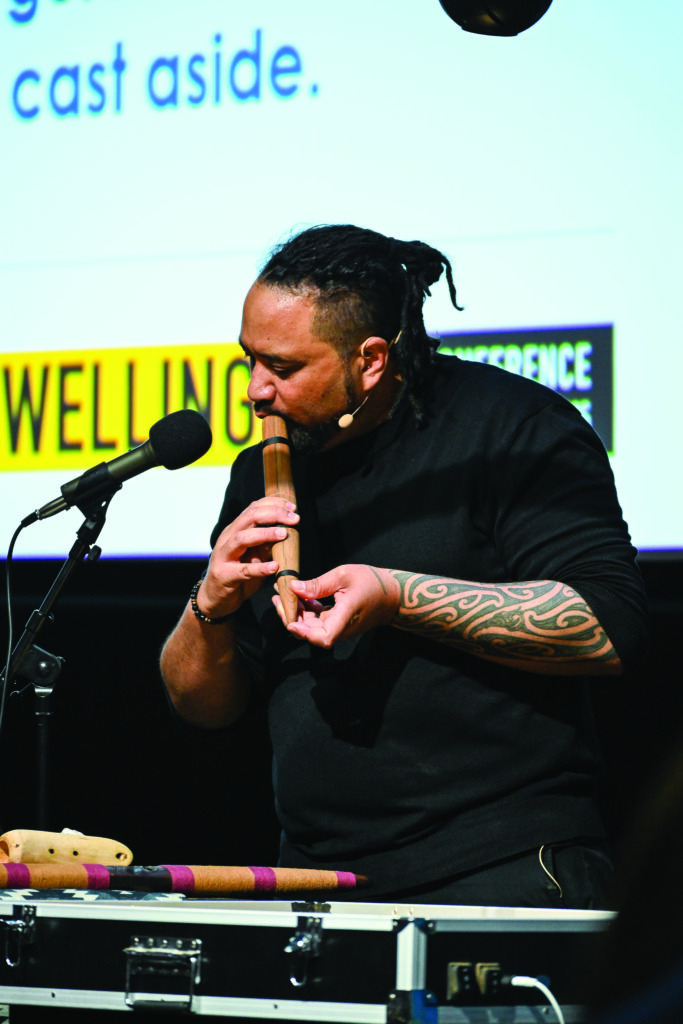
Marcus Winter is a highly talented ‘sand artist’ who tells stories through his art, which are inspired by his indigenous Māori culture. He began with the ‘creation story’ of Ranginui, the Sky Father and the Earth Mother Papatūānuku. As he narrated the story, he simultaneously created it in sand art form, which was projected onto big screens for his audience to see. It was a hypnotising experience for the school principals who watched in awe of his performance.
He also incorporated the four winds into a metaphor for the present turbulence in education which resonated well with the theme of the conference. He captured the nature of the winds of Wellington which, as he explained, can vary from angry to gentle, by weaving them together through his traditional musical instruments, creating a haunting atmosphere evocative of the feeling we experience when those winds whistle about the tall buildings of Wellington city.
It was a beautiful metaphor, relating to the state of transformation and shifting shape of education, just like the Wellington winds. His infectious humour infused his performance, and left his audience feeling optimistic, and eager to embrace the turbulence ahead with renewed energy.
President, Leanne Otene
Leanne Otene gave a quick ‘round up’ of NZPF’s achievements, especially wins, like the $32 million investment in leadership, including doubling the number of Principal Leadership Advisors, and the heavy focus on additional investment in learning support, for which NZPF has been vigorously advocating. She noted the pace of change had not relented for structured literacy and mathematics, but a reprieve which pushes out the date for introducing the refreshed curriculum was pleasing.
The main topic of her address was ‘The Purpose of Education’. She adopted Gert Bieste’s thesis that the purpose of education is threefold. It is about qualifications, sociability and subjectification. These three, she argued, are equally important and should each take a third of our time – and our school timetables should reflect that.
The basics of the curriculum are also important, she said. Qualifications lead to knowledge gains and skills to function effectively in society and the workplace. Outcomes can – and usually are – measured as test results or formal qualifications.
Just as important, she said, are social skills, like cultural values and norms that enable us to participate in and live together in society. We want our young people to have a strong sense of fairness and justice; be collaborative team players; contribute to developing and growing our society; understand and participate democratically; and have empathy for others. We want to foster in young people a sense of giving back, being inclusive, tolerant, and embracing of others, and being culturally aware citizens – who enact our founding document Te Tiriti o Waitangi – and embrace our multi-cultural society.
The third ‘pillar’ she described as subjectification or developing as an autonomous human being responsible for our own life actions. We want our young people to make good decisions for themselves and to understand that, with the freedom to make choices, comes responsibility for both ourselves, for others, and for our planet.
When professionals focus on these three domains, educators can move beyond narrow performance metrics to engage with deeper, value-driven goals that foster genuine human development and autonomous, empathetic, thoughtful citizens, she said.
Our young people must therefore go out into the world well armed with critical thinking, problem solving, creativity and strong communication skills. With the introduction of AI we can immediately see that the unprepared will be vulnerable and exploited if we don’t educate them for it now, she said.
Otene announced that she will be returning to her school in Whangārei next year after three years leading NZPF. She thanked the NZPF membership, her executive group, sector partners and Ministry staff and her family for being her unfailing support throughout her three year journey as President.
Gold Business Partner, Furnware, Celebrates 30 Years with NZPF
Furnware was first opened in 1934 as an educational furniture manufacturer based in Hastings. Ninety years later, it still is. Furnware designers built strong relationships with teachers and schools, and conducted large-scale research in the early 2000s which showed that the existing furniture did not fit the children correctly. Consequently the design was changed and the company developed its signature ergonomic furniture including the Bodyfurn chair. Mobile tables and soft furnishings have followed along with modular storage and now furniture designed to accommodate our neurodiverse children.
NZPF is proud to partner with the Furnware business, whose vision is to provide the best environment for children to learn and grow. We congratulate Furnware and look forward to continuing our relationship into the future.
NZPF Celebrates New Life Member
Denise Torrey, famous for her ‘servant style’ leadership was honoured with the NZPF Life Membership Award at conference this year. Denise was recognised not just for her outstanding school leadership but for service to her Canterbury colleagues and community through both the Christchurch earthquakes and the Pike River mining disaster. She was also praised for establishing the Kahukura PLD Collaboration for Canterbury principals and, as NZPF President, for advocating for and achieving the appointment of the first Principal Leadership Advisor, which later became 22 Principal Leadership Advisors across the country and will shortly double in number again.
Service with Distinction Award was granted to Iain Taylor, Principal of Manurewa Intermediate School. Iain has a long career in principalship and along the way has achieved many milestones including a Woolf Fisher Scholarship, and the Prime Minister’s Excellence in Education Award for outstanding teaching leadership and innovation. He has also published his own book on his leadership journey, sharing the gems of wisdom he has learned along the way.
Gihan Perera
Gihan Perera’s observations and analysis of AI and what it means for ‘future ready’ leaders was inspiring. It was especially interesting that he presented a context for AI discussion based on global demographics to show us that people power has shifted to Asia with China, India and Indonesia now dominating the world’s population; Facebook has a following of three billion people; and the combined population of the G7 countries reaches just 550 million. In other words the USA and Europe are now far from the seat of people power and Facebook followers alone are a bigger number than the two most populous countries of the world.
The audience was also alerted to the principles of a framework for AI, which, as he noted, Australia has now implemented. These six principles include teaching and learning, human and social, transparency, fairness, accountability and privacy, security and safety. They form an excellent framework for schools to adopt, in this new technological environment, he said.
Perera also drew attention to Howard Gardner’s Five Minds for the Future, which remind us that with the entry of AI, the place of creativity and critical thinking has just been elevated. Gardener describes the five minds as a disciplined mindset, being a connector, being creative, being respectful and thinking of others, and being ethical. As we move into the AI era, he said, principals must balance the benefits of AI with these ethical and human considerations, remembering that AI is a tool to serve people.
Jehan Casinader
Not only was Jehan Casinader our MC for the conference, this year he was also a Keynote speaker.
He gave us an insightful presentation on some of his assignments as a reporter, including the 2014 Lindt Cafe siege in Martin Place, Sydney, to demonstrate how our news media focus more heavily on negative than positive news. As he so graphically expressed it, ‘If it bleeds, it leads’, is the journalistic mantra, yet feeding out negative stories only creates a warped model, which exaggerates threats.
He told us through many examples, how our stories become our reality and influence the way we behave – a potent message for all principals who are the lead storytellers for their schools and communities. He also noted how, with social media and online news sites, we are over-informed but under-reflective, another very important take-away for our principals.
Many principals took to various social media platforms to report how moved they were by his presentation and how determined they are to celebrate wins more in the future.
Barbara Coloroso
American educator Barbara Coloroso’s messages on managing behavior, peppered throughout with her wonderful wit, resonated loudly for the audience of school principals. The way she distinguished discipline from punishment, explaining that punishment deprives the child of the opportunity to develop their own ‘inner’ discipline, was affecting. Her point that punishment is something we do to students, while discipline is working with students, is a message every principal will take back to their school.
Similarly, her distinction between mistakes, mischief and mayhem through applying her ‘Big I and three Cs’ formula was not lost on principals either. In deciding whether a student has made a mistake, is up to mischief or deliberately creating mayhem, can be judged by applying her formula of first asking what was the Intent, what was the Content, what were the Circumstances and what were the intended or unintended Consequences of the event? The intent, she said, is critical to establish or you can make the wrong decision about how to make the student accountable for their behaviour.
She used an example of damaging a school desk. ‘A student who accidentally marks a desk while colouring in a picture, is a mistake. Another who purposefully draws a cartoon on the desk with a permanent marker is up to mischief. And one who carves the name of a teacher/fellow student (with a gross term next to it) into the desk, has created mayhem. They have all marked the desk but the intent, content, circumstance and possible intended or unintended consequences are all different’, she said.
In the case of mistakes, she suggested four things a teacher can do. These are for the student to own it, fix the problem, learn from the mistake and move on.
In the case of mischief, she suggested we show students the mischief they have done, give them as much ownership of the problem as they can handle, give them options for solving the problem – which tells them you believe they can figure out a way to solve the problem and finally ensure that their dignity remains intact.
In the case of mayhem, or wanton destruction, she suggests three ‘Rs’. These are Restitution (fix what you did), Resolution (figure out how you keep it from happening again) and Restoration (healing yourself and the party you have harmed).
Coloroso was clear that at the heart of restorative justice is a willingness to confront the wrongdoing and reach out to the affected party. Revenge and punishment are not effective as restorative measures, she said.
Managing behaviour in schools is challenging and if principals can successfully apply Coloroso’s advice, they will be creating a ‘just and caring school climate and culture’.
Janelle Riki-Waaka
Janelle Riki-Waaka explained the process of colonisation for Māori as causing generational trauma. Seeing through this lens helped us better understand the current journey as one of recovery, survival and using the education system for revival of culture and language.
Of special value in her presentation was the way she showed the progress that has already been made, with a burgeoning Māori economy and a younger generation of Māori who walk confidently in two worlds with outstanding young role models such as multi-gold medal olympian Lisa Carrington, the Kuini Māori, Te Arikinui Kuini Nga wai hono i te po and Māori member of parliament for Te Pati Māori, Hana-Rawhiti Maipi-Clarke. As she explained, many rangitahi now grow up with uninterrupted reo, culture and understanding of their identity and when that happens, the future for Māori is assured.
She too presented a future of optimism, whilst acknowledging that there is still a long way to go. Importantly, she noted the role of education in continuing the journey.
Minister of Education, Hon Erica Stanford
Principals appreciated the Minister’s acknowledgement of their leadership and skill which she offered generously, and were heartened at her commitment to ongoing PLD of at least five years for ‘the long journey’ ahead. She noted that 74 per cent of teachers have received PLD for structured literacy, and two-thirds of teachers have already changed their teaching of reading practice to structured literacy which is showing results already. She also noted that she values the feedback principals give her, which includes a call to retain the competencies or ‘soft skills’ which are all important in the age of AI. She told her audience these competencies will be interwoven throughout the entire curriculum, not as a stand alone set.
Her updates on paying teacher registration and changing the structure of the school property portfolio to achieve cheaper builds and free up more investment were noted. Her most popular investment – through Budget 2025 – was learning support. She explained that in response to feedback, the transition from ECE to school would now be smoother for those qualifying for learning support and the boosted budget would include funding more specialists, teacher aides and Learning Support Coordinators, who would be appointed through an equitable system, in accordance with feedback. Her decision not to make the rest of the curriculum compulsory until 2027 was also much appreciated by the audience.
Fi McMillan
Fi McMillan is the lead lawyer for NZPF’s Principals’ Advice and Support [Legal] or PASL. All financial members of NZPF are entitled to subscribe to PASL and access the legal services available.
Fi advises on issues that may affect a principal’s employment. Often it is not until principals find themselves in crisis that they think about PASL as an option and sometimes it is too late. Just like any insurance scheme, PASL – a fully owned subsidiary of NZPF – cannot cover issues that occurred before the principal subscribed.
Presenting at our conference, Fi quite rightly noted, everything can run smoothly, until it doesn’t, and even experienced principals can find themselves dealing with an unexpected crisis. A principal may have received a glowing appraisal from a Board’s Presiding Member one year only to find the opposite happens the next year with a new Presiding Member.
A senior lawyer, working for Anderson Lloyd Lawyers in the Dunedin office, Fi has a team of lawyers who assist with the legal ‘hotline’, which is a free service for PASL subscribers. Sometimes they may also be involved in more complex or serious cases, under Fi’s supervision. Most issues are resolved at the lower level, Fi said and she encouraged principals to give early notification of problems through the ‘hotline’ to help prevent escalation.
She pointed out that complaints can come from a variety of sources including the school’s Board of Trustees, staff, parents or through an OIA to the school. During the conference, she also ran a special clinic for principals seeking her advice, or wanting to join up to the scheme. Currently, more than half of all NZPF members are subscribed to PASL.
Gino Acevedo and the Wētā Workshop Team
Gino Acevedo opened his presentation with his own back story, saying that he was a very curious child, with a fascination for monsters. This fascination led him to eventually make them – including turning Roddy McDowall into a talking chimpanzee.
Bringing Samuel Burton-Harris to the stage as a Monster to be made up by the Wētā Workshop make-up artist, Tuesday, was a memorable highlight for the audience. He also shared the challenges of transforming actors into monsters, with lines like ‘You can only add to a face, you can’t take bits away’, and brought the mundane realities to our attention, such as ‘I once spent six months making vampire blood.’
But it was learning about his creative work on ‘Lord of the Rings’ that greatly fascinated the audience, especially his commentary on the use of AI. It was heartening for us to hear that at Wētā, under Richard Taylor, human creativity and authenticity comes before AI.
The conference audience of principals were exposed to a variety of speakers, in a time and context that strongly reflects the presence and powers of technology, social media and now AI. It was clear that technology is leading our social lives, our school lives, the media, political agendas and the creative world. Each of the speakers brought different issues to this context from cyber-bullying behaviour, the imbalance of negative news reporting, exacerbated by online platforms, the positive capabilities of social media to bring people together to support a common cause and the ethical and equity concerns that are heightened by new technologies.
The winds of change were evident throughout the conference, both metaphorically and in the daily Wellington weather patterns. If principals come to conferences to be stimulated, provoked, informed and motivated, they will have gone home satisfied with a bag full of take-aways.