
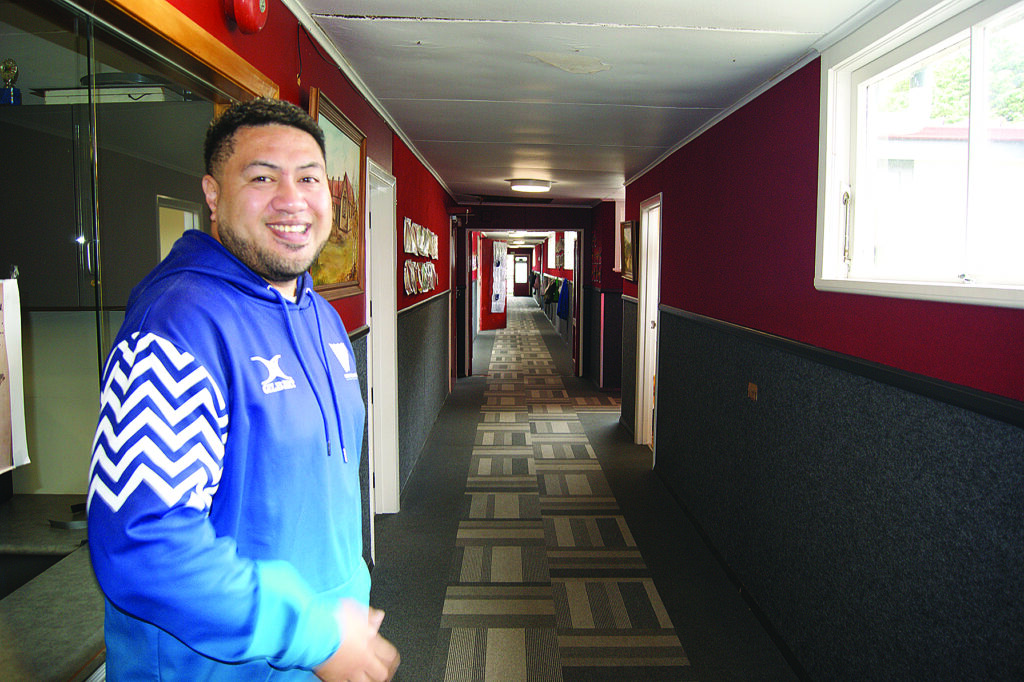
Woodville is a small rural town nestled at the northern end of the Tararua Range. It’s not so remote now the new Te Ahu a Turanga section of State Highway 2 is open – it’s now the gateway to Tararua, Hawke’s Bay, and Wairarapa from the central North Island. In any case, it still classifies as a town in ‘the middle of nowhere’.
Like many rural towns in Aotearoa New Zealand, Woodville is steeped in history and heritage. It’s still home to between a handful and a couple of thousand residents (depending on who you’re talking to), and also houses one of Aotearoa New Zealand’s oldest schools, currently run by first-time principal Wes Va’ai-Wells.
Wes doesn’t quite match the country setting he’s thriving in. He’s young, urban and has a decisively modern outlook. To be fair, Woodville wasn’t exactly part of his plan. But four years into his principalship there, he’s making a big difference to the school and community, leaving his mark on a place he once never imagined he’d set foot in.
Taking a leap of faith
Wes gained more than a decade’s experience teaching at an intermediate level before taking on the role of deputy principal at Te Kura o Wairau in Highbury, Palmerston North. After four years serving as deputy principal for the U4 kura, Wes decided he was ready to take the principalship plunge. He quickly learned that the first step into school leadership often requires a bit of flexibility and more than a little bit of faith.
“I really wanted to pursue principalship, but I wanted to do that in the safety of my own town,” says Wes, born and bred in Palmerston North. “Woodville was not on my list of schools that I wanted to target. In fact, nowhere outside of Palmy was.”
Wes recalled being told that, if you really want to grow your principalship, you should go into a small country school to hone your craft. So, he cast his net further afield and started to look at smaller schools throughout the central North Island. One of those was Woodville School.
Bringing an outside perspective
The former principal of Woodville School had left after the school was placed under statutory management. The majority of the staff followed suit simultaneously. The Board needed someone capable, someone who could capture the community’s confidence and deliver a vision for the school.
“It needed an outside perspective, someone outside of the community that was going to come in, make an impact and make the school better for it,” says Wes.
Being Sāmoan and raised in the city, Wes had his concerns about many of the principal roles he was applying for and his suitability for them. Woodville was no exception. As an outsider, would he be accepted by the local rural community? Was it the right call taking a job at a school that had been in decline for some time? Did he have what it would take to turn the school around? Did he really know what he was getting himself into? Armed with determination, conviction and a broadened mindset, Wes was ultimately offered the top role.
“I back myself in what I can achieve and what I can do,” Wes says, “but it’s not easy when you’re trying to convince a panel of generally four or five people that you’re the best person for the job and best person for their community.”
“You’re taking a Sāmoan with mainly urban teaching experience, and you’re putting them in the middle of your rural setting and basically saying, ‘good luck’. But I knew I could make a significant impact there and bring my own learnings and experience to the school, particularly having worked with lower socio-economic communities before.”
Being baptised by fire
Woodville School needed a fair amount of work – a “massive understatement” according to Wes. Positions needed filling, maintenance needed doing, curricula needed planning.
“I knew coming in at the time, the school was not in a great place,” says Wes. “There was heaps to do, and all of that needed to be done under the close watch of statutory management.”
While some would squirm at the prospect of a statutory manager overseeing your every move, it would only be for his first six months and Wes took it as a blessing.
“I think they were the best thing for me and for the school,” he says. “I would talk to them often and it was honestly really great. They walked me through all the legal and administrative side of things and made sure that was all in order so I could concentrate on other things.”
On top of learning the school and learning the community, what Wes describes as “just listening”, a number of unforeseen issues came out of the woodwork in his first few months. This included hitting the media for delaying the enrolment of a high needs student until Wes was certain the right measures and supports were in place.
A family wanted their high-needs child to start with less than two months left in the school year. The Ministry was offering a one-to-one teacher aide for the student, but secure perimeter fencing wasn’t due to be set up at Woodville School until the summer break.
It was a balancing act for Wes to keep everyone happy and safe. With support from the statutory manager and a lawyer, Wes pushed back to the Ministry, delicately handled the media and parents, and put a plan in place for the child. At the end of the day the family chose to attend another school.
“Our community uses social media as a main forum for communication, and the unfortunate media coverage played a significant role on our staff, the board’s, and my leadership team’s well-being during that particular period,” says Wes.
“The Woodville community were very supportive, often defusing the negative narratives being portrayed with ‘common-sense’ and endorsing the school’s stance.”
Despite the adversity, Wes reaffirmed something absolutely critical from that experience: Thick skin helps, but community support is a key element to coping and managing in leadership roles.
Getting the vibe back on track
With a well-handled crisis under his belt and the community on his side, Wes started to institute the changes he knew the school needed. He talked about the vibe of the school as a principal’s primary duty, noting that it wasn’t great at Woodville when he showed up.
“You can instantly feel it when you walk into a school,” Wes explains.
“Another colleague of mine calls it the tone, or pulse,” he says, referring to former New Zealand Principals’ Federation President Iain Taylor who Wes and another first-time principal, Thomas Bartlett, travelled to California with in 2024. It was during this trip with Iain and Thomas, visiting schools and institutions in low socio-economic environments and discussing programmes and pathways for disadvantaged students, where Wes truly understood how important the tone and pulse of schools is.
Iain is most known for turning around Manurewa Intermediate and then going on to win the Prime Minister’s Education Excellence Award. What Wes is doing in Woodville echoes the achievements and work ethic of the preeminent principal.
“I wanted to give Woodville School its heartbeat back, so a major focus of mine for the past few years has been building up the school’s culture, getting it back its tone, its pulse.”
Resurrecting the school’s values
The most critical piece for Wes in the early days was defining the school’s culture. The school definitely had values, but they weren’t, as Wes says, “easy to access”.
“In building up a strong school culture, I wanted to have values that were important to both our students and our staff; they wouldn’t just be for the kids, they were for the adults as well.”
He gathered ideas from his students, staff, parents, and local iwi and, with their input, landed on three core values, mana, pono, and ako, and two overarching beliefs of whanaungatanga and kotahitanga. Then a game of kī-o-rahi through one of the local iwi, Rangitāne, led Wes to a chance encounter with Troy Tawhai, the kī-o-rahi trainer, who was also a graphic designer. Troy helped to visualise the values and pulled them together into a new logo for the school.
“This was cool because it brought all the work we had done with the school and the community to life.”
But Wes knew that if he was going to really embed these values within the students, both at school and at home, it’d take more than some fancy terms and pretty pictures. He went back to the students and staff to get them to describe what the values meant and looked like, through ‘I/We can’ statements.
“We needed some practical statements about the values so it’s easy for everyone to access,” says Wes. “The process has helped our students understand the values and our school’s identity, and it’s helped our parents get to terms with them and on board too.
“We’ve now got five statements per value, and we’re going to blow them up and put them around the school. I can’t wait!”
Ensuring a great team
Critical to its success has been Woodville School’s staff. There are currently six full-time teachers including a Deputy Principal, plus Wes and a whole bunch of teaching assistants and support staff. Wes has hired virtually all of them.
“Our values guided the criteria that our staff had to meet when we hired them, but we primarily needed them here for the right reasons. They had to put the children first.
“Even though we’re a small school, I wanted overachievers,” Wes says, clarifying that he means that as a term of endearment. “I want hard workers who are as ready to learn as they are ready to teach.”
“I’ll admit that we’ve had a high enough turnover since I’ve arrived that I’ve had to hire 23 people,” Wes says, “but that is not necessarily a bad thing.
“I want to see my staff go on to be leaders in some way, shape or form, maybe at Woodville or wherever their next step takes them.”
Right now, Wes has a core leadership team that involves his DP, a senior team leader and a junior team leader as well.
“It helps maintain the flow when one of us has to step out for sure, but I think what I’ve been super conscious of is not being the linchpin at the school either and making sure there are real opportunities for my staff to step up to lead and progress their careers.”
Wes hasn’t had any second thoughts about his decision to come to Woodville School.
“I guess it was a bit random, but I have zero regrets having made the jump,” he says.
“Looking back to before I accepted the role at Woodville, I thought I was confident enough to manage a bigger urban school without principal experience. But I have learned so much in the past few years, even just by having to be ‘everything’ in the school.
“From relief teaching to being the caretaker to the cleaner to teaching assistant support or office admin, having to do everything in one shape or another has given me such a great appreciation for the work that everyone does to help manage or do the day-to-day operational stuff.”
Becoming the school of choice
There isn’t a lot of money in the bag, but Wes is resourceful. He knows that little changes can make a big impact if they’re done with good intentions and care.
“We might be the poorest community in the area,” Wes says matter-of-factly and with an air of pride, “but I am striving to make us the school of choice for the district.”
Wes’ plans for the school are nowhere near complete, some haven’t even begun. While renovations were in full swing in November – getting reliable toilets and draught-proof windows installed in one of the heritage blocks, and Wes was waiting on some work to fix a gaping hole in their hall left by a falling tree – it’s a far cry from the work Wes has envisioned.
“It’s a bit sad, as a lot of my ambitions have been consumed by maintenance,” says Wes.
“We have been able to do little things,” he says, “The new basketball hoops were donated because the last ones were probably installed in the 70s, the courts have been painted, and the playground that was inherited from Linton Country School replaced our old playground that was frankly a death trap. But these are not really beautifying the school – they really needed to be done.”
Wes has had to yet again push back plans for some new learning spaces and a fresh colour scheme for the exterior but, all things considered, his mission is going well.
The role has gone up to 136 from 86 in the last four years, and the staff has doubled in size with a significant increase in teaching assistants.
For the first time in decades, they’re getting interest from outside of the local community.
“Before my time, there were more schools that people arguably would choose before us, but we’re now getting some families with students at these schools coming to us saying that Woodville was recommended,” Wes says.
“I’ve really noticed that, over the last two or three years, Woodville School’s reputation is changing. And not just in our community, but wider afield. Outside of Woodville and going all the way to Dannevirke, we’re becoming more recognized for being a quality school.”
“It gives me great pride and confidence in the school’s future, whether I’m here or not.”
Why Woodville?
Wes was a little apprehensive when I first approached him regarding this article and asked, “Why Woodville? What’s interesting about me or this school?”
I didn’t have an answer for him then, but having toured the school and seen some of the magic Wes is making happen there, the answer is simple. Woodville School is a school with a principal that cares – about his students, his staff, his community, and making his school the best place in the district to learn.