
It has been praised as the greatest innovation of our times, and criticised as unethical and completely lacking in humanity. It is admired and despised, embraced and rejected, in equal measure. But whether pro or con, it is difficult not to take an interest in this controversial technology.
As I write this article, our Prime Minister has just been scammed. In an AI generated, ‘deepfake’ interview with well known Q&A current affairs television programme anchor, Jack Tame (AI bot), the Prime Minister (also AI bot) guarantees New Zealanders an income of $35,000 per month, through a new investment scheme supported by the Reserve Bank, the government and other credible sounding institutions, for a joining fee of $450. Joining the scheme urgently, is of course necessary, and ‘Prime Minister bot’ tells us he has already earned more than $45,000 from the scheme. The interview takes place on what appears to be the set of Q&A and it has been advertised as an ‘exclusive’, complete with the red ‘breaking news’ tape, trailing across the bottom of the screen. The deepfake interview between ‘Jack Tame bot’ and ‘Prime Minister bot’ appears on Facebook.
The media report on this incident explains how efforts to have the scam removed from the Facebook platform were unsuccessful. This is not an isolated incident and scamming is not a new activity. It’s just that AI makes it so much easier for the scam to appear genuine and the social media platforms cannot easily remove them.
In describing other similar deepfake scams, ‘Police, lawyers and tech experts are warning these moments offer a glimpse into a future where crime is harder to spot, trust is harder to earn, and justice is harder to deliver.’ AI enables crimes like scams, to be executed far more quickly and easily and more cheaply for the criminal.
On the other hand AI technology is positively transforming medical science. Certain operations can now be performed by programmed bots. Under the direction of a human surgeon, the bot conducts surgery with greater accuracy, through techniques that are less invasive and offer faster recovery for the patient. All of this means that more surgeries can be completed in a much shorter time, and patients are recovering and leaving the hospital more quickly. It creates huge efficiencies and can further assist the surgeon by producing an accurate and timely report post the operation. The surgical bot doesn’t come cheap and the power consumed in the course of its work is high, but the outcomes are impressive and the possibilities seemingly endless.
Health is not the only winner. Business operations are also embracing AI for its time saving features and for those involved in the production of virtual reality games, augmented reality or other interactive experiences, adding AI in the mix makes for even more excitement. Innovative film makers, similarly, are using AI to their advantage.
Similar efficiencies have been reported by those working in the education system. In a matter of seconds, teachers are able to create daily, weekly, monthly or whole term lesson plans according to the parameters entered and covering whatever curriculum subjects they choose. Data analysis of learning progress is also made easier. Some highly skilled teachers are engaging tamariki in the coding of bots and creating teacher assistant bots for individualising learning programmes. As in the health system there are endless possibilities for further AI applications, some of which are explored later in this story.
Many principals report they are regular users of AI applications such as ChatGPT, Claude and Gemini for summarising documents, preparing reports for their Boards of Trustees or the Ministry, writing newsletters and speeches for various school events, using deep research tools and reducing the time commitment of numerous other administrative tasks. This frees up principals to do their core work of leading teaching and learning, setting the culture of their schools and building relationships.
Unsurprisingly, rangitahi are quick to adopt innovations and, we read stories of young people using ChatGPT and the like as a writing tool both socially and to complete assignments. While initially it was easy to detect such use, in time that has become more difficult as users learn to frame their instructions so that responses avoid cliches and a stereotypical, dry language style and include humour and creativity. Some would argue that the question is not just whether AI can learn to converse like a human, but whether humans will start conversing like AI.
Discussions have also arisen in academic circles about the problems users of social media already have in distinguishing reality from non-reality, because social media platforms provide sophisticated tools for altering images and AI will further facilitate this practice. Issues of copyright arise, as poets, novelists and musicians have their work mined by AI to be reproduced in some other form, but without recognition or compensation for using the original creations.
Those engaging at the philosophical level suggest that AI may herald the end of creativity, as young people using AI tools mine only the information already in existence, to fulfil their own social, academic and learning requirements, thus subverting the creation of new ideas and therefore the development of solutions for the many problems facing the planet. They also express concern that the boundary between real and fake is fading and will soon disappear, such that we will not be able to distinguish real from non-real, no matter how honed our critical thinking skills are. Some predict AI will take the joy out of learning and de-motivate young people who report that their love of learning comes from discovering solutions for themselves, rather than just directing AI to find everything for them.
The issues associated with this new technology are many and varied, positive and negative, but in Rotorua they are rolling out the welcome mat.
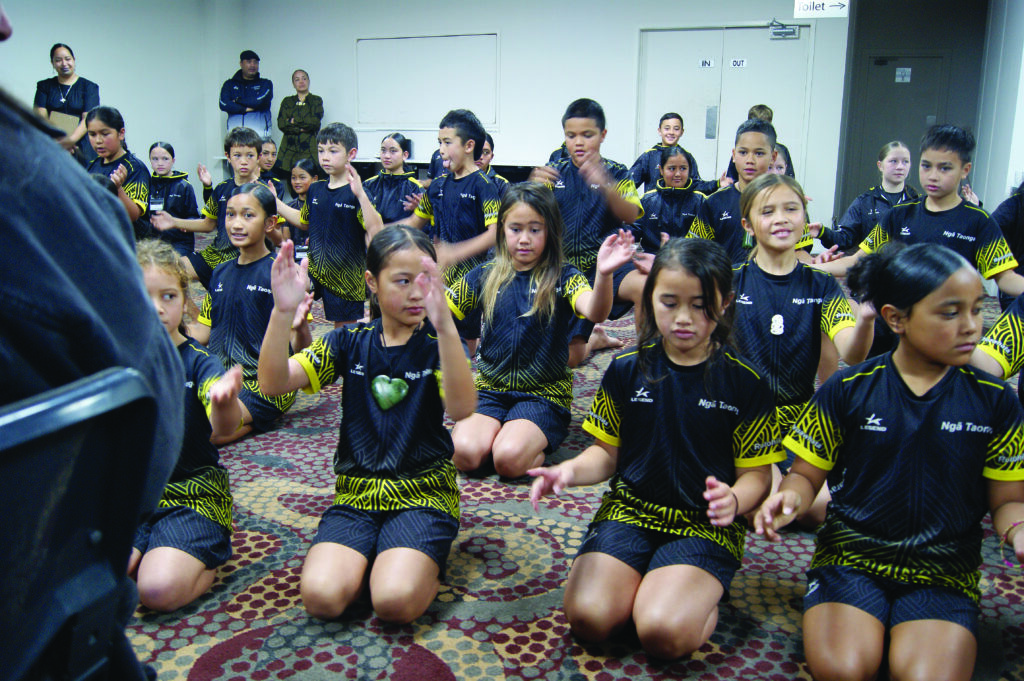
Fred Whata, principal of Rotorua Primary School, says his school has a high Māori student population – exceeding 80 per cent – and the students’ future is dependent on succeeding as Māori in all curriculum areas especially soft skills like creativity, critical thinking, collaboration and communication skills. All of this is woven into a strong school culture that is centred on Māori self-determination, Te Tiriti o Waitangi, Māori language, culture and identity. Half the classes in his school are rumaki reo or full immersion.
Fred predicted that engaging technology, including AI, would assist his school to effectively reach their goals. They set out on a long five-year journey which first led them to qualify as an ‘Apple Distinguished School’. Throughout this journey his teachers were becoming expert ‘Apple users’. ‘There are very few Apple distinguished schools in New Zealand because the bar is so high,’ he said.
I asked Fred to explain the benefits of reaching this distinguished standard.
‘We have access to a global village and connection to every indigenous culture in the world, and there are viewers all over the world becoming interested in what we are doing,’ he said, ‘because now we also have AI incorporated into our system,’ he said. He went on to explain that all the documents you want AI to access are loaded into the ‘back’ of the system.
‘The whole of Te Tiriti oWaitangi is in there, the stories of our local iwi, our pepeha, all our guiding school documents like the school vision, mission, strategy and planning documents, our graduate profile, the curriculum, Ka Hikitia, the Māori Education Strategy, Te Whare Tapa Wha (a Māori holistic model of health developed by Sir Mason Durie), strategies for neurodiversity such as ADHD, Autism, Cerebral Palsy – because technology can help us overcome the communication challenges these children have – school policies and much more. We can just keep adding to the bank of information available to the system,’ he said. ‘The key to using AI is that all the design is created and controlled by humans and then we use AI to generate what we want it to produce. Technology with AI has relieved so many burdens for our teaching and support staff,’ he said.
Teachers use prompts to get AI to generate the documents they want for their classrooms such as lesson plans, including detail and teaching prompts if necessary, and assessment analysis, including producing reports. What’s more, Fred expects that before long every teacher and every one of his students will have their own bot assistant. ‘It will be like having two teachers in every classroom and every child will have an assistant!,’ he said. ‘In effect, all of our tamariki will have personalised learning.’
That said, Fred is very clear that we must put a framework around the AI. AI is not human. AI only has in it what the teachers put in it, and it needs to be trained to work for us. It is not open to the world wide web, and Fred insisted it will never replace the human teachers and support staff. The staff are very mindful that it works as teachers and students direct it, not the other way around. It is here whether we choose it or not but, ‘If we don’t teach our moko AI, the rest of the world will,’ he said.
Technology is deeply embedded in everything tamariki are learning at Rotorua Primary School. One classroom I visited had a display of beautifully written stories celebrating Matariki, and was a great example of how technology can be used to enhance the experience – like going to space to see the whetu of Matariki – as an avatar!
At another level, young children use ‘Tinkercad’ to design and construct objects on their iPads or laptops. All you need to get underway is a ‘what if’ question. Once that’s answered you head to the ‘How to make a . . .’ screen and follow the directions. This is the start of the design process, and also helps young children to learn the fundamentals of the programme. Step by step, tamariki then build their constructions.
Alternatively, with another Apple app, children can build new creations from a set of shapes by manipulating the size and placement of the shapes. Through the process, children learn what works and makes sense and what doesn’t. In this way, they may accidentally come across a new shape they hadn’t thought about and design a different creation.
‘One important lesson, through using technology and AI, is that ‘failure’ takes on a different meaning. To ‘fail’ is positive – it means – you haven’t yet found the solution – and you go find another path to try out. This is especially effective when children are collaborating on solving problems,’ said Fred.
A favourite hideaway is the ‘E-Sports Room’ where you can take a drifting class. While boys especially find this car game exhilarating, there are many skills to learn. There are keyboard skills, learning how to control the car on the screen, reading and problem solving, coordination and spatial awareness, collaboration and teamwork.
The school uses the DMIC (Developing Mathematical Inquiry Communities) mathematics approach which is focused on culturally responsive group problem solving and critical thinking in mathematics. DMIC was chosen as a good match for the school’s culture because it is about improving student achievement by encouraging the children to bring their cultural identities and voices into the classroom to solve problems collaboratively. The teacher learns to step back, and let tamariki apply their own thinking. This is where AI is helpful to prompt, but not instruct, the children.
Apps are also available for language learning – poetry, stories and history. Through the app the children can download pictures, and create timelines and maps.
A ‘Notes’ app is especially useful for children who are in the early stages of developing verbal skills. It has a built-in microphone and translates their spoken story into written form which they can illustrate. They then copy their own story.
‘The biggest room in the world is the room for improvement,’ says Fred Whata, and embedding technology and AI throughout the curriculum at his school has been a game changer. The technology is so motivating for the children and uplifting for them. ‘We are a low decile school of tamariki who are achieving and enjoying their learning every day.’
It has its pros and its cons, but when it comes to AI, Rotorua Primary School is all about harnessing the positives, and ensuring the community continues to see new technology as a support that will never replace the human craft of teaching.