
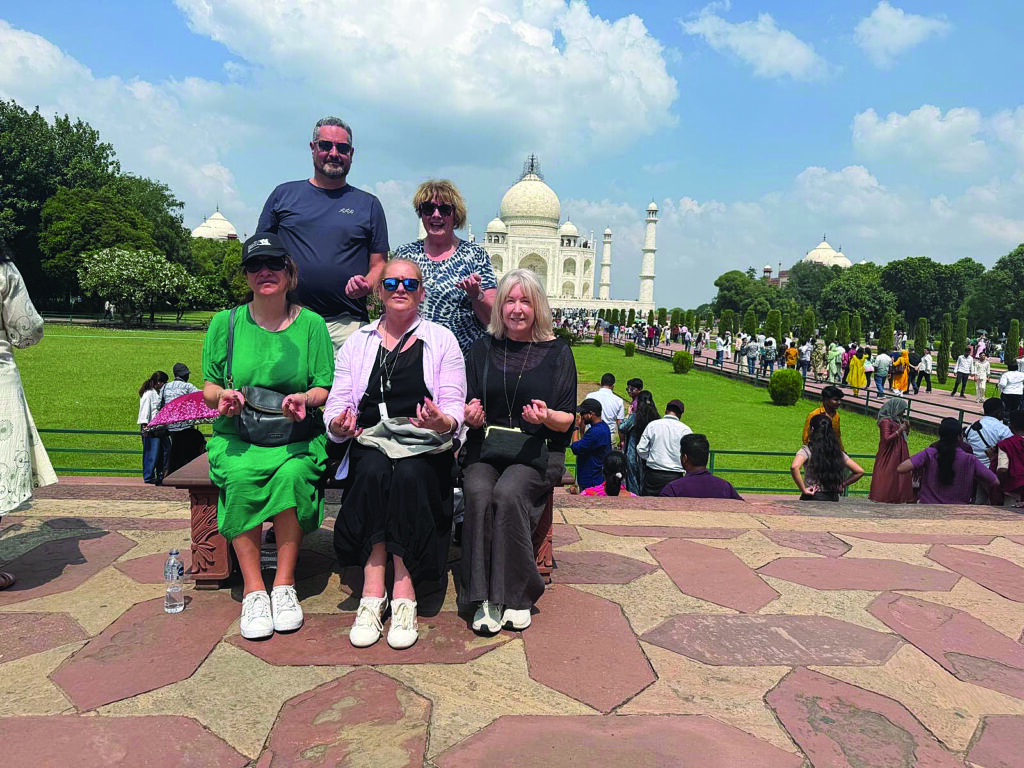
The Republic of India is a country of contrasts – tradition and modernity; advantage and deprivation; local and global; rural and urban. Depending where you look, India can charm with its centuries old craftsmanship and grandeur with examples such as one of the seven wonders of the world, the Taj Mahal in Agra, Uttar Pradesh, and Humayun’s Tomb in Mathurin, or sadden with homeless beggars, completely dependent on the generosity of tourists and locals for financial support.
New Delhi, the National Capital Territory (NCT) of India, although not listed amongst the ten most economically advanced states of India, is home to India’s Central Government, the President and the Prime Minister and has a population density of 11,320 people per sq km. The whole of Delhi has a population of 16.79million with 97.50 per cent living in urban areas. Annual temperatures range from 3 degrees Celsius to 45 degrees Celsius.
Geographically, India is the seventh largest country in the world and has the world’s highest population with 1.451 billion people. Some of India’s biggest social problems include poverty, pollution, illiteracy, corruption, gender inequality and violence against women.
Schools, and the education they offer, are the mechanism through which some of India’s social problems will be resolved. Despite schooling being compulsory in India through both private (mostly) and government school options, there are many millions of Indian children who do not attend any school. That is partially due to a well-entrenched ‘Caste System’, which was endorsed by colonialism but officially abolished in 1950. Despite the abolishment, the social hierarchy, imposed by birth, persists through ingrained social attitudes, segregation, and surnames that identify a person’s caste. Essentially this ‘Caste System’ divides the people into a hierarchy of five distinct groupings. These are the Brahmins (priests and scholars), Kshatriyas (warriors), Vaishyas (merchants), Shudras (laborers) and Dalits (once known as the ‘untouchables’).
The ICP Council meeting was sponsored by the Salwan Education Trust, which boasts nine schools, and includes both private and public options. The Trust is chaired by Mr Harpel Singh, an educational philosopher who believes in education that cultivates the mind and teaches young people how to think critically so they can live satisfied lives, and become the custodians of humanity. ‘Teachers,’ he said, ‘are not deliverers of knowledge, they are facilitators of curiosity, builders of empathy and connectors.’ In a world of AI, where we are losing our ability to dream, ‘We must preserve human connections and values, collaboration, creativity, problem solving and resilience, to create a more equitable, sustainable and harmonious world.’
In India, he said, education is not to build careers but to build character. Education is not about teaching scriptures but teaching skills – how to be good with nature, how to serve society with humility and respect differences.
He also reminded us of our duty to the planet and the importance of sustainability, respect for communities, and that inclusivity must be a lived reality. In India, after independence in 1927, access to schools was just 18 per cent of children. Now it is 75–80 per cent. He quoted C.S. Lewis who eloquently postulated, ‘Education is not to cut down jungles but to irrigate deserts.’ In other words education is not about seeing learners as untamed jungles of ignorance to be cleared, but as young people to be nurtured and given a thirst for learning. On technology and its advancement he said, ‘Technology should and will change tools of learning, but values must remain the moral compass of humans.’
His words will continue to resonate with the ICP Council members because they are deeply felt and grounded in what it is to be human.
The Council meeting also hosted Yuri Belfali, who heads up the OECD division of early childhood and schools. Her opening remarks reminded us that data without context is meaningless. ‘Knowing is important,’ she said, ‘but more important is how young people live together to create better societies.’ ‘Schooling is not just for economic development it is for creating values and ways to solve problems.’ She noted that the countries with the highest creativity scores are Singapore, Finland, Australia and New Zealand, which was to be celebrated.
Panel discussions on building collaborative leadership and on managing leadership succession and Artificial Intelligence were lively and interesting and a presentation from Irish delegates on sustainable leadership – from thought to action – reminded us of the importance of having a coherent structure within the education system to support and sustain quality leadership for the future.
The New Zealand contingent had the opportunity to present their plans to host the 2026 ICP Council meeting and Convention (conference) which will be held at Auckland’s ‘New Zealand Convention Centre’ 16–18 September 2026.