
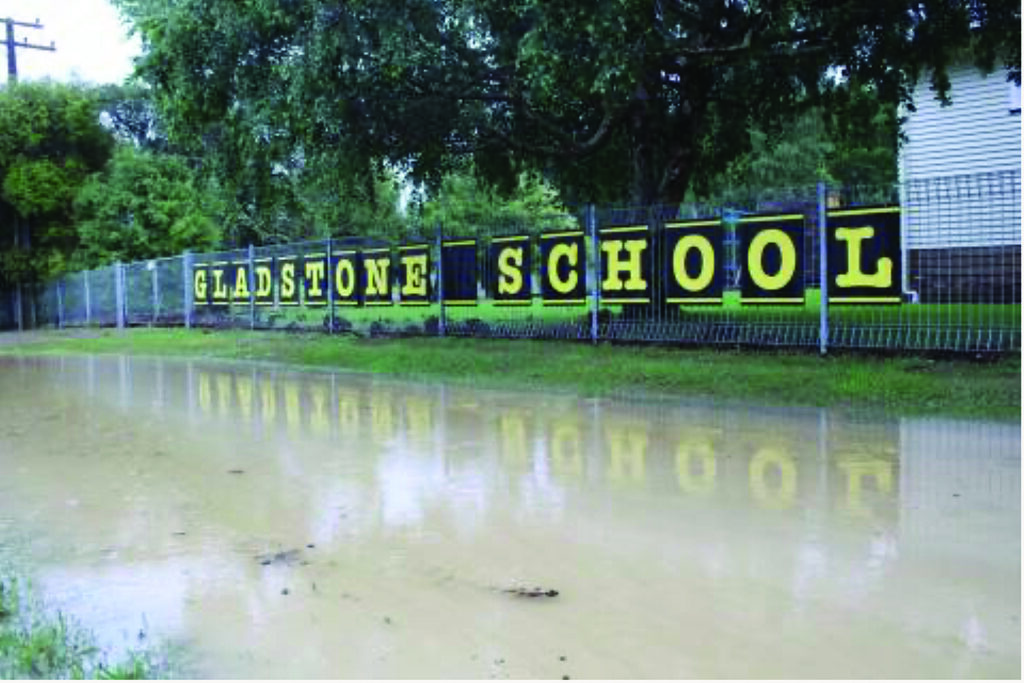
From sandbagging and to , more frequent extreme weather is impacting schools, families, and communities across Aotearoa.
For the first time in 2024, we asked about these impacts in . We asked principals about two specific types of events: flooding, and excessively hot days.
Many principals reported flooding impacts
We found that 41 per cent of primary principals responding to this part of the survey (n=176) reported flooding impacts to their school or homes in the school community during the previous five years.
More specifically, 31 per cent reported floods that affected school property, or student or staff access to school (for example, roads, bridges). A similar proportion (32 per cent) said there were students and staff whose homes were impacted by flooding events. These effects were felt by schools in 15 of New Zealand’s 16 regions, with Auckland and Hawke’s Bay among the hardest hit.
While our national survey did not collect information about the extent or longevity of these impacts, in 2023 hundreds of , and some of the hardest hit schools in Hawke’s Bay have had to or even months.
Schools provided support to affected communities
Over a third (35 per cent) of principals NZCER surveyed agreed or strongly agreed that their school had provided community support during and after climate-related events – including every responding principal from more extreme flood-affected regions like Hawke’s Bay, Marlborough, and Nelson, and many from Auckland.
These findings highlight the crucial social role schools play in crisis response, with school leaders and teachers often playing the role of ‘quiet heroes’ in supporting communities through the immediate and long-term processes of recovery (; ).
Many schools remain exposed to flooding risks
While our survey findings may be a bit confronting, they are not entirely surprising. An initial Ministry of Education assessment in 2024 identified 1,102 schools and kura (about 44 per cent of all schools) as potentially exposed to coastal, surface, or river flooding.
A separate risk assessment commissioned by the Climate Change Commission suggested that dozens of schools are currently vulnerable to coastal flooding during increasingly common ‘1 in 100 year’ storm events, and 106 schools are vulnerable to coastal flooding or landslides under a projected sea-level rise of just 20 centimetres – a plausible scenario within a matter of decades (). The latter report did not assess the number of schools at risk from non-coastal flooding.
Some primary schools find hot days a challenge
While extreme heat has been a less common experience in New Zealand than storms and flooding, heatwaves were the most significant climate hazard to disrupt schooling globally in 2024, affecting an estimated 171 million students worldwide (UNICEF, 2024).
Keeping learning spaces cool on hot days was a challenge for some schools in our survey, with more than a quarter (28 per cent) of primary principals disagreeing that ‘we are able to keep all our learning spaces cool on very hot day’. Nearly a fifth (19 per cent) of principals reported experiencing excessively hot days that disrupted student learning or physical activity. These schools were most often in the same regions already grappling with flood risks. These findings raise important questions about the inequitable impacts of compounding climate stressors.
In addition to daily temperature maxima that might affect children during schooling hours, it is also important to consider overnight temperatures, which can have an impact on sleep and health, the persistence of high temperatures across multiple days, and levels of humidity. Research-based definitions of ‘heatwaves’ in New Zealand are also evolving, from older approaches that used a single temperature threshold (for example, 25 degrees), towards newer methodologies that take a more nuanced, regionalised climatic approach, defining ‘heatwaves’ relative to the baseline temperature and climate norms experienced in those locations (). Recent New Zealand research has identified links between daily temperatures and hospital admissions in young children, including ethnic, sex and socio-economic differences in vulnerabilities to these risks ().
Wildfires
A further climate-related impact that we considered, but did not ask about in 2024, was schools’ exposure to wildfires and smoke. At present, we assume that too few New Zealand schools will have experienced these climate impacts to merit inclusion in our national survey. However, researchers expect the incidence and severity of wildfires in Aotearoa to increase as global warming continues (). In addition to the immediate risks to property and life, exposure to wildfire smoke has significant health impacts, particularly for children and adolescents (). Like other disasters, experience of wildfires can have ongoing mental and physical effects for learners () and the wider community.
How are climate stressors impacting young people’s education?
At this stage, we do not have a comprehensive picture of the extent to which climate-related events are impacting on learning, achievement, and wellbeing of our young people. However, international research warns of multiple ways in which exposure to climate stressors present a threat to children’s development and educational outcomes (Prentice et al., 2024), and there are certainly equity challenges given the inequitable distribution of climate events, and the impacts of inequities on how well a community can respond and recover from such events.
Recent New Zealand research suggests that the size of the population affected through both direct and indirect impacts of climate events has been underestimated (). In addition to direct impacts on homes, schools, and other infrastructure, communities can experience longer-lasting social, emotional, and economic consequences ().
A Growing Up in New Zealand survey found higher levels of reported anxiety and depression amongst young people who had experienced the effects of the early 2023 weather events, compared with those who had not experienced these events (GUiNZ, 2024). Schooling impacts may include impacts on attendance due to practical barriers to, or anxieties about, sending children back to school ().
How can our school network be more climate resilient?
Climate change is no longer a future problem for our education system – it’s a current, lived reality. The discusses the weather and temperature pattern changes we are already experiencing, and projections for the future as further global warming occurs.
Schools and communities cannot tackle these challenges alone. We need joined-up, equity-focussed and future-ready planning to ensure that every school is a safe, sustainable, and resilient place to learn.
This includes:
-
Integrated infrastructure planning that accounts for climate risk.
-
Investment in schools as climate hubs – for education and community resilience.
-
Action to mitigate the impacts of climate stressors for learners and communities, recognising that these stressors have multiple and complex impacts that can affect education and health outcomes.
As Prentice et al. (2024) note, climate stressors can begin to impact on children/learners even before they are born, due to parental and community exposures to climate stressors. With climate impacts likely to continue and worsen into the future, long-term planning with strategies to mitigate these risks is even more essential.
We also need to consider how climate change mitigation, adaptation, and resilience can be supported through curriculum and learning design. My next posts will explore what learning for climate and sustainability action can look like in our schools.
References
Anderson, M. J., Conrow, L., Hobbs, M., Paulik, R., Blackett, P., & Logan, T. (2024). Distributional justice and climate risk assessment: An analysis of disparities within direct and indirect risk. Risk Analysis, n/a(n/a).
ERO. (2022). Missing Out: Why Aren’t Our Children Going to School? Author.
GUINZ (2024) Extreme weather survey findings.
Harrington, L., & Frame, D. (2022). Extreme heat in New Zealand: A synthesis. Climatic Change, 174(2).
Lai, H., Lee, J. E., Harrington, L. J., Ahuriri-Driscoll, A., Newport, C., Bolton, A., Salter, C., Morton, S., Woodward, A., & Hales, S. (2024). Daily Temperatures and Child Hospital Admissions in Aotearoa New Zealand: Case Time Series Analysis. International Journal of Environmental Research and Public Health, 21(9), Article 9.
Melia, N., Dean, S., Pearce, H. G., Harrington, L., Frame, D. J., & Strand, T. (2022). Aotearoa New Zealand’s 21st-Century Wildfire Climate. Earth’s Future, 10(6), e2022EF002853.
Mutch, C. (2015). Quiet heroes: Teachers and the Canterbury, New Zealand, earthquakes. Australasian Journal of Disaster and Trauma Studies, 19(2), 77–86.
NZEI Te Riu Roa. (2024). We are still here. How educators in Te Matau-a-Maui have supported their communities in the aftermath of Cyclone Gabrielle.
Oerther, S., Manspeaker, S., Wix, A., Oerther, D., & Marsit, C. (2024). The Effects of Wildfires on the Mental and Physical Health of School-Age Children in North America: A Scoping Review. Journal of Child and Adolescent Psychiatric Nursing, 37(4), e70002.
Prentice, C. M., Vergunst, F., Minor, K., & Berry, H. L. (2024). Education outcomes in the era of global climate change. Nature Climate Change, 14(3), 214–224.
Urban Intelligence. (2024). National infrastructure exposure & property isolation assessment [Prepared for He Pou a Rangi Climate Change Commission].
Zhang, Y., Tingting, Y., Huang, W., Yu, P., Chen, G., Xu, R., Song, J., Guo, Y., & Li, S. (2024). Health Impacts of Wildfire Smoke on Children and Adolescents: A Systematic Review and Meta-analysis. Current Environmental Health Reports, 11(1), 46–60.