
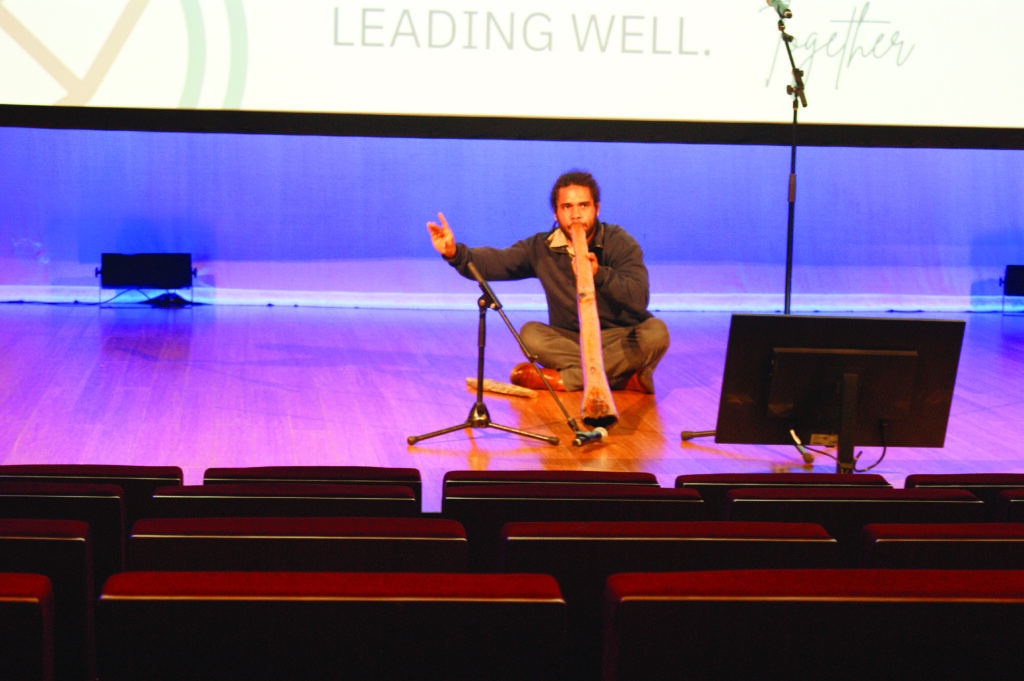
As is always the case when New Zealand principals meet with Australian colleagues, humour, teasing, and competition were all on stage at this year’s annual APPA (Australian Primary Principals’ Association) conference in Brisbane. Temperatures of at least 20 degrees every day were an added bonus for the Kiwi contingent who quickly repacked their merino jumpers for the return journey.
The conference was opened with a ‘Welcome to Country’ ceremony in recognition of the indigenous people of the land and the theme ‘Our Primary Purpose: Vision, Voice, Agency, Impact’ was well explored by the many speakers.
Derek Oram–Sandy, a traditional custodian of the Goori, Yerongpan clan of the Yuggara nation, performed the ceremony, welcoming principals through the ancestral spirits of the Totem of the area, ‘that will keep us all safe.’ He explained the close connection between the indigenous people, the land and bird life and how, by listening to the call of the Koel bird, his ancestors would avoid floods. He concluded with a memorable didgeridoo song of welcome.
The Federal Minister, Jason Clare was the first to speak, noting that working together was the best way to achieve long term agreements on education funding and reform. He told an affecting story of a primary school friend of his own son who had experienced grief in his family. The school principal checked in with the boy every day to make sure he was OK. She sometimes played board games or cards with him, and they shared hot chips.
Minister Clare emphasised that such empathy is what principals show every day and he thanked his audience for, not just their important educational role, but also looking out for the welfare and social–emotional needs of their students.
The Queensland Education Minister, Hon John–Paul Langbroek, was interviewed by MC for the conference, Libbi Gorr. He outlined what his government had done for education, emphasising the removal of ‘red tape’, introducing a set of guidelines for parent communications, including online communications, and a student anti-bullying plan for both online and offline bullying behaviour. Additional specialists and psychologists, chaplains, a parent line and more PLD for teachers and principals rounded out his list. ‘Great schools are built on great leaders and as a government we have a duty to support you,’ he said.
Speakers covered multiple topics including lessons from a victim of the London bombings, education for tomorrow, leading well together, harnessing individual strength for team success, mastering modern leadership, and building trust and belonging in schools. Below is a report on a selection of the speakers.
Justin Coulson talked about the importance of building relationships so that staff and students feel they belong and feel safe to engage. He encouraged principals to consciously allocate ‘connection time’ and recognise that investing in staff and student relationships builds trust. Similarly, he said, repairing relationships is far more important than rule enforcement. He advised that brief, consistent relational moments scattered throughout the day work best. He said interactions should be based on the person feeling seen, heard and valued so that they know their principal understands the actual challenges they face. Too often, he said, schools optimise for efficiency rather than human relationships. Trust is key to all we do, he said, and building relationships is the key – something being efficient won’t achieve.
Dr Cam McDonald presented his audience with ways of harnessing the individual strengths to build a strong team of teachers and a balanced classroom. Key to achieving this, he said, was to understand individuals and match them carefully. Insights from the medical world can be transferred to education to help achieve that.
Student wellbeing is influenced by teacher wellbeing, so if teachers bring stress into the classroom, students behave in a stressed manner, he said. When our emotional environment matches our biology, however, we feel calm and safe. The natural state of ‘match’ differs for different people.
He indicated that AI will help with working out the matches by analysing a student’s biological characteristics – more accurately than a doctor – and examining the behaviours that result. Teachers would group students according to compatibility and set the environment to accommodate their expected responses. This makes for a huge shift in thinking for the future, he said. To illustrate his point, he described two very different types of personalities and their biological characteristics to show that while one was risk taking, the other was a carer. He called them Activators and Guardians. Activators, he said were adrenaline driven (biological), can’t sit still, love adventure, are risk takers and expansive. The guardians are nurturing, like predictability, are sociable and deeply caring, and they are stable in nature. There are many more personality types which AI can identify, allowing school leaders and teachers to adapt their environment so each can perform optimally.
APPA President, Angela Faulkenberg
A popular President, Angela Faulkenberg opened her speech saying, ‘We (APPA) are here because principals’ work is complex.’ APPA has a list of key priorities, she said, to address the major issues. They are valuing the profession, addressing principal health and wellbeing, acquiring equitable and sustained funding, streamlining the curriculum, shifting national testing to national sampling and removing NAPLAN results from the MySchool website.
We are first leaders of learning and must be trusted to do our job, by the government and our local communities, she said. On wellbeing, APPA has a role in conducting principal surveys, sharing stories and conducting campaigns to bring the issues to public attention. ‘We must elevate the profession, and give it the respect, investment and support it needs,’ she said. ‘If students start well [at primary school level], they learn well,’ she said. ‘Invest in the years that matter most, and the rest will follow.’
She also addressed how offensive student behaviours affect principals’ productivity and highlighted the research that APPA was undertaking to launch a campaign on this topic. Other issues she raised included, quality teachers, mobile phone use, AI opportunities, quality PLD and professional supervision, and the culture of compliance, especially assessment.
Her final point was that the future will need creative citizens who are collaborative, equity driven and ethical, just as principals must be, to lead their education.
The conference concluded with a motivational speaker, Gill Hicks, a survivor of the London underground bombings. Her address was littered with life lessons. Her show stopping opening line was: ‘When the emergency people arrived, it didn’t matter whether you were rich or poor, male or female, clean or dirty, educated or not, religious or not, it just mattered that you were a precious human life.’ Gill Hicks is a double amputee as a result of the bombings – having lost both legs.
An Australian by birth she chose to live in London as a young adult. As she boarded her plane, a close friend handed her an envelope. It wasn’t loaded with cash. The card inside had a simple message, ‘Trust yourself’. Little did she know what a powerful message this would prove to be.
She told the story of walking past a bunch of homeless men each day on her way to work in London, and stopping to speak with them. Once trust was established they asked her to bank their weekly welfare entitlement for them – because without a permanent address, they could not open a bank account. That taste of trust, she said, helped her cope with what happened next.
When the bombing occurred she thought she was dying. Bodies were being catapulted through the air and she said her mind randomly returned to her young life in Australia, eating pasta, watching movies, walking on the beach. She put up her hand and a stranger connected with her – in the darkness anonymous commuters became life-lines – holding each other’s hands to stay alive. It was real humanity in that carriage, she said – including humour. ‘A Kiwi beside me said, don’t tell me I’m beside an Australian and have to explain everything.’ After what felt like an eternity, but was an hour, a torch appeared in the darkness – It was a surreal, Spielberg film moment. But that one accessory said all will be OK – we’re here. The response from the injured was basically ‘Thank you, I love you and please be our family’. The paramedics had been told no one could go down to rescue the injured until they were sure there were no more bombs, but they came down anyway. ‘We will not let you die,’ they repeated. It was the power of us – holding hands – staying connected that got us through. In the ambulance I flat-lined but the paramedic intubated me and kept on with CPR. He said, ‘she’s dead, but she’s still talking.’ That was my ticket to life, so my advice is ‘If you don’t think it’s your time to go, keep talking.’ It was agreed to carry on for three minutes and then stop the CPR. ‘I made it – by 30 seconds.’
Next were all the firsts – like the first shower without legs – the nurse brought humour to the occasion and we laughed till we cried. She turned this horrific moment into a joy.
Then the prosthetics – how interesting to learn that our height is the same as our arm span. The opportunity, in adversity, was to ask if I could increase my height and I walked out of the hospital a whole foot taller, she said gleefully.
After that it was all about trusting myself. My mentors and role models are those who kept me alive. Their love took away all the hatred and retribution and reminds us that HUMANITY needs a U and an I.
Whilst it is difficult to imagine that experiencing a bombing and losing two limbs could be a positive experience, Gill Hicks brought a level of joy, humour and positivity that sent the entire conference home uplifted and thinking, ‘The human condition is all about connecting, empathy, fun and love.’ What connects us is far greater than anything that can divide us.
The theme of connection, relationships and humanity was woven throughout many of the presentations, and reminded us that as we face a future with AI, these qualities of human intelligence will be needed more than ever.