
Successful business often suggests successful leadership and leadership is NZPF business. The question is whether school leaders can learn useful strategies from the business world. Leadership theories and practices are not always compatible in different contexts, but curiosity led me to Furnware, a successful company and long-term partner of NZPF, to find out whether their company’s leadership might also enlighten school principals.
Although many questions were emailed in preparation for the meeting, on arrival, I was not ushered into the main office to discuss applied theories of leadership. I was taken on a tour of the factory.
‘So, what’s your job here, Phil?’ I asked a Furnware factory worker.
‘My job is to support children to learn and grow,’ he beamed, ‘and I’ve been doing that for over thirty years,’ he added proudly.
Phil was operating a machine, beside a stack of steel tubes. He fed the tubes into the machine, and out came a perfectly bent chair, stool, and table legs. Phil makes sure the legs for the chairs and tables are strong, of exactly the right length, and bent in exactly the correct position. He helps create the environment for children to learn and grow – on safe, strong, comfortable chairs and stools, at tables that are perfectly designed and at the right height for the learning task.
Wherever I wandered in the massive, Hastings-located factory, the answer was the same. Everyone employed at Furnware is supporting children to learn and grow. This mantra extends to the furniture designers, researchers, builders and steel powder coaters, table cutters, strength testers, stackers and packers, account managers and main office workers. The office is adjacent to the factory and mingling of the two sets of workers is not just made easy, it is actively encouraged.
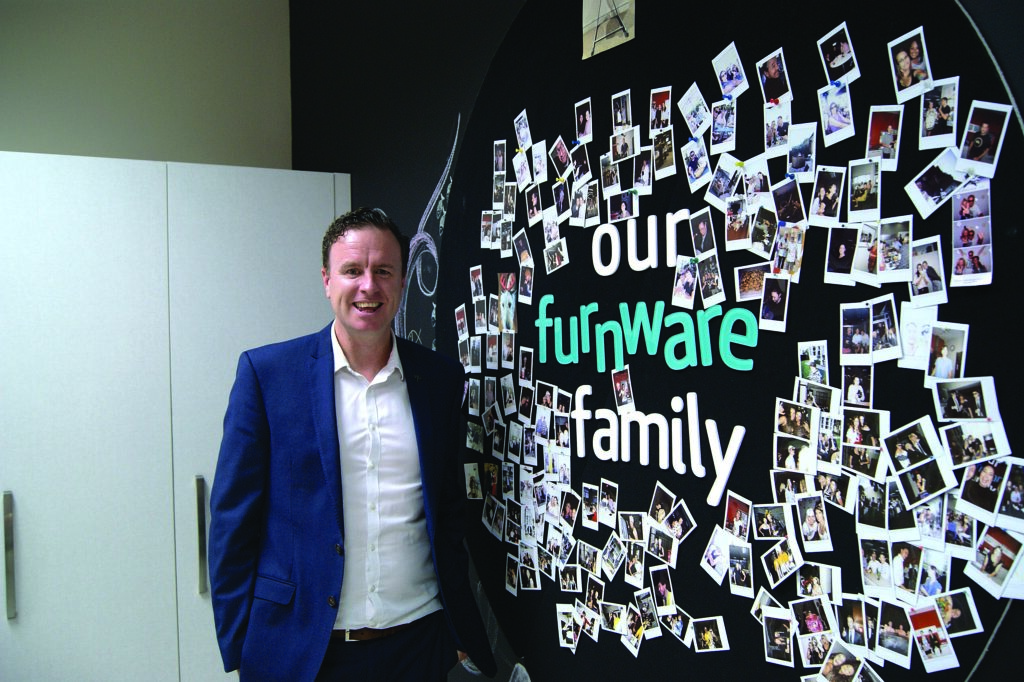
Furnware is one big family, as the staff room’s ‘Our Furnware Family’ display illustrates. Staff are encouraged to mark special family events, celebrate sporting and outdoor achievements, or just share personal milestones with their workmates. They also have a lot of fun and staff sometimes set up competitions, in teams, to fundraise or support a local cause.
The family theme comes naturally to Furnware because it is a family-owned business. In 1993 Hamish Whyte and his family purchased the company, determined to retain the business in provincial Hawke’s Bay and to source all construction materials in Aotearoa New Zealand.
‘All our main components are sourced here in New Zealand,’ says Furnware’s Country Manager, [New Zealand], Leigh Tasker. ‘The raw steel is manufactured by Industrial Tube in Hamilton, plastics from Whanganui, and our panel from Hamilton.’
‘The factory operates just like a normal family,’ says Leigh. ‘We trust the people we employ to do a good job – and they do! We do our best to recruit for diversity, then make sure everyone is comfortable and supported in their job and feel “at home” here,’ he said.
People and culture are the beating heart of Furnware and ample opportunities are available for staff to communicate individual requests to improve the workplace and staff wellbeing. ‘Staff can bring their dog to work, for example, so long as it doesn’t interfere with others being free to do their work,’ says Leigh.
There were two dogs in the open office area, contentedly resting near their owner’s workplace, and clearly well immersed in the staff culture. ‘They are very much part of the team,’ said Leigh, ‘and much loved by all the staff,’ he said.
Furnware’s school clients all have a strong focus on learning, but so does Furnware.
‘The whole factory is a school,’ says Leigh. ‘We are all learning and changing all the time. We learn from the schools we have relationships with, from our own creative thinkers, and from each other. We operate a high trust workplace, and we welcome everyone’s ideas on how we can be more efficient, more flexible and more responsive to children’s learning needs,’ he said.
The latest development is a suite of furniture supporting mindfulness for the growing neurodiverse population of children. ‘We learned from observing and talking to principals and teachers that a growing number of students have sensory and wellbeing needs,’ said Leigh, ‘and so we partnered with Mindfull, a new product design business whose mission is to design and build a suite of “mindful” classroom “aides” that take on this challenge,’ he said.
Furnware is well known for their innovative, flexible designs and long-lasting, hard-wearing products. That is why many schools in Aotearoa purchase Furnware furniture. Principals are drawn to the company, not just for the high-quality furniture, but because Furnware staff draw their design inspiration directly from children and teachers.
‘Key to our success,’ says Leigh, ‘is that we go out to the schools and ask them to describe their pedagogy and tell us what they are trying to achieve. Our job is to listen and support them with products that will help the children reach their learning potential,’ he said.
The researchers and the designers carefully observe the children in their learning environments and listen to the aspirations of the teachers and school management staff. They apply these observations and conversations to their design knowledge and skills to create furniture which will best meet each school’s needs.
‘That is how we decided to eliminate all hard, sharp edges on our furniture,’ said Leigh. ‘All our tables and storage furniture have smooth rounded edges, to keep the children and teachers safe.’
Engaging with principals, teachers and children is also the reason that Furnware strength tests every new product. ‘We have special machines that are programmed to repeatedly test the strength of our furniture. This gives us the confidence to know that everything we produce will be durable and withstand the rigors of classroom life,’ he said. ‘We have learned from the school principals that they want their classroom furniture to last and not have to endlessly replace broken equipment.’
Through building these close relationships with schools, Furnware is constantly looking to improve their selection and keep up to date with changing school routines and learning approaches.
‘We have a table named the “Paparoa Table” and another the “Endeavour Table”,’ he said proudly. ‘These were designed through ideas that came from the Paparoa Primary School in Christchurch and Endeavour Primary School in Hamilton.’ The Paparoa table has a whiteboard top for writing on, and a ‘curved cut out’ for the teacher to work with small groups of children. The Endeavour table is also curved and is mobile for flexible learning spaces. So, when you ask, “Who put the curvature in the furniture?” The answer is principals, teachers, and children.’ Unsurprisingly, many schools have since found the Paparoa and Endeavour tables useful additions to their own learning environments.
The business operates on the improvement principle, believing that you never reach perfection. Whilst their first goal is to support children to learn and grow, close behind is to provide an exceptional customer experience. ‘Our job is not finished when the order is delivered,’ says Leigh. ‘We contact the school later and go back to make sure everything is working exactly as intended,’ he said. ‘We map every “touch point” in the process and then check out how we did. With this feedback we are constantly improving,’ he said.
The company has a low staff turnover, staff satisfaction is high, and the business has expanded to 32 countries including Hong Kong, Singapore, Dubai, and Australia.
‘Staff feedback tells us this is a wonderful place to work, but we know it’s not about us. It’s about everyone. Everyone is trusted, empowered, and encouraged to take an active part in the business, and they do,’ said Leigh.
As the oft recycled quote goes, ‘If you are the smartest person in the room, you’re in the wrong room.’ At Furnware, humility and collective success is highly valued. Breeding individual stars? Not so much. Setting a culture where all staff can be curious, caring, and courageous? Absolutely!
To return to the question of whether school leaders can learn useful strategies from the business world, I leave it to the readership to decide. But if school leadership is having a common vision and purpose for your school, which every staff member fully understands and adopts; creating a high trust environment where every staff member’s contribution is valued equally; building reciprocal relationships with every student and their whanau; observing, listening to and acting on your students’ and whanau ideas and suggestions; viewing your entire school community as one extended family; celebrating school successes together as a community; and constantly looking to make improvements, then perhaps school leaders can absorb some valuable lessons from the business world.