
Since Waitangi we have been flying Tino Rangatiratanga at my kura. Every day 8 year old Reade Murrie raises a flag on our school flagpole. We have done our research and we know that we need to ensure that we give equal mana to our New Zealand flag and Tino Rangatiratanga. For Reade and his Pāpā flying Tino Rangatiratanga is a proud statement about Māori sovereignty and Tiriti partnership.
Toitū te Tiriti
According to the New Zealand Herald there were an estimated 50,000 people at Waitangi this year. Many of whom were young people wearing T-shirts emblazoned with Tino Rangatiratanga, Toitū te Tiriti and 1835 Te Whakaputanga. In an interview with RNZ, Hīkoi leader Reuben Taipari talked about the new generation of Māori young people:
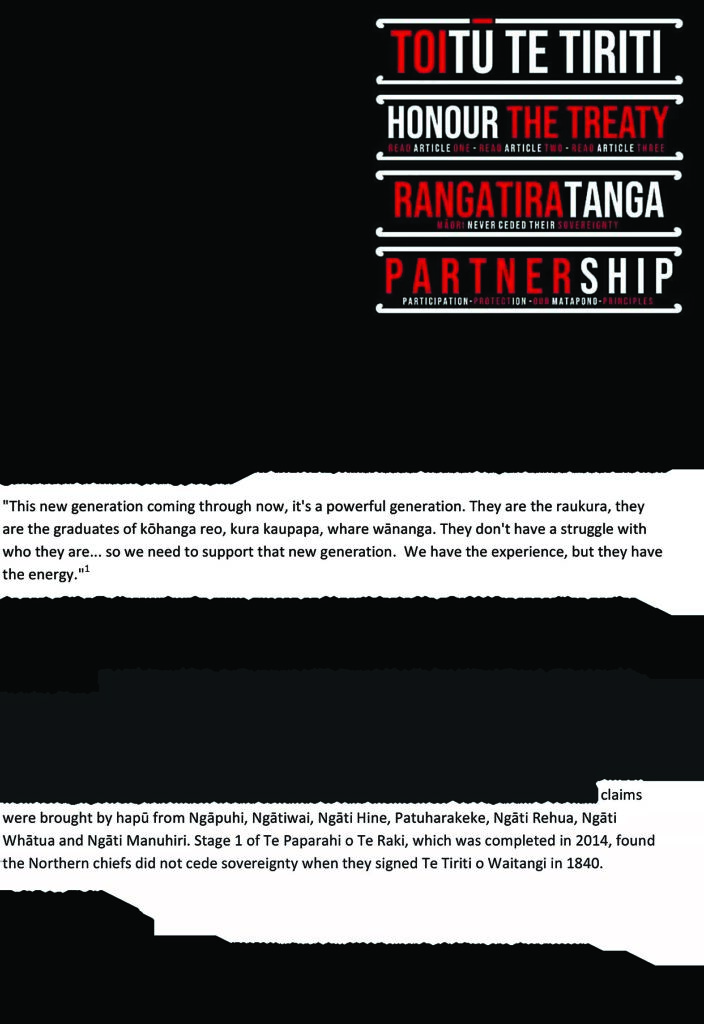
‘This new generation coming through now, it’s a powerful generation. They are the raukura, they are the graduates of kōhanga reo, kura kaupapa, whare wānanga. They don’t have a struggle with who they are . . so we need to support that new generation. We have the experience, but they have the energy.’1
As part of the Te Korowai waka crew, my son and I participated in pōwhiri for opposition parties, government, the Kingitanga and the Governor General. The haka was powerful. My son Manu is 13 years old. Whilst he doesn’t fully understand the details of David Seymour’s Treaty Principles Bill – he knows that the Waitangi Tribunal’s report of Te Paparahi o Te Raki (Great Land of the North) Inquiry, found that Britain wanted sovereignty and the right to make laws over both Māori and Pakeha when it invited Ngapuhi chiefs to sign the Treaty. The chiefs, however, believed – based on the Māori wording of Te Tiriti and explanations by Governor Hobson and others – they were only giving Britain the right to govern its own settlers and keep the peace. Britain would protect Māori from foreign powers, but Māori would continue to rule themselves. Te Paparahi o Te Raki claims were brought by hapū from Ngāpuhi, Ngātiwai, Ngāti Hine, Patuharakeke, Ngāti Rehua, Ngāti Whātua and Ngāti Manuhiri. Stage 1 of Te Paparahi o Te Raki, which was completed in 2014, found the Northern chiefs did not cede sovereignty when they signed Te Tiriti o Waitangi in 1840.
Toitū te Tiriti
As our waka crew waited for Dame Cindy Kiro to enter the Treaty Grounds I found myself thinking long and hard about my own role as Tangata Tiriti. As a Pākehā leading a kura where 60 per cent of my tamariki whakapapa Māori and where 100 of my tamariki learn in Te Reo Māori, I have a duty to them to ensure I consider this role frequently. The best summary of the role of Tangata Tiriti that I have read, was written by Tina Ngata. She recommends, ‘a few things that justice requires of Tangata Tiriti.’
I have summarised Tina Ngata’s 10 recommendations – some of which I hope you will find challenging – I know that I do. You can find them in detail in the article referenced below:
-
Be tau (at peace) with your position*. You need to be able to speak frankly about the process of colonization that created the space for you to be here in Aotearoa.*
-
Respect boundaries. So much space has been taken from us, so primarily you need to respect our boundaries where we lay them down.
-
Be prepared to make sacrifice*. If you understand the story of privilege that has shaped Aotearoa you will understand there has been a mass transfer of power. Justice cannot be restored without addressing the power imbalance.*
-
There will be many spaces where your voice will be valued*. Speaking to your fellow pākeha about being good Tangata Tiriti. Discussing what it means to be pākeha. Dispelling fear of decolonization.*
-
Stand with us for our language rights, for our health rights, for the rights of our children and women and stop perceiving Indigenous rights abuses as an Indigenous problem, rather than a colonial inevitability.
-
Benchmark the discomfort of your decolonization experience against that of our colonization experience, every time you want to ask us to wait*.*
-
Understand that learning our content and knowing our experience are two different things. Learning the reo is not your get out of Treaty free card.
-
Don’t expect us to know everything about Te Ao Māori or have our own identity journey sorted out for you. Colonization has made, and is still making a mess of our identity, and our relationships, and that is difficult enough without having to explain ourselves to you. Especially when you have yet to do the hard work on your own identity as pakeha.
-
Nothing is automatically a 2 way street. I, for instance, can talk frankly about what a good Tangata Tiriti looks like. Tangata Tiriti cannot tell me what being a “good” Tangata Whenua is.
-
Don’t expect backpats or thank yous*. You may get them (in fact you probably will – it’s another product of our colonial experience that pakeha are thanked and recognized for doing Tiriti justice work much more than Māori), but it’s important you realise that justice work is as much for yourself as it is for anyone else.*2
Toitū te tiriti
I am currently completing our Strategic Goals. Last year as part of our kaiako consultation process we used Core Education’s poster to consider what we currently see, hear and feel in our kura that enacts (we felt enacting is where we should be at) Te Tiriti o Waitangi. We then considered what we would like to see, hear and feel moving forward. It was a 30 minute activity in Staff Hui that gave me some clear direction for our planning.
Part 2 of this article will give some examples of what this mahi could look like in our kura. If you have examples from your kura I would love to share what you are doing. Email me at principal@ruakaka.school.nz
References
1	https://www.rnz.co.nz/news/te-manu-korihi/508521/waitangi-day-2024-thousands-of-visitors-one-clear-message

2	https://tinangata.com/2020/12/20/whats-required-from-tangata-tiriti/