
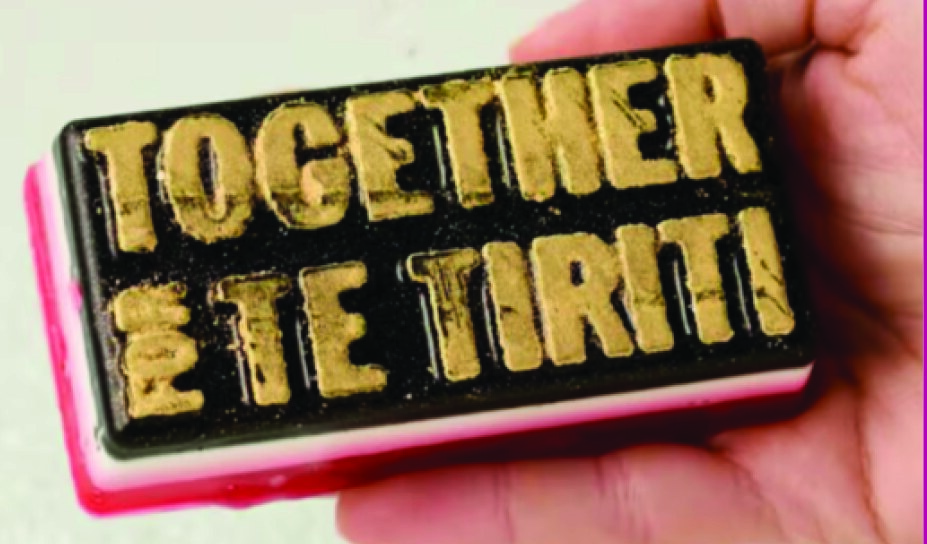
I never imagined myself writing the next sentence but here goes. In late January, I felt an overpowering compulsion to buy several bars of soap – one for myself and one for each of my four adult children.
Nothing to do with our family hygiene habits, however, the soap bars in question were part of a ‘Together for Te Tiriti’ limited edition made by the ethical, fair trade cosmetics company Lush Aotearoa. If you’ve ever visited a Lush store in any of our cities where they have a presence, you will no doubt have seen children and rangatahi congregating animatedly in and around them, attracted not just by the bright colours, tactility and fragrant aromas of the handmade products, but also by the highly visible, socially conscious corporate messaging, and the tangible opportunity this seems to give young people to feel part of doing right by spending right (much like Anita Roddick’s local franchisee-owned Body Shop stores did in my youth).
As reported by RNZ’s early career Māori News Journalist Layla Bailey-McDowell (2025), Lush launched an instore and online campaign to encourage customers to sign the rangatahi-led Ngāti Whakaue petition to stop the Treaty Principles Bill. The soap bar campaign is the brainchild of Lush Aotearoa’s advocacy and activism executive Jessielee Pearce (Ngāpuhi, Ngāruahine, Ngāti Hine). It is a collaboration that includes Lush Aotearoa and advocacy group Action Station and has the support of Linda Munn (Ngāi Pōtiki, Ngāpuhi), the kaitiaki and last living designer of the tino rangatiratanga flag. All profits from sales of the soap go to Action Station to fund its Te Tiriti justice work (https:// actionstation.org.nz/).
A couple of things stand out for me from this inspirational civil society ‘soap opera’. First, the campaign and the reporting of it are both youth-led. As we have seen frequently in the media over recent months, rangatahi Māori are now front and centre in 2025 calling out breaches of Te Tiriti o Waitangi. As their elders often say, the next generation have energetically taken up the moral and practical challenges of continuing ngā rōpū tautohetohe or Māori protest movements. Remember, for instance, Pania Newton and her cousins’ leadership of the occupation of Ihumātao? Or Hannah-Rawhiti Maipi-Clarke’s performance of the Ka Mate haka at Parliament?
Or think of the school and kura students of all ages from around the country, tangata whenua, tangata Tiriti and tauiwi, who attended te Hīkoi mō te Tiriti in our provincial cities or marched through Wellington to Parliament to protest. Children’s participation was forcefully disapproved of by some politicians and tumuaki principals because ‘every day matters’ in school attendance; but was equally forcefully defended by other politicians, tumuaki principals, and the children’s families and whānau, as a fundamentally important, formative ‘witness to history’ moment for them.
And of course, it’s not just rangatahi Māori leading and taking civic action on justice issues that really matter to them. In the same historical tradition, we must include the impressive social media-coordinated ‘hashtag activism’ national strikes that involved some 170,000 school students aged 8 to 18, organised by Strike 4 Climate NZ (led by Sophie Handford and Raven Maeder), and 350 Pacific—also known as Pacific Climate Warriors (led by Mary Moeono-Kolio and Kalo Afeaki).
Second, the moment shows us that Te Tiriti justice discourse has now irrevocably entered our mainstream popular culture, here in the form of a $13 bar of soap, but elsewhere also very creatively in fashion, the visual, performing and recording arts, and social media; led too in many instances by children and youth. Popular cultural texts articulate and reflect the interests, hopes, aspirations, anxieties and fears of ordinary people, including children. Popular culture actively shapes and is shaped by lived experiences, the personal and collective commitments to action that people make, and by their interactions with our social institutions, including schooling.
In mid-2024, the Prime Minister told Newztalk ZB’s Breakfast host Mike Hosking that he was prepared to see schools defer arts and music curricula in order to raise achievement in functional maths and reading. And in late 2024, the Minister of Science, Innovation and Technology announced the cutting of humanities and social sciences research from the Marsden Fund in order to focus the fund on core scientific research ‘with a purpose’. Yet, any school principal or tumuaki worth their salt as a leader of learning and children’s development knows that many children and young people make sense of their puzzling, adult-dominated worlds primarily through the arts, humanities and social sciences: learning ‘with a purpose’. We adults get to learn about what matters to children, and what appeals to them, by engaging with their popular cultural texts. We educators ignore the message or the media at our peril and we need to see all the curriculum learning areas as equally essential ‘basics’ in the social self-formation of Aotearoa New Zealand’s future generation, not optional ‘frills’.
Together, the lyrics and video of Canadian singer-songwriter Frazey Ford’s 2020 song, The kids are having none of it, speak evocatively and poignantly to adults about issues that matter to ordinary children (According to Ford the cast in the video are all friends, mothers and neighbourhood kids that her son grew up with). These issues that matter include children’s utter frustration and disappointment at many adults’ apparent passivity and indifference in the face of trenchant social injustice and environmental collapse. Speaking to her adult audience, Ford sings that she is not worried because she knows that children will not unquestioningly take on the values of their elders, nor be bought, nor be taught their hate; but they will want to ‘play’ the game of life in their own way. She channels children’s existential frustration at adults’ willingness to accept a deeply corrosive social, economic and environmental status quo: ‘Get out of the way, you’ve had your day. And it’s no longer how we gon’ play’.
Self-evidently, schooling can be seen as part of the problem for children, or just as easily part of the solution. Principals tumuaki, take note.
References
Bailey-McDowell, L. (2025). ‘Together for Te Tiriti’: Lush joins fight against Treaty Principles Bill. https://www.rnz.co.nz/news/ te-manu-korihi/540520/together-for-te-tiriti-lush-joins-fight- against-treaty-principles-bill
Ford, F. (2020). The kids are having none of it. https://www.youtube. com/watch?v=Tge9e-DJhAM&list=RDTge9e-DJhAM&start_ radio=1&rv=1jcaL_Is6yY