
A place named Swannanoa has to be visited. Turns out an American, John Evans Brown – nicknamed ‘Yankee Brown’ by the locals – settled in the Waimakariri farming District in 1864, and named his land Swannanoa, after the Swannanoa River in Western North Carolina. When he eventually returned to his homeland, he named his home there ‘Zealandia’. Something of a giver and a taker, was ‘Yankee Brown’!
I’ve attended many school fairs but never before have I been brought to a standstill by a queue of traffic 1.8kms from the fair gate. As my friend and I inched our way down the North Canterbury Tram Road towards the Swannanoa School, about a dozen Aberdeen Angus bulls inched their way towards the Tram Road fence. We came to a halt parallel to the big beasts, who had also stopped – to stare at us as curiously as we stared back. As we crept on, at the pace of a tardy tortoise, my friend suddenly exclaimed, ‘Just as well you’re not driving your bright red car today!’ We spontaneously swung around – just to check – that 8,000 kilos of raging bulls were not about to crush our car!
The bulls continued their static staring, and our focus soon shifted to the many families, laden with picnic baskets, camp chairs and rugs walking from the northern end of Tram Road towards the fair’s gate. Some had parked several hundred metres further down the road.
Many fields surrounding the school had morphed into car parking spaces for the day, but by the time we were directed to our paddock, several others were already at capacity. It wasn’t yet 10:00am, the official opening time. The main entrance to the fair was across the road, so off we trotted to spend our cash and support the school. That was the deal.
I later spoke to Te Koromiko Swannanoa School principal, Brian Price. Brian told me that the Swannanoa Country Fair – its official title – had featured on the school calendar for 25 years.
‘It started as a car boot sale back in 1998,’ chuckled Brian, ‘and today it has set up costs of about $25,000,’ he said. ‘According to a rough count of our gate takings this year ($5 per adult with children free) we welcomed somewhere between 12,000–15,000 people. We’ll know more when we get the final figures in,’ he said, ‘but this year we got the perfect storm. The weather was kind, and all the stall holder spaces were gone by February.’
The fair missed a couple of years after the Christchurch earthquakes, but other than that it has been an annual highlight – and every year it just gets bigger!
‘I reckon we draw the biggest crowd of any school fair in the country,’ said Brian. ‘They now come from all over the South Island,’ he said.
I believe him. I can’t think of another school fair, including in Auckland, that would attract 12,000–15,000 people, but the record is open to challenge!
The most astonishing thing is that the Swannanoa Country Fair gets little if any paid promotion, although it does get a nudge through the local radio stations. It is held in the country, a half hour’s drive from Christchurch, yet the people come in droves, from every direction. The word got out first within country circles but the fair’s special character – as a community event – a festival of family friendly fun – now ensures much wider popularity.
Organising the Country Fair is a joint effort between the school and the local community, and all the profits go straight back to the school. ‘The fair is our school’s major fundraiser,’ explained Brian.
I spoke to one parent who has had children at the school for six years. ‘The fair is extremely well known now and that’s just happened by word of mouth – and every year we get more and more people coming,’ she said.
‘We work for months on the organisation and each year, we learn something new or something we could do better next time – it’s all voluntary hours given by the families and staff, and we all go above and beyond to make sure the fair is a success,’ she said.
‘Last night there were volunteers here till 11pm finishing the last of the set up. Everyone wants to play their part, and everyone does what they can. It’s a wonderful way for new parents to meet others and is a true community effort for the school. In the end, it’s all for the children,’ she said.
‘Between our fair sponsors and the school community, we’ve raised thousands of dollars for our school over the past two decades,’ said Brian. ‘We are a high decile school so our Government funding is lower, which means we have to fundraise for any upgrades to our school facilities,’ he said. ‘That’s the deal.’
‘Like most schools, we never get close to the funding we need for learning support,’ said Brian, ‘so every year, the first half of our school fair profit goes straight into learning support, such as funding more teacher aides, so that our children with diverse needs don’t miss out,’ he said.
Te Koromiko Swannanoa School has stretched its identity in the past decade or so, as the community has moved from a strictly farming district, to a mix of lifestyle blocks and farming. The formerly small rural school has grown to be a much larger semi-rural school and approximately 320–350 children of Years 0–8 are expected this year.
‘The school has always been – and continues to be – the centre, a meeting place for the community, and the school fair is one of those events that connects us all,’ said Brian.
‘One thing we have always retained is a strong set of rural values. For example, we have a “seeds of learning” programme within our National Curriculum that reflects our community. This includes animal husbandry which the children engage in,’ he explained.
‘We grow our own chickens and sell their eggs, breed goats, feed and care for them and sell the baby goats – we’re the only school in the country that sells kids,’ he chuckles.
The next project will be establishing bee hives and selling the honey.
‘These are some of the ways the children learn the purpose of farming animals,’ said Brian.
Brian later took me on a tour of the massive school grounds, which stretch across five hectares of land, including several large paddocks, where the goats and chickens are raised, a fruit forest is under development, to complement the edible gardens, and seedlings are propagated for building up the school gardens. A space is also leased to the local Community Pre-school. ‘All the food we grow here, including the fruit, is for the use of our community,’ says Brian, ‘and the children are directly involved in all of these projects,’ he said.
The school is in partnership with the Waimakariri Biodiversity Project called ‘Seedlings in Schools’ and we have acquired a bespoke seed growing structure to nurture and grow the seedlings into plants. ‘The children raise them and we plant them out in our own school gardens. Any surplus plants are sold – including at our fair,’ explained Brian.
Locals support the school through working bees. ‘Our community is deeply invested in the activities of the school and our people are incredibly unselfish when it comes to volunteering their time and equipment, especially when it comes to outdoor projects,’ says Brian.
Parents and students of the school have developed beautiful tracts of indigenous harakeke, and other native bushes and trees – including koromiko bushes. The koromiko is indigenous to the area and is now represented in the school’s name.
The school was gifted their name, Te Koromiko, and cultural narrative by the local Ngāi Tūāhuriri Rūnanga, who have resided in the Waimakariri area for over 40 generations.
Brian explained that to enact Te Tiriti o Waitangi in his school, as required by the Education and Training Act 2020, he needed to connect with the local Rūnanga and Ngāi Tahu Iwi. He aspired to immerse the children and their whānau in the cultural stories of the whenua (land), but he would need help.
‘Ngāi Tūāhuriri Rūnanga were incredibly generous with their time, knowledge and expertise,’ said Brian, ‘and so we began our cultural journey. Most importantly, we could not rush our community,’ he said. ‘They needed time to discuss the cultural concepts which – for most – were new ideas, and we gave them plenty of opportunities to reflect and ask questions. Through conducting surveys at each step, we made sure that every decision was theirs to own,’ he said.
Brian explained that what they achieved in the end was a cultural narrative which includes the school’s values, its name, and its stories. The school’s taonga (values) are woven into the daily life of the school through the PB4L (Positive Behaviour for Learning) programme, and include Community (Whakawhanaungatanga), Success (Ako), Respect (Kaitiakitanga), Kindness (Kotahitanga) and Integrity (Tikanga). These values are reflected in the Five Peaks programme through which children are encouraged to explore their interests, and develop skills which align with the overarching theme of success (Ako). Added to these values are the rural aspirations, shared by the community and embedded in the narrative through the school’s ‘Seeds of Learning’ programme.
Further, the school’s organisational structure, or school Hapū, are now named after the native birds of the whenua – Years 0–2 Pākura, Years 3–4 Piwakawaka, Years 5–6 Kārearea and Years 7–8 Ruru. Buildings are named after different parts of the koromiko bush. These practices pull the cultural narrative into a holistic philosophy – a beautiful set of ideas to live by.
Pounamu carvings etched in Oamaru stone and mounted on wooden Pou are visual reminders representing the school values and were designed and carved by local iwi experts. These carvings are named Roimata (respect), Toki (Integrity), Pikorua (Community) and Porowhita (Success). To commemorate the school’s 150th anniversary (1871–2021) artist Shaugn Briggs and a team of student sculptors carved a special pounamu incorporating all of the school’s values, hapū and symbols of those things held dear by the school and its community. It is a beautiful piece of art and a story in itself of the connectedness of the whole school community to its whenua.
‘Our cultural narrative is a beautifully connected whole,’ says Brian, ‘A true taonga for our school – a partnership with our tangata whenua – and links our community at every level,’ he said. ‘We are also incredibly proud of our kapa haka group and how special they are to both the children and their whānau,’ he said. ‘Our community has come a long way culturally, and we are all incredibly proud of the progress we have made together,’ he said.
‘All of these activities, together, provide the children with a sense of empathy and a deep knowledge of both cultural and rural values,’ he said. ‘They want these values retained and that is one of the main reasons they want their children at our school,’ he said.
Te Koromiko Swannanoa School parents love the sense of connection the school offers and they love being involved in the school, especially in organising the school fair. That is just as well, because there is an expectation that every parent will contribute whatever they can, through whatever skills they have, to organising the school fair.
‘We have the knitters and sewers, the builders, the bakers and the candy floss makers,’ he laughed. ‘Just organising traffic control requires an enormous team of 20+ parents who do a fantastic job, marshalling the cars all day,’ he said.
There’s also the building of the stage and sound system for the bands, the ever popular ‘Jump Jam’, the Pooh Bear ‘dance classes’ and the North Canterbury Belly Dancers. The ground has to be marked out for the different sponsors, businesses and individuals to exhibit their products and services. The children’s fun zone of a dozen or more entertainment, climbing, sliding and exploring inflatables must be set up, along with the giant pool for the plastic boats, their games and rides. There’s a convoy of giant trucks, including military vehicles, and a display of vintage cars to inspect. Not to mention the dozens of portaloos to be positioned.
One teacher at the fair told me that ‘Our school children also like to take part, and many senior children sign up to help at the fair. This supports them to learn independence, confidence and extend themselves,’ he said.
It also gives them an opportunity to earn ‘points’ for the school’s ‘Five Peaks’ programme. One senior student, helping out on the school cake stall, explained that the ‘Five Peaks’ are represented by the five school values. By helping at the school fair, you can earn points for more than one of the ‘peaks’ she explained. She proudly showed me the five badges sewn on the arm of her school uniform, indicating that she had already completed the ‘Five Peaks’ programme. Clearly these values were well ingrained and now she was keen to volunteer, for the sheer pride of serving her school and community.
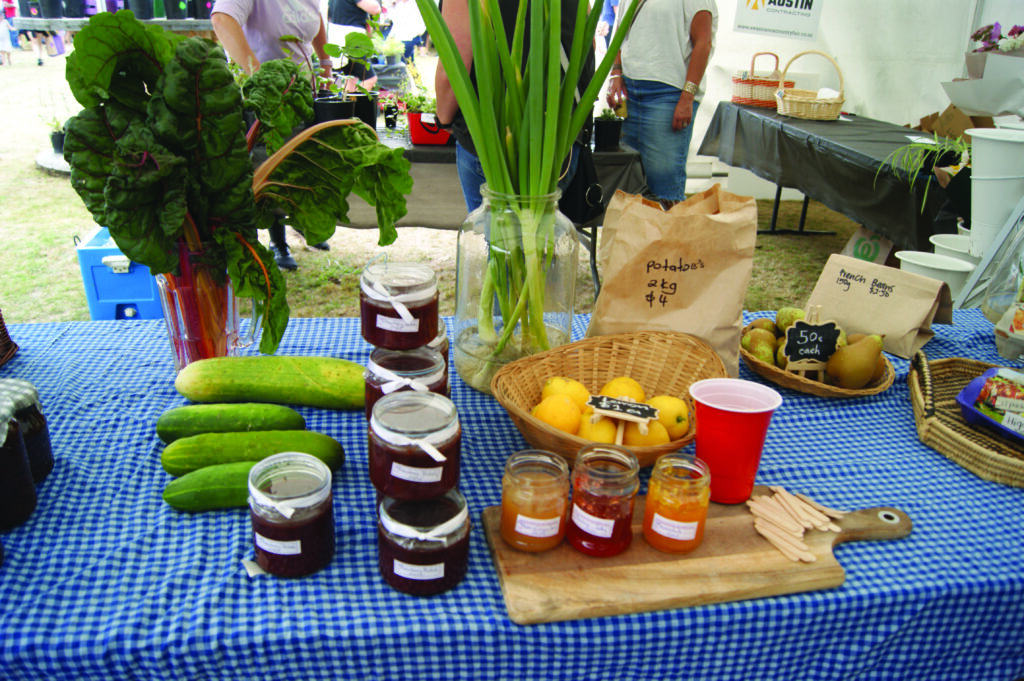
Touring the Country Fair’s stalls was a bit like visiting your Great Auntie Annie’s cottage. Coconut ice, fudge, layered sponge cakes – sold in very generous slices – home baked loaves, biscuits, slices and squares, hand knitted babywear, jumpers and cardigans, homemade jams, pickles, jellies and preserved fruit, fresh eggs, freshly picked fruit and veges – you could even order a live laying chook for $35 – and of course there’s the always popular netball court sized ‘White Elephant’ stall where you’re bound to find little treasures amongst the trinkets, or you might choose a hoodie from the rack or a book from the carefully categorised ‘second hand library’ in the ‘calm space’. There were wooden trains and trucks built by someone’s retired grandfather, and framed photos, reflecting the district’s proud farming history, were the focus of a mother and daughter team.
Naturally, there were strategically located coffee vans and the sausage and onion sizzle was a winner all day long. The two dads turning those sizzlers on their expansive grills never saw the end of the queue during our four hour visit. It was accepted the barbecuing pair would generate lengthy wait times and some even brought a book to read as they patiently contemplated their sausage sandwich treat.
We were all delighted when the school’s very large kapa haka group assembled at the front of the stage to give us a rousing performance, despite having little practice time. They were superb and well appreciated by the audience. ‘We are so proud of our kapa haka group,’ said Brian. ‘They were so excited to be performing at the fair and have been practising every spare minute,’ he said.
As the massive crowd shuffled its way through the maze of craft and trade stalls they did so to medleys of ‘country style’ music, interspersed with stage entertainment. One such episode involved the arrival of Pooh Bear who danced to a different tune and taught his gathered audience a string of dance moves that only a rolly polly bear would invent. Meanwhile others stretched out on the many scattered hay bales to watch and enjoy.
Pooh Bear wasn’t the only show of the day. Afterall a school fair must have some element of education, and this year the education came from an enthusiastic bunch of kitted out firemen. The Fire Safety Team came complete with their cooking caravan and proceeded to demonstrate what not to do in the privacy of your own kitchen.
They set the gas element going and placed a pot – partly filled with oil – on the demonstration stove. While it heated up, the firemen educated us. We learned about how fire alarms can literally save lives. We learned to keep low when exiting a burning building and to keep away from glass which may explode. We learned to leave everything behind, to get out quickly and stay out.
Through short catchy phrases, we learned ‘Don’t drink and fry’; ‘Keep looking while you’re cooking’, ‘Get out and stay out,’ ‘No water on the fat fire.’ Little quizzes were put to the children on the ‘fire facts’ and then the ‘Big Reveal’! The pot of oil got so hot, it burst into flames, and when, for effect, the fireman put water on the oil, it flared even more. It took the fire hose to put it out. For some the fire display was the highlight of the day, and certainly it was an educational feature of the day.
If you ever get the chance, visit the Swannanoa Country Fair. It truly is a festival of fun and food, art and craft, entertainment and education. The atmosphere is ‘country’ and authentic, like the food and the handcrafts. The people are down to earth and genuine. You won’t find pretence on display at the Swannanoa fair. The people know what service means, they know what connectedness means, and they can do both with a roll of No. 8 wire. Above all, they want to see these values embedded in the next generation. That’s the reason for the Swannanoa Country Fair. It’s a pretty good deal!