
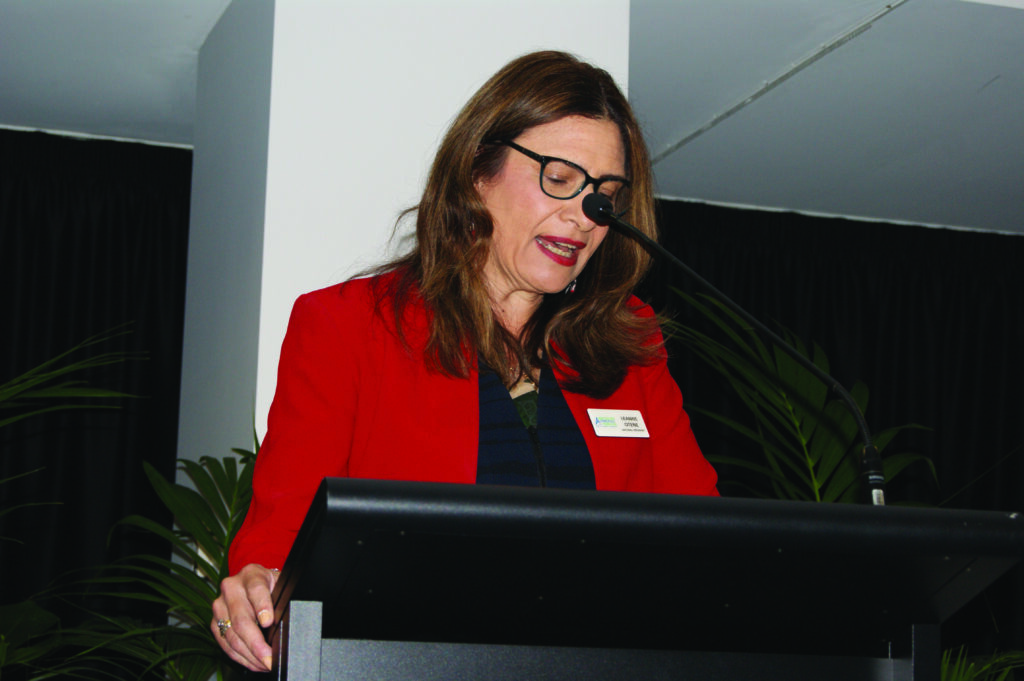
As always, NZPF Regional Presidents enthusiastically turned out for the Moot this year – filling the room with animated debate, discussion and most importantly – contributing the regional voice – to shape the on-going policy and mahi of the NZPF National Executive.
President, Leanne Otene, has championed regional voice during her presidency, ensuring that no NZPF position is formed without taking account of how it might affect the membership across the motu. She does this through consultation with the regional leaders.
Moot is not the only forum she uses to determine the mood of principals across the country. She has also introduced regular ‘zoom’ meetings with regional presidents, which are issues focused. This gives her the opportunity to listen to the different regional views and learn from them how best to act as the national spokesperson. She knows that Government policies can affect different regions in different ways, and is acutely aware that she is elected to represent all principals. Giving regional presidents a strong voice has opened up the communication lines and the opportunities to share good ideas, for the benefit of all.
The NZPF executive team is always on the lookout for better and more effective ways to draw out the regional voice. This year some changes brought two panel discussions to the Moot programme which included a geographically spread selection of four regional presidents and a panel of four Māori and Pacific Island representatives. Panellists were interviewed by the ever popular, prize-winning journalist, Jehan Casinada.
Interactive activities were also injected first by two executive members, Jason Miles (VP) and Stephanie Thompson. They presented a novel way to draw out the elements of sustainable school leadership, while at the same time measuring how sustainable school leadership in Aotearoa New Zealand stacked up – by measuring responses through ‘mentimeter’ technology in real time.
More interactive activities through Q and A sessions with the two guest speakers, Tim White – the Chief Leadership Advisor in the Ministry and Pauline Cleaver – Senior Curriculum Hautu in the Ministry, were also popular and yielded helpful insights.
The regional presidents were also invited to give their feedback on how to improve the strategic plans of each of the NZPF Pou on areas of work, including leadership, curriculum, learning support and policy/ legal/ constitution.
In 2023 the regional presidents developed a set of six principles to guide NZPF in their mahi. They represent a ‘moral compass’ to check that decisions made are ethical and moral. These principles were also included in the NZPF 2023 political manifesto, setting out NZPF priorities for education. Since election year is nearing again, it was felt that now was a good time to revisit the six principles to test their relevance. Hayley Read and Heidi Hayward from the national executive led the session which called for feedback through a pre-prepared survey.
Below is a more detailed account of each of the Moot undertakings, including feedback from the regional presidents.
The theme of the Moot was ‘Effective, sustainable school leadership.’
Following the official opening by NZPF Kaumatua, Haterei Temo, President, Leanne Otene gave her opening address.
NZPF President, Leanne Otene
Leanne opened the Moot by welcoming the regional presidents and special guests and thanking the presidents for their contributions both to NZPF and their own regional members, throughout the past year. ‘I cannot express just how valuable our discussions and your feedback have been in the past year,’ she said.
‘When acting as your National President, I draw confidence from your feedback. I feel the power of your numbers and the weight of your support behind me and this gives me strength to voice what is right for you and for our tamariki, no matter what the issue of the day,’ she said.
With one eye firmly fixed on the theme of the day, she then proceeded to explain the four essential principal leadership dimensions including:
- Setting expectations through a clear vision.
- Leading learning.
- Fostering Collaboration.
- Developing staff, people and capacity.
She referred to the recently released UNESCO Global Education Monitoring (GEM) report, which included a sample of 92 countries including New Zealand, to show that only 20 per cent of school principal preparation and training programmes globally focus on all of these dimensions and barely half of them focus on any.
She noted that leadership implies decision making and the autonomy to make decisions. On that score, New Zealand rates well, she said, since we are all self-managing schools, however compared to the sample of countries in the study, our Government’s contribution of GDP to the education system is relatively low. So while we can make the decisions, we do not always have the financial capability to fund the necessities of our diverse contexts.
She also noted that increasingly, control over curriculum decisions was under threat of political interference. She illustrated her point using the current directive from the Minister to introduce Structured Literacy and Structured Maths with testing twice yearly for Year 0–8 students. What is missing from the Minister’s directive, she said, was a response to the huge demand from schools to provide increased learning support structures. Unless professionals are involved in the co-design of the curriculum, we will not succeed, she said. Principals are the leaders of learning and next to the classroom teacher, have the greatest impact on children’s learning, she said. That means we must be involved in all curriculum matters.
This led her to remind the audience of their stated preference for a Cross-Party Coalition for education policy-making so that long-term plans and decisions could be made without the constant changes coinciding with the three-year political cycles.
She spoke at length about professional learning and development noting that at the leadership level, teacher level, and support staff level, PLD was found wanting. She also addressed the need to create ways for the profession to collaborate, share knowledge and skills and mentor and coach future leadership potential to ensure an ongoing stream of high quality school leaders. Whilst many school principals did an excellent job of growing new leaders, there were few resources to call on and insufficient release time to do the job well, she said. This is clearly not sustainable.
‘The system is inequitable at every level, and rural schools are especially disadvantaged. It is no surprise that it is becoming difficult to attract high quality leaders to small or remote rural schools,’ she said, ‘with the responsibilities far outweighing the remuneration and resources and access to PLD.’
She also addressed hiring practices, which the UNESCO report also discussed, saying that the problems were not so much about fairness, but more about the quality of appointment panels which school boards could muster, and the availability of talented candidates applying for some smaller and rural schools.
‘We need strong eligibility criteria for principalship, and better on-going support for beginning and remote school principals,’ she said. She also noted the progress the Ministry leadership team had made in establishing an induction process for principals shifting schools or beginning their career as principals, which will make a huge difference.
Principals need preparation for setting a vision and culture for their school that is relevant and true to the aspirations of their tamariki, staff and community, she said. That means a high level of expertise in relationship building. Sadly, she said, some new principals have not developed these essential skills and more needs to be done in preparing our middle leaders and aspiring principals so they do not crash at this first hurdle. The UNESCO report noted that half of principals do not receive training in these skills nor in administration skills which are also critical to being a successful leader.
She suggested that establishing a Leadership Centre would be a useful way to bring all school leadership issues together. ‘It was one of the recommendations of the Tomorrow’s Schools Review, she said, but all these years later has still not become a reality. She noted the work of NZPF in researching other jurisdictions such as Ireland, Wales and Scotland who do have models of Leadership Centres and noted that a goal for the NZPF executive was to pull together relevant aspects of these models to create a bespoke Aotearoa New Zealand model. ‘This work will continue,’ she said, ‘and we are pleased that the Minister is also in favour of the concept.’
She concluded with a challenge, to find a way to attract more quality school graduates into teacher training so that we can be assured of a quality future workforce that is sustainable and thus create a career pathway to future sustainable leadership of our schools.
Keynote Speakers – Pauline Cleaver, Ministry of Education, Hautu, Curriculum
Pauline presented an update on the curriculum changes and assessment saying that the Ministry is trying to be as consistent as possible, in the knowledge that the audience of schools is vast and varied. ‘Giving you the correct messages is our aim,’ she said, ‘and your feedback is important to us.’
She outlined the six priorities that guide the Ministry’s work on curriculum which are:
-
Clearer national curriculum – establishing a knowledge-rich curriculum grounded in the science of learning.
-
Better approach to literacy and numeracy – implementing evidence-based instruction in early literacy and mathematics.
-
Smarter assessment and reporting – implementing consistent modes of monitoring student progress and achievement.
-
Improved teacher training – developing the workforce of the future, including leadership development pathways.
-
Stronger learning support – targeting effective learning support interventions for students with additional needs.
-
Greater use of data – using data and evidence to drive consistent improvement in achievement.
These are the priorities as they apply to the curriculum changes the Minister announced last year. The changes come with PLD and resources which are fully paid by the Ministry.
‘Getting the maths resources out to every school has been an extraordinary undertaking,’ she said. ‘I know there have been some delays, especially with Numicon, which did take a while and we apologise to those who had to struggle with that,’ she said.
She was emphatic in saying that the resources are not the curriculum. ‘They are there for teachers who need more scaffolding,’ she said. She noted, however, that the writers of the curriculum were very clear about the stages of the curriculum and that the PLD may need to be extended. ‘This extra support must not be seen as taking away from how your teachers teach,’ she said.
She assured her audience that there would be extra money in the Operations Grant for structured literacy and maths, and that there was a five-year ‘roadmap’ for implementation.
Moving on to assessment, she said ‘We tried to use e-asTTle (electronic assessment tool for teaching and learning) but it isn’t possible. We couldn’t guarantee that the numbers of schools using it would not crash the system,’ she said. ‘Besides we want an assessment tool that is socially relevant to the New Zealand context and aligns with the new curriculum without making a huge investment.’
‘We need a platform that is stable for updating content and that uses the latest technology,’ she explained.
She summarised the key changes that took effect from term one this year. They included the requirement for primary schools to teach the updated:
-
English and Te Reo Rangatira for Years 0–6.
-
Mathematics and Statistics, and Pāngarau for Years 0–8.
-
Release draft Maths, Pāngarau and Te Reo Rangatira Years 7–13 for consultation.
-
Making phonics checks and Hihira Weteoro available for students in their first year at school or kura.
In addition she noted the Ministry has also:
- Delivered maths textbooks and maths PLD for teachers of Years 0–8.
- Delivered Pāngarau resources for kaiako in Years 0–8.
- Started delivering Maths PLD.
- Continued delivery of structured literacy and Rangaranga Reo ā Tā PLD.
She then told the regional presidents what to expect next.
There would be information coming out about how to apply for Pāngarau PLD for kaiako in Years 0–8 and guidance and resources to support schools and kura with reporting to parents and whānau – which would focus on describing levels of achievement. For those wanting clarity on what to do in 2025, ‘Continue to use your current assessment tools and develop quality assessment and aromatawai practices,’ she said. She added that the draft English learning area content for Years 7–13 is out for consultation.
As the 2025 school year progresses, she said that schools and kura will be adjusting their assessment, aromatawai and reporting to reflect student progress against the new Years 0–6 English and Te Reo Rangatira and Years 0–8 maths and Pāngarau curricula.
She said that assessment information can be found in the new curriculum teaching guidance and teaching considerations sections of the curriculum. Best practice guidance will be shared later, she said, and new reporting to parents and whānau guidance will be added to Tāhūrangi shortly.
‘Regulatory requirements for reporting to parents and whānau have not changed, but schools are now required to report progress against the new English Years 0–6, and mathematics and statistics Years 0–8 learning areas,’ she said.
Phonics checks and Hihira Weteoro Te Kete Aromatawai Rangaranga Reo ā Tā for te reo settings are now available for schools and kura to use.
In concluding her presentation she noted that, in response to feedback, an implementation hub has been established on Tāhūrangi. ‘You just go to the implementation support page for supporting products and services to help you implement the changes. There you will find the five year implementation timeline which will be regularly updated.’
‘The hub also includes a kete of previous updates, news items and curriculum newsletters,’ she said.
Q & A Session
Q: The three-day PLD is a great start but it’s not enough to build capability. Can we expand on the ‘expert model’?
A: Yes, there is new money for PLD for structured literacy. As we unpacked how to prioritise the PLD budget, we built in PLD for structured literacy. We will look at the curriculum past practices to see what leaders need to support them into the future.
Q: First, there is a collaboration disconnect between the science of learning and our children with learning needs, which must be addressed – what is being done about this?
We used to have a curriculum team in the regional offices and we would love to see that come back because we don’t all have the funding to access PLD. What are your thoughts on that?
A: I agree there is work to be done for diverse needs students and there will be more said by the Government on that matter.
We have grown the curriculum advisory in our regional offices but now we need to connect to local expertise – we need to know where the pockets of knowledge are. We will never have all the expertise and will have to consider partners to facilitate the advisory.
Q: There is a disconnect between the maths resources and their phases and the way we organise our classes which are composite Years 1, 2 and 3. The new maths resources are not flexible to accommodate composite classes. What is your solution?
A: That was not the intention of the policy and we will need to work separately with you to resolve this problem.
Q: The Advisory Service for leadership is a tremendous service but it’s not working in the Far North because there are so many new principals. Most principals do no more than three years and there are not enough of them to support the area. Are there plans to get more leadership advisors in the North?
Secondly, the curriculum is more than just literacy and maths. There is art, social sciences and other subjects as well. Will the curriculum advisors be covering these subjects too? They will not come back through local initiatives only.
A: Tim White and Yolanda Meijer in the Leadership Advisory will pick up the rest of the curriculum. We want to be sure that local experts are part of the discussions in future. If the Kāhui Ako are not the way, then we have to find other ways.
Q: There needs to be trust and collaboration between the Ministry and principals to move forward. The trouble is, we get information gaps and they will be filled with ‘noise’. For example an RFP (Request for proposal) was posted on GETS (Government Electronic Tenders Service) searching for an online assessment tool for structured literacy and maths. Immediately principals think we are going backwards – to the national standards days and all the threats they brought with comparing schools publicly and league tables, etc. All of this angst could have been avoided if we had a greater trust relationship. How can this be fixed?
A: We have not been effective enough on this. It wasn’t intentional but it did happen, unfortunately. It was an incident that led us back to a tired debate.
Q: For specialist schools structured literacy is hard work. All our learners have high, complex needs. Were these students considered at all the stages of the changes, including access?
A: If we have an understanding of inclusivity for high needs students, the pay off should be great. I know your specialist schools association is committed and the DVG (Disability Voices Group) was heard in the design of all of the options.
Tim White, Chief Leadership Advisor, Ministry
Tim’s presentation was especially popular with the presidents because of the well researched, rich data he presented, much of which had been generated by the mahi of his 16 Leadership Advisors across the country.
He opened his address saying that the Government has a vision for high quality, effective leadership across all stages of a principal pathway, and the Minister is committed to a focus on growing aspiring principals. ‘The principal’s journey starts when they begin teaching,’ he said.
Sustainability is critical to the pathway and Tim outlined six features to achieve a sustainable future. The first of these is to be informed of reality. On average it takes 13 years for a beginning primary teacher to become principal of a very small school, 15 years to lead a small school, 16 years to lead a medium school and 17 years to be principal of a large or very large school.
Ideally, he said, a teacher would move up to a position of team leader or unit holder and then move into senior leadership before principalship. But only one third of primary principals, in the past ten years, followed that pathway. 15 per cent had no senior leadership experience, six per cent had no middle or senior leadership experience and 60 per cent had no middle management experience. For secondary principals, the statistics were very different with 92 per cent following the stages in sequence. Further, he added, statistics show that nine out of ten promotions occur internally.
The second feature of sustainability is learning and nurturing and this is where the leadership advisory [there are 16 seconded leadership advisors across the country], which Tim heads up in the Ministry, comes in. The service has been operating for several years now and is proving to be a popular and successful service. Tim thanked the regional presidents for inviting leadership advisors to participate in their regional meetings.
Leadership advisors have had 9,435 engagements with principals (some repeat visits or calls) and 5,860 of these have been face to face. Other times they have consulted online or by phone. 73 per cent of the schools are full or contributing primary schools and 10 per cent are secondary schools. ‘The service is certainly hitting the mark,’ said Tim.
Feedback is frequently sought and on the latest findings, 95 per cent of those who have engaged with their leadership advisor record high levels of satisfaction. The quality of support was described by 88 per cent as excellent. Tim also presented the main benefits to users of the service:
-
80 per cent said receiving advice, ideas or examples of how others have responded to similar challenges.
-
70 per cent said increasing clarity of what we are expected to do.
-
60 per cent said reflecting on my situation and practice, thinking out loud and brainstorming alternatives.
-
56 per cent said working collaboratively with others and reducing the feeling of isolation.
-
55 per cent said having a place to start and where to go next.
-
49 per cent said positively influencing the way I think about my role or how I will lead in the future.
The third feature of sustainable leadership is to have differentiated learning to suit the diversity of principals. A suite of learning modules is available for principals to complete including modules on school culture, pedagogy, systems, partnerships, wellbeing and Te Tiriti o Waitangi. By far the biggest category of learning modules is systems (37 per cent), indicating the level of administration tasks required of principals. These can be completed as principals have the time, but statistics show that there are far more who start modules than ever complete them.
Synergism is the fourth feature and neatly combines learning modules with podcasts on many topics, such as leading through change, ERO reviews, supporting students with diverse needs, legislation, strategies for connecting to the community, managing transitions and support systems. Podcasts have been created by experienced principals and give practical examples, which principal learners find helpful and real. There is a very clear synergy between the learning module and the podcasts. Shortly there will be 48 podcasts available to complement the learning modules. ‘Making podcasts to support beginning principals is an excellent way to give back to the profession and I know many of you are very keen to make a contribution in this way,’ he said.
The fifth feature is partnerships. Tim explained that when principals are in partnership with the Government they can play an active part in contributing to and supporting the system. In turn, they will receive support and benefits largely from the system. ‘We cannot do this alone,’ he said. ‘We have to do it with you, and we thrive on interacting with you. We need your wisdom and advice,’ he said.
He also introduced his audience to two recent publications entitled ‘Effective preparation for aspiring principals’ and ‘What does good look like? A programme for beginning principals’ support and development in New Zealand’.
The sixth feature of sustainable leadership is networking. Your regional leadership advisors will be working with regional leadership teams to organise regular induction hui for all principals starting in a new school and we would love regional associations to be involved in this process, working together with us. The induction process will have a regional flavour, he said.
‘We are also in the process of developing a “Principal Development Map” so that principals have a “one-stop-shop” to find all PLD offerings – which in time will be subject to a full accrediting system achieved through a sector-led panel of experts,’ said Tim.
The website will cover all PLD or learning courses, scholarships, awards and secondments.
Sections of the website will cover topics like coaching advice and guidance, communities and networks, tools and resources, and regular events. Tim said they will be looking to the regional associations to pass on information on events and hui they are organising so these can be included on the Principal Development Map.
Tim’s presentation, crammed with excellent information on sustainable leadership, was warmly received, by an appreciative audience.
Principal Panels
The restructured Moot programme included a panel of two Pacific Island principal representatives and two Māori principal representatives, interviewed by our MC Jehan Casinada. A second panel of four Regional Presidents, from Northland, Auckland, Nelson and Southland were also interviewed. Whilst questions were in keeping with the theme, the panel interview style allowed for real stories to be told which added a richness to the session. Many comments and compliments from regional presidents, following the Moot, confirmed that introducing panels was an effective move which also set a positive and energised tone for the day. The panellists answered questions thoughtfully and enriched the audience through their stories and examples.
The audience learned that we need cultural sustainability for learning and one stand out PLD option is the Māori Achievement Collaborative (MAC) kaupapa. It is just as important as PLD for literacy and maths, if we want to lift achievement. It unpacks racism to reveal how and why racist practices endure. It changes hearts and minds, and has a history of making a positive difference. Tamariki Māori benefit from feeling valued as learners and want to connect with their stories.
We learned that for Pacific Island people, especially in South Auckland, poverty is rife. Yet politicians are not taking this seriously. Schools have been funding lunches for their children for years. Children must be at their best Tautai o le Moana – captain of the ocean – to overcome challenges and succeed. A PLD offering of the same name helps school principals to better understand Pacific Island culture, just as the MAC does for Māori. It is essential that it continues. We learned that the Samoan approach to principalship is through respect, love, humour and service and that the main guiding curriculum is Tapasa.
Putting the people before the paperwork was a common mantra of all the panellists.
Regional Presidents accepted their collective responsibility to grow new leaders. They noted barriers to middle and senior leaders becoming principals this includes remuneration in small and rural schools. It’s also important to find the balance between encouraging middle leaders and not forgetting to expose them to the realities of the role. The job has high demands. Staff shortages, especially relief staff, mean principals are expected to take classes at times, so administration is pushed to after-hours. Further barriers included lack of support, travel and housing and, in some areas, work–life balance. It was generally believed that aspiring principals need at least five years preparation. Principals also must be given the skills of mentoring and coaching if we are to have a sustainable workforce for the future. The job is about being good at relationships. Learning skills is much easier.
Sometimes issues like the rate of change a government wants are not good for the children and leaders have to do what is morally right for them first. In such cases you might be brave, slow down, and say ‘proceed till apprehended’. Improvement is always better than change. Such conflicts create high stress. Having regional associations that stand together as one can be powerful in pushing this message. When things become overwhelming, the answer is people. Lean on your colleagues.
Feedback from the audience on the panel discussion
Most comments concurred with the panellists’ views but some additional comments and suggestions were made:
- Turnover of principals is very high in rural areas caused by burnout and unmanageable expectations.
- It may help to have the retiring principal of a school sit on the appointments committee.
- Removing all administration tasks would allow school principals to lead learning and teaching without so much stress.
- Is the school governance structure the best model – one Board for each school?
- A further stress can be social media campaigns against the principal.
- There is no incentive for schools to support other schools even if they can – because there is no recognition through extra units under school self-management.
- Create a network for aspiring principals to work alongside other school principals.
- Politicians introduce change at pace with no understanding of schools and their context.
- The lack of learning support is the biggest barrier to teacher recruitment, retention and aspiring leaders.
- Is spending $30 million on private publishers for structured literacy and maths the best spend?
- De-funding Resource Teachers of Literacy means 28 students don’t get support in my school. Learning support is already woeful.
- The principal field is getting smaller.
- The Equity Index is not a true reflection of need.
- Remuneration should be based on years of experience, not the size of the school. That would alleviate one issue for attracting and retaining principals in rural schools.
- Principals cannot be held accountable for things we can’t control – like attendance.
- We need to celebrate more. It’s great to be in a room with like-minded principals.
- At the heart of leadership is what we choose to do, and not do.
NZPF Executive presentations
Shifting the Dial on Effective Sustainable School Leadership
NZPF Executive members Jason Miles and Stephanie Thompson led an interactive session entitled ‘Shifting the Dial on Effective Sustainable School Leadership’. The session covered understandings we share about sustainable leadership, including:
-
The role of the principal.
-
Structures and resources to support the school leadership.
-
The ability of principals to focus on their core purpose of leading learning.
-
The capacity within schools to operate distributive leadership strategies, and
-
The health and wellbeing of principals.
Regional Presidents participated via ‘mentimeter technology’ in responding to questions on these topics by rating each of a number of statements relating to sustainable leadership. The findings were compared to findings for principals in Ireland and from a sample of ICP members. Overall our regional presidents gave more optimistic results about sustainability of principalship than either of the other two groups. At tables, they also noted what the focus for principals should be, and what must happen to enable that. Feedback included:
-
Articulate an inspiring and empowering vision and be clear about your expectations.
-
Keep focus on your philosophy.
-
Build a culture of trust based on the school’s vision that includes the academic, cultural and social aspects of the school experience.
-
Be the school champion of fairness, an initiator, navigator, listener and mediator.
-
Be a relationship builder and master collaborator.
-
Take responsibility for your own wellbeing.
-
Build strong connections with the school community.
-
Communicate clearly and have difficult conversations in a timely manner.
-
Manage change in a deliberate and restrained way – without stress.
-
Keep above the detail always having the ‘Bird’s eye view’.
-
Shift the administration duties to Administration and free up your time to lead.
-
Know and understand what is needed to ensure a broad, holistic curriculum is delivered.
-
Model and share best teaching practice.
-
Coach and mentor staff, and create conditions for staff to thrive and develop.
-
Celebrate and acknowledge staff regularly.
-
Build leadership in middle leaders.
-
Ensure the right resources are available to support teaching and learning.
-
Consider sharing staff across schools.
-
Engage the learning support necessary for your learners to thrive.
-
Provide a safe learning environment for students and staff.
-
Show aroha for every learner and reduce barriers.
-
Ensure every child has an equal opportunity to succeed.
-
Make learning fun whilst developing learner competencies and values.
-
Know the story behind the data/results.
The Case for a Leadership Centre in Aotearoa New Zealand
The NZPF VP, Jason Miles, gave a brief synopsis on why establishing a Leadership Centre in Aotearoa New Zealand would enhance the critical importance of school leadership and provide a single location for:
-
The roadmap to sustainable principal leadership.
-
A PLD accreditation system and full complement of PLD offerings for all levels of leadership.
-
The induction programme for all principals starting in a new school.
-
The pathway(s) to school leadership.
-
Mentoring and coaching for sustainable school leadership.
-
Any future school leadership developments.
He referred to examples of School Leadership Centres in Ireland and other countries.
Feedback on NZPF Strategic Plans
Representatives from each NZPF Executive Pou presented their strategic plans, their current undertakings, and sought feedback from the Regional Presidents on any gaps. Feedback is included in the summary of the day at the end of this report.
The Six Principles
The Six Principles are the ‘moral compass’ that we apply when considering policies and practices, and they help guide our current and future presidents in their representational and advocacy work. It is important to regularly review the principles to make sure they continue to be relevant.
Feedback on the Six Principles which were constructed with the Regional Presidents at Moot two years ago, was the last activity of the day. Hayley Read had previously constructed a survey for the Regional Presidents to complete.
The Six Principles feedback and recommendations for changes appear below:
Principle 1: A successful public education system, that gives effect to Te Tiriti o Waitangi, will lead to a more equitable and prosperous country.
Suggested Change: ‘A successful public education system that fully integrates the principles of Te Tiriti o Waitangi, ensuring equitable access and outcomes for all, will contribute to a more just, inclusive, and prosperous society.’
Rationale: The revised wording emphasises ‘fully integrates’ to reflect the need for deeper, systemic embedding of Te Tiriti principles, and clarifies the goal of achieving equity and inclusivity for all students, ensuring the connection between education and societal prosperity.
Principle 2: Positive, collaborative, and constructive working relationships between the education sector, Tangata whenua, and the government are critical to the implementation of education policy.
Suggested Change: ‘Building positive, collaborative, and trust-based relationships between the education sector, Tangata whenua, and the government is essential to effective, culturally-grounded, and long-term education policy development and implementation.’
Rationale: This revision emphasises ‘trust-based’ relationships and highlights the importance of cultural grounding and long-term policy development. It reflects the need for collaboration that isn’t just about policy implementation but also the process of building lasting partnerships.
Principle 3: State and state-integrated schools, Kura Kaupapa Māori, and Kura a-Iwi receive fair, equitable, and adequate resourcing to achieve agreed educational aims and outcomes.
Suggested Change: ‘State and state-integrated schools, Kura Kaupapa Māori, and Kura a-Iwi are resourced equitably and adequately to meet the diverse educational needs of all students and achieve the desired outcomes for an inclusive, culturally responsive education system.’
Rationale: This wording focuses on the diversity of student needs and the emphasis on ‘inclusive, culturally responsive’ education, reflecting the recommendations for more equitable resourcing and support, particularly for schools serving students with learning and behaviour needs, Māori and other underserved communities.
Principle 4: Students leave school with the appropriate lifelong competencies and skills to succeed in a fast-changing world.
Suggested Change: ‘Students graduate with the necessary lifelong competencies, skills, and cultural knowledge to succeed in an increasingly diverse and fast-changing world, with a curriculum that adapts to both global and local contexts.’
Rationale: This revision reflects the need for students to be prepared for an increasingly diverse world and emphasises the importance of integrating both global and local perspectives in the curriculum.
Principle 5: The governance and management of New Zealand schools are vested in local communities and school boards.
Suggested Change: ‘The governance of New Zealand schools are led by local communities and school boards, with clear roles, accountability, and support to ensure effective, respectful, equitable, and culturally responsive leadership.’
Rationale: This change incorporates the need for clarity in roles and accountability within school governance, as well as a focus on cultural responsiveness and effective leadership, which was a key concern in the suggestions.
Principle 6: New Zealanders can expect teachers to provide a high-quality, relevant, inclusive, and culturally appropriate education system.
Suggested Change: ‘New Zealanders can expect a high-quality, relevant, and inclusive education system, where teachers are supported with ongoing, culturally responsive professional development to provide equitable educational experiences for all students.’
Rationale: This revision emphasises the ongoing support and professional development needed for teachers to ensure they are equipped to deliver a culturally responsive and equitable education, aligning with the suggestions for continuous learning and investment in teacher practice.
The survey feedback on the six principles suggested a seventh be included.
Principle 7: Ensure equity and success for all students, and a comprehensive, long-term education plan that aligns funding, support, and policy across all levels. This plan will be apolitical, inclusive, and adaptable to future needs and address teacher shortages, inequitable resourcing, and provide specialised learning support to reduce inequities and improve student outcomes.
This new set of NZPF principles will be presented at the next national executive meeting for ratification.
Summary – Themes and Insights from NZPF Moot 2025
This summary includes the themes of leadership pathways, rural education, staffing challenges, and systemic education concerns.
1. Leadership Development and Succession Planning
- Broad support for a dedicated Leadership Centre to develop aspiring and current principals.
- Urgent need for structured, resourced pathways into principalship, including mentoring, coaching, and practical experience.
- Leverage the expertise of recently retired principals as short-term mentors.
- Shift from relying on goodwill (‘Number 8 wire’) to systematic investment in leadership capability.
- Address perception: the role must appear sustainable and inspiring, not exhausting.
Actions for NZPF to consider in their Annual Strategic Plans
- Advocate for the establishment and resourcing of a national Leadership Centre.
- Collaborate with the Ministry to co-design structured leadership development pathways.
- Establish a national mentoring register to link retiring principals with aspiring leaders.
- Lobby for increased resourcing for administrative support.
- Promote policy change to reduce direct teaching loads for principals.
- Advocate, on behalf of Principals, to NZSBA for guidelines for Boards on supporting principal wellbeing.
2. Rural Education
- Barriers include access to services, inadequate housing, travel demands, and isolation.
- Difficulty attracting and retaining quality staff and relievers.
- Boards in rural areas sometimes reject experienced urban principals.
- Principals, particularly in small and rural schools, are often teaching multiple days per week.
- Administrative demands leave little room for instructional leadership.
- Lack of office support staff exacerbates workload, leading to burnout and poor work–life balance.
Actions for NZPF to consider in their Annual Strategic Plans
- Advocate for reinstatement and expansion of school housing in rural areas.
- Partner with regional principals’ associations to highlight localised solutions.
- Work with MOE to develop regional incentives for leadership recruitment.
- Advocate for more equitable office staff provision to support principals.
- Boost the workforce for rural schools.
- Work on more equitable remuneration for rural schools.
3. Learning Support and Complex Needs
- Widespread concern about insufficient Learning Support Coordinators (LSCs) and ORS funding.
- Principals report schools acting as default providers of mental health and social services.
Actions for NZPF to consider in Annual Strategic Plans
-
Push for reconvening of the learning support advisory panel with NZPF representation.
-
Campaign for baseline FTTE entitlement for LSCs and SENCOs in all schools.
-
Advocate for cross-agency collaboration to support high-needs learners.
4. Staffing Shortages and Retention
- Shortages are pushing DPs and principals into the classroom, masking the true crisis.
- Retention issues are particularly acute in small schools and challenging locations.
Actions for NZPF to consider in Annual Strategic Plans
- Advocate for retention and recruitment incentives in hard-to-staff schools.
- Highlight the issue in media and policy forums.
- Promote data collection on staffing stress points across regions.
5. Promoting the Role and Sector Narrative
- Call to shift the narrative: ‘Celebrate the joy and influence of the role.’
- Share success stories, highlight student and staff impact.
- Reframe principalship as a privileged leadership opportunity, not a burden.
Actions for NZPF to consider in Annual Strategic Plans:
- Launch a national storytelling campaign showcasing the impact of principals.
- Provide messaging tools for regional associations to use in their communities.
- Include positive principal profiles in national publications and media.
6. Systemic and Structural Issues
- MOE decisions often disconnected from local realities.
- Kāhui Ako/COLs require review to ensure equitable PLD distribution.
- School housing stock being closed down, limiting relocation possibilities.
Actions for NZPF to consider in Annual Strategic Plans
- Coordinate a sector-wide submission on Kāhui Ako/COLs review and recommendations.
- Monitor MOE decisions for regional impact and advocate for better consultation.
- Engage in national dialogue on school infrastructure and housing policy.
7. PLD Induction and Support
- PLD access is inequitable, especially for schools not in Kāhui Ako/COLs.
- Need for mandatory induction programs for new principals.
- Greater support is required for teacher training and practical preparation.
Actions for NZPF to consider in Annual Strategic Plans
- Develop and promote a PLD access equity framework.
- Advocate for a mandated, funded national induction and mentoring programme.
- Collaborate with training providers to improve practical readiness.
8. Remuneration and Incentives
-
Disparities where experienced teachers earn more than principals.
-
Inadequate financial recognition for the scale and scope of principalship.
Actions for NZPF to consider in Annual Strategic Plans
-
Note: NZPF is not a union, however when in discussion with Principal Unions, advocate for the following:
-
Pay parity and role recognition through collective bargaining.
-
Recommend financial incentives for rural and high-complexity roles.
-
Highlight the impact of current remuneration models on the leadership pipeline.
9. Curriculum, Literacy and Equity Concerns
- NCEA literacy/numeracy tests are creating new inequalities with high failure rates and poor feedback.
- Structured Literacy is being rolled out with high fidelity, but concerns exist around loss of creativity and over-prescription.
Actions for NZPF to consider in Annual Strategic Plans
- Advocate for a review of the new NCEA literacy/numeracy framework.
- Work with curriculum developers to maintain a balance between structure and creativity.
- Promote sector feedback on early childhood-school transitions.
Conclusion
Aotearoa’s principals are committed to delivering excellent education but are under increasing pressure from systemic, staffing, and structural issues. Addressing leadership development, equity of access to resources, and the attractiveness of the principalship role must be sector priorities. With strategic investment and a reframed narrative, principalship can be repositioned as a rewarding and sustainable career path.
The changed format of the NZPF Moot 2025 proved to be a winner on the day, with some well seasoned regional presidents commenting that it was the most interactive, energetic and informative Moot they had attended. As NZPF President Leanne Otene says, ‘When we connect closely to our regions we carry their voice and can be more confident in our advocacy work on behalf of all principals.’